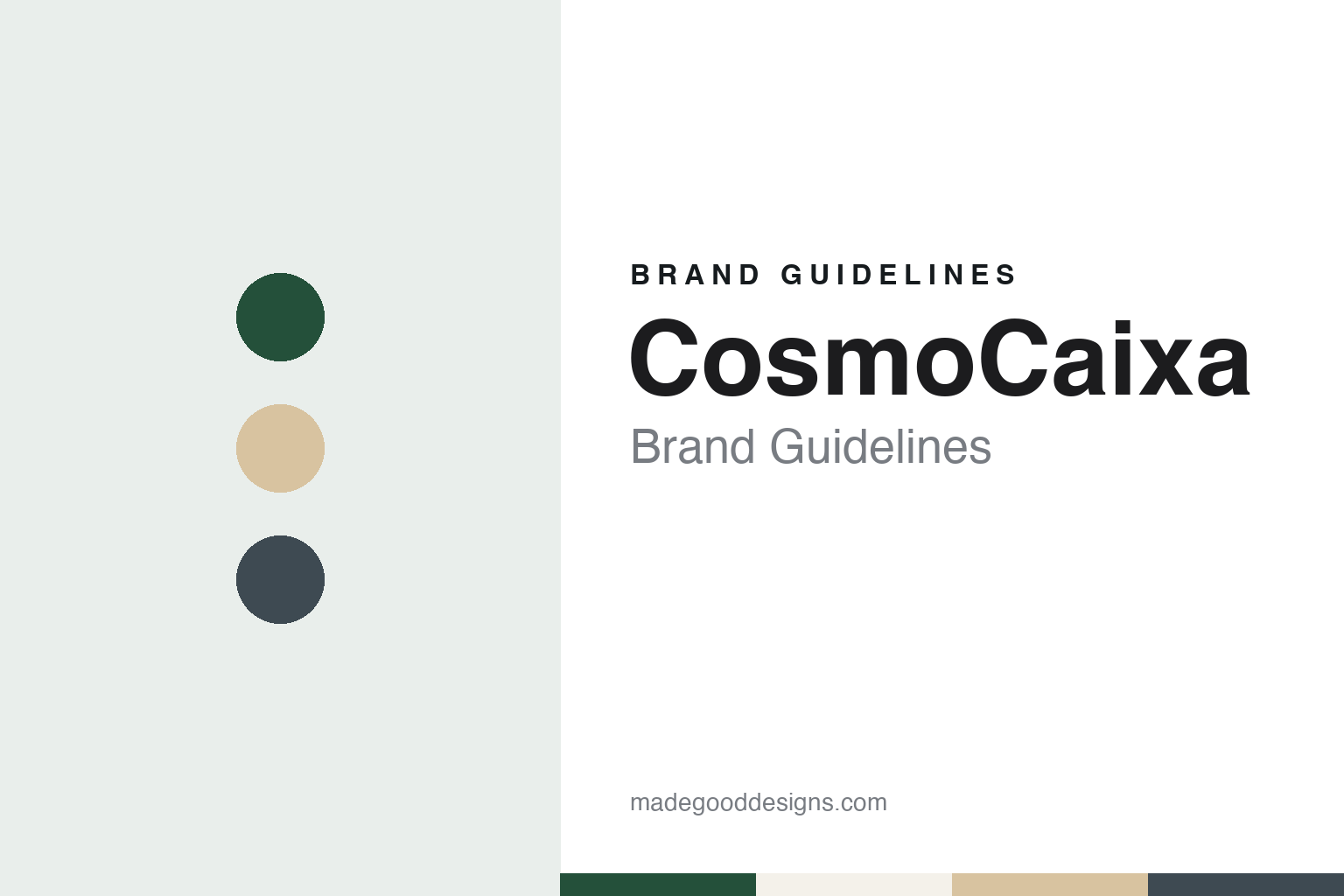
CosmoCaixa Brand Guidelines
Barcelona’s science museum, from a modernist asylum to a rainforest under glass.
Aa
Two constants: a forest green, sandstone and slate palette and a museum sans register. Abstract homage — not a CosmoCaixa mark or artwork; no logo, sign or building image is reproduced.
Museu de la Ciència
A savings bank’s science museum in a modernist asylum below Tibidabo.
CosmoCaixa is the science museum of Barcelona run by the “la Caixa” Foundation, as Spanish Wikipedia describes it. It stands at the foot of Tibidabo, the hill above the city, in the Sant Gervasi–la Bonanova district, and it grew out of an earlier museum on the same site: the Museu de la Ciència (Science Museum).
That first museum was created in 1980 by the Caixa de Pensions per a la Vellesa i d’Estalvis, the Barcelona savings bank, according to the Gran Enciclopèdia Catalana; Spanish Wikipedia and the Catalan government’s cultural-heritage pages give 1981 as the year it opened. Its starting principle, the heritage text says, was that science must be touched. The encyclopedia lists its areas: a planetarium; rooms for optics, mechanics, perception, computing, astronomy and astronautics; a space for travelling science exhibitions; an auditorium, an astronomical observatory and a weather station, as well as a small submarine.
The building has its own history. It is a modernist building by the architect Josep Domènech i Estapà, put up as an asylum for the blind, the Empar de Santa Llúcia; the Catalan government dates it to 1904 and Spanish Wikipedia to 1909, and Spanish Wikipedia says the asylum operated until 1979. For the museum it was remodelled and extended by the architects Jordi Garcés and Enric Sòria, Spanish Wikipedia says.
The owner’s name has changed along with the bank. Spanish Wikipedia records that the Caixa de Pensions, founded in 1904, merged with the Caixa de Barcelona in 1990, that its banking business was moved into CaixaBank in a restructuring announced in January 2011, and that in 2014 the savings bank became a banking foundation, the Fundació Bancària “la Caixa”, to manage the social and cultural work it had inherited. The same article says that at the end of 2025 the foundation was the main shareholder of CaixaBank, through Criteria Caixa. The Gran Enciclopèdia Catalana adds that an earlier foundation of the same name had been set up in 1983 and was dissolved in 2014.
Colour
Four times the space, six floors below ground.
In 2002 the museum moved temporarily to the Palau Macaya, another building in Barcelona, while its home was rebuilt and extended, the Gran Enciclopèdia Catalana says. It reopened in September 2004 under a new name, CosmoCaixa. Spanish Wikipedia gives the date as 25 September 2004 and names the architects of the reform and extension as Terradas Arquitectos; it speaks of five years of works, while the encyclopedia gives seven.
The new museum is much larger than the old one. Both sources put its area at more than 50,000 square metres, about four times the earlier space. Spanish Wikipedia describes a building in which glass and steel take a new role, with nine floors, six of them below ground but with natural light, and a large public square with views over the city. The encyclopedia names that square the Plaça de la Ciència (Science Square), open to the public, with large-scale experiments that explain science.
Three spaces stand out in the descriptions. The Bosc Inundat (Flooded Forest) recreates a section of flooded Amazon rainforest; the Catalan heritage pages give its area as more than 1,000 square metres and describe a flooded section, dry land and an underground section, with tropical rain, while Spanish Wikipedia organises it into three realms: below ground, in the water and from the air. The Mur Geològic (Geological Wall) shows the geology of the Earth through seven large pieces of rock from different places, 24 metres long in all, Spanish Wikipedia says; the encyclopedia adds that it explains how a rock is born, how dunes form and how continents collide. The Planetari uses full-dome projection with a programme that changes periodically.
The permanent exhibition, the Sala Univers (Universe Hall), runs from the big bang to the present, the encyclopedia says. Spanish Wikipedia divides it into three areas: Kósmos, on the laws of physics, the solar system and the Earth; Evolució, on the history of life, with live animals and fossils; and Fronteres, on the frontiers of knowledge, centred on a large dome shaped like a brain. For younger visitors the museum has spaces such as Clik, Creactivity, for children from seven, and the Planetari Bombolla (Bubble Planetarium), a first introduction to astronomy. The heritage pages add that CosmoCaixa runs many activities for state schools and for families.
Typography
How science centres present themselves.
Science centres in Europe, Asia and Oceania tend to introduce themselves first through the body that runs them. Some are foundations, such as Experimentarium in Denmark, which its own website describes as governed by a foundation board; some belong to a bank’s foundation, as CosmoCaixa in Barcelona belongs to the “la Caixa” Foundation; others are run by a city, a national agency or a charity. That name usually sits close to the centre’s own on signs and in print.
The building is often the second introduction. Several centres occupy reused sites: Experimentarium has used a former Tuborg bottling hall in Hellerup since 1991, and CosmoCaixa keeps part of an early twentieth-century modernist asylum in Barcelona. Some stand in new buildings on rivers, harbours or former industrial land, and their architects are part of the story they tell about themselves.
Inside, the vocabulary is shared. Hands-on galleries invite visitors to touch and try exhibits; some add a planetarium, a dome or a giant-screen theatre; and some keep living collections, such as the indoor Amazon forest at CosmoCaixa or rainforest and aquarium zones elsewhere. Programmes for schools and families sit beside the galleries: the Catalan government’s heritage pages say CosmoCaixa runs activities for state schools and families, and Experimentarium lists teaching rooms in its rebuilt house.
Names change too. CosmoCaixa took its present name when the Museu de la Ciència reopened in 2004, and Experimentarium ran a temporary branch, Experimentarium City, while its Hellerup building was rebuilt before reopening in 2017. This guide sets out, for each centre, who runs it, where it stands, what is inside and how its name has changed, using dated sources, and treats its colours and type as an unofficial interpretation.
Aa
A calm museum sans for hall names and labels. (Specimen set in Manrope, a sans STAND-IN; NOT the CosmoCaixa logo.)
CosmoCaixa
A name shared with its owner.
The Swedish exhibitions agency Riksutställningar described CosmoCaixa in May 2006 as a new museum opened in September 2004 on the site of an older museum. The name links the museum to its owner. The foundation’s cultural centres also carry the “Caixa” name, among them the CaixaForum exhibition centres in Barcelona, Madrid and other Spanish cities, and the Gran Enciclopèdia Catalana records a second CosmoCaixa, in Alcobendas near Madrid, which was active from 2000 to 2013. In Barcelona the name sits on a building that is partly much older than the museum.
The building shows its two lives side by side. The Catalan heritage pages note that CosmoCaixa keeps part of the modernist building where the first museum was located, while the 2004 extension, in Spanish Wikipedia’s description, gives glass and steel a new role and reaches six floors below ground. Our palette takes its tones from those three elements, the green of the flooded forest, the warm stone of the old building and the grey of the new structure, without copying any official colour.
For a design guide, CosmoCaixa shows how a museum can keep an early twentieth-century building as its front while a glass-and-steel extension and a rainforest indoors carry a new name. Compare CaixaBank, the bank in which the foundation is the main shareholder, and the Science Museum in London, another museum of science and technology. For this guide we use forest green, sandstone and slate with a sans, an unofficial interpretation; no product or logo is reproduced.
Explore & save
Keep CosmoCaixa’s identity on hand — save it to a board in the Made Good inspiration library.
CosmoCaixa identity set
Pin the forest green, sandstone and slate palette and the museum sans register to your own board.
Source & notes
Frequently Asked Questions
What font can I use to match the CosmoCaixa look?
This guide describes CosmoCaixa’s type as “A calm museum sans for hall names and labels”. Its type specimen is set in Manrope from Google Fonts as a stand-in; Manrope is not CosmoCaixa’s own lettering.
What colours are in the CosmoCaixa palette?
This guide’s CosmoCaixa palette is Forest green #24503A, Ink #161B1E, Sandstone #D8C3A0, Slate #3E4A52 and Paper #F4F1EA. The tones are the guide’s own unofficial interpretation, not official CosmoCaixa hex codes.
When did CosmoCaixa open?
CosmoCaixa opened in 1981 (as Museu de la Ciència), in Barcelona, Spain.