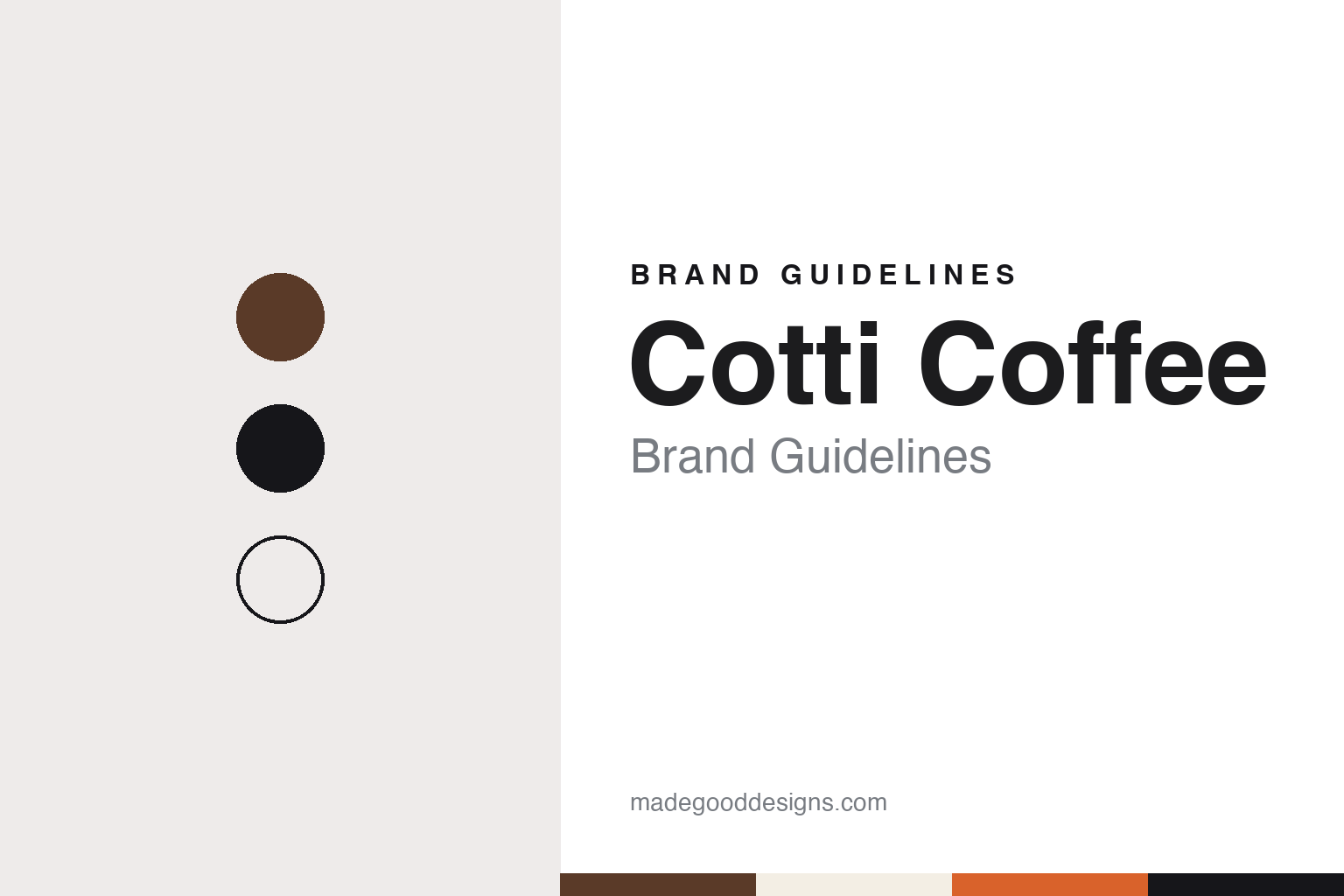
Cotti Coffee Brand Guidelines
The Fuzhou-born franchise coffee chain that crossed 10,000 stores in two years.
Aa
Two constants: a roast brown, cream and signal orange palette and a wide geometric sans register. Abstract homage — not a Cotti Coffee product or mark; no cup, logo or shop front is reproduced.
Fuzhou, October 2022
A new chain from former Luckin executives.
Cotti Coffee, written 库迪咖啡 (Kùdí Kāfēi) in Chinese and styled COTTI COFFEE, was founded in 2022 by Lu Zhengyao and Qian Zhiya, English Wikipedia says; World Coffee Portal and Daily Coffee News describe the founders as former Luckin Coffee executives. Chinese Wikipedia dates the opening of the first shop to 22 October 2022, in the Fuzhou International Finance Centre in Fuzhou, the capital of Fujian province. Sixth Tone reported on 24 October 2022 that the shop had opened over the weekend and that the brand was being described as a “pan-coffee lifestyle,” serving meals and snacks as well as coffee and tea.
Inside Retail Asia, writing on 25 October 2022, said the Fuzhou shop served coffee and Italian desserts in the morning and meals and wine in the evening, that ordering and delivery ran through WeChat with more than 40 products on the menu, and that the brand planned two formats: a mini store of about 50 square metres for takeaway and a larger standard shop with more of an in-store experience. The same report said Cotti would sponsor Argentina’s national football team and serve co-branded drinks in China during the World Cup that November.
Chinese Wikipedia says the core management team came from Luckin and from the car-rental company Car Inc, and that the company first set up its head office in Beijing, with an operations centre in Tianjin. In February 2026 it signed an agreement to set up a new headquarters in the Suzhou high-tech zone, in Jiangsu province, Chinese Wikipedia says.
Colour
Franchise partners and a fast count.
Cotti grew through partners rather than company-run shops. English Wikipedia says it chose a fully franchise-based model and charges service fees based on a store’s gross profit instead of traditional franchise fees. Chinese Wikipedia says the chain had more than 2,000 shops within its first half-year, opened its 5,000th store in Sanlitun, Beijing, on 4 August 2023, and by that month had shops in every province of mainland China. World Coffee Portal reported in October 2024 that Cotti had reached 5,000 stores across China within twelve months of opening.
Pricing has been central to the story. Chinese Wikipedia says a promotion in February 2023 cut a single cup to a few yuan, and that rival chains answered with low-price offers of their own, and English Wikipedia describes a mixed strategy of special discounts alongside regular prices. World Coffee Portal added that the chain relies on an in-house app for payment, delivery, pick-up orders and promotions, and on stores near busy office districts in large cities.
The count kept climbing. World Coffee Portal reported on 23 October 2024 that the 10,000th store had opened in Doha, Qatar, and that the chain was present in 28 markets, though the vast majority of its stores were in China. Daily Coffee News reported in June 2026 that Cotti had set a public target of 50,000 stores by the end of 2025 and fell well short, reaching about 15,000 by August 2025, and that the company now claims more than 18,000 stores in 33 countries. Cotti is privately held, the same report says. In 2025, Chinese Wikipedia adds, the chain introduced a convenience-store format under a plan called “within reach.”
Typography
How coffee-shop chains present themselves.
Coffee-shop chains are brands people meet at the counter. The cup handed over, the sleeve around it, the menu board behind the barista and the sign over the door all carry the name, and the companies show them in their own photographs and on their own websites. A chain that buys another often keeps the second name on the shop front, so one owner can run several looks on the same high street.
Naming is usually plain and close to the product. Chains name house blends, seasonal drinks and loyalty schemes in their own voice, borrow words from Italian or from their home language, and describe store formats by where they sit: high streets, railway and underground stations, airports, shopping centres and, more recently, drive-throughs. Some keep a single format; others add kiosks and cafés inside other retailers.
Ownership is where the stories diverge. Many chains began with one café and a founder, then passed through private equity firms, family investment companies or stock-market listings, and some have gone private again. Corporate pages tell the founding story, while independent trade press and national newspapers record the deals, the restructurings, the court rulings and the openings abroad, with dates.
This guide sets out what can be checked about each chain: who founded it and where, who owns it now, how it grew and what it says about its coffee and baking. Where a fact rests only on the company’s own word, it is given as the company’s claim. The palette and typeface shown are our own unofficial interpretation, not the brand’s.
Aa
A wide geometric sans for a takeaway-first chain. (Specimen set in Sora, a sans STAND-IN; NOT the Cotti Coffee logo.)
Cotti Coffee
From Seoul to Honolulu in under a year.
Cotti went abroad within a year of opening. World Coffee Portal says its international debut came in South Korea in August 2023, and Chinese Wikipedia dates the first overseas shop to 8 August 2023 in Gangnam, Seoul, followed by Jakarta on 15 August, a shop at the Akamon gate of the University of Tokyo on 26 August, and Hong Kong on 30 October 2023. English Wikipedia lists further shops in Thailand, Malaysia, the Philippines and Singapore, and in several European countries including France, Germany, Spain and the Netherlands.
In the US, Daily Coffee News reported in June 2026, Cotti opened its first store in Honolulu in spring 2024 and its first New York City store in May 2025, with later shops in Washington, D.C., Illinois, Tennessee and California. The same report, drawing on a 2026 franchise disclosure document, says the brand’s marks are held by a Hong Kong company, Cotti Coffee International, which is also the holding company for about 234 stores outside China, and that most US locations run as licensees rather than franchises. It adds that the chain’s main roasting plant is in Anhui province, and that US customs records show a Delaware supply affiliate importing goods from the company’s manufacturing subsidiary there.
The brand has leaned on partnerships for its look in the shop. Besides the Argentina football sponsorship, English Wikipedia lists collaborations with Garfield, SpongeBob SquarePants, Spy × Family and the game Honor of Kings, and Chinese Wikipedia records a 2025 agreement with Rwanda’s agriculture ministry on a coffee development park in Kigali and a 2025 trade agreement with Uganda on coffee supply.
For a design guide, Cotti Coffee shows how a young chain can carry one name across franchise, licensed and convenience-store formats in many countries at once; compare it with the Luckin Coffee brand guidelines and the Kopi Kenangan brand guidelines. For this guide we use a roast brown, ink, cream and signal orange with a wide sans, an unofficial interpretation; no product or logo is reproduced.
Explore & save
Keep Cotti Coffee’s identity on hand — save it to a board in the Made Good inspiration library.
Cotti Coffee identity set
Pin the Cotti Coffee roast brown, cream and signal orange palette and the wide geometric sans register to your own board.