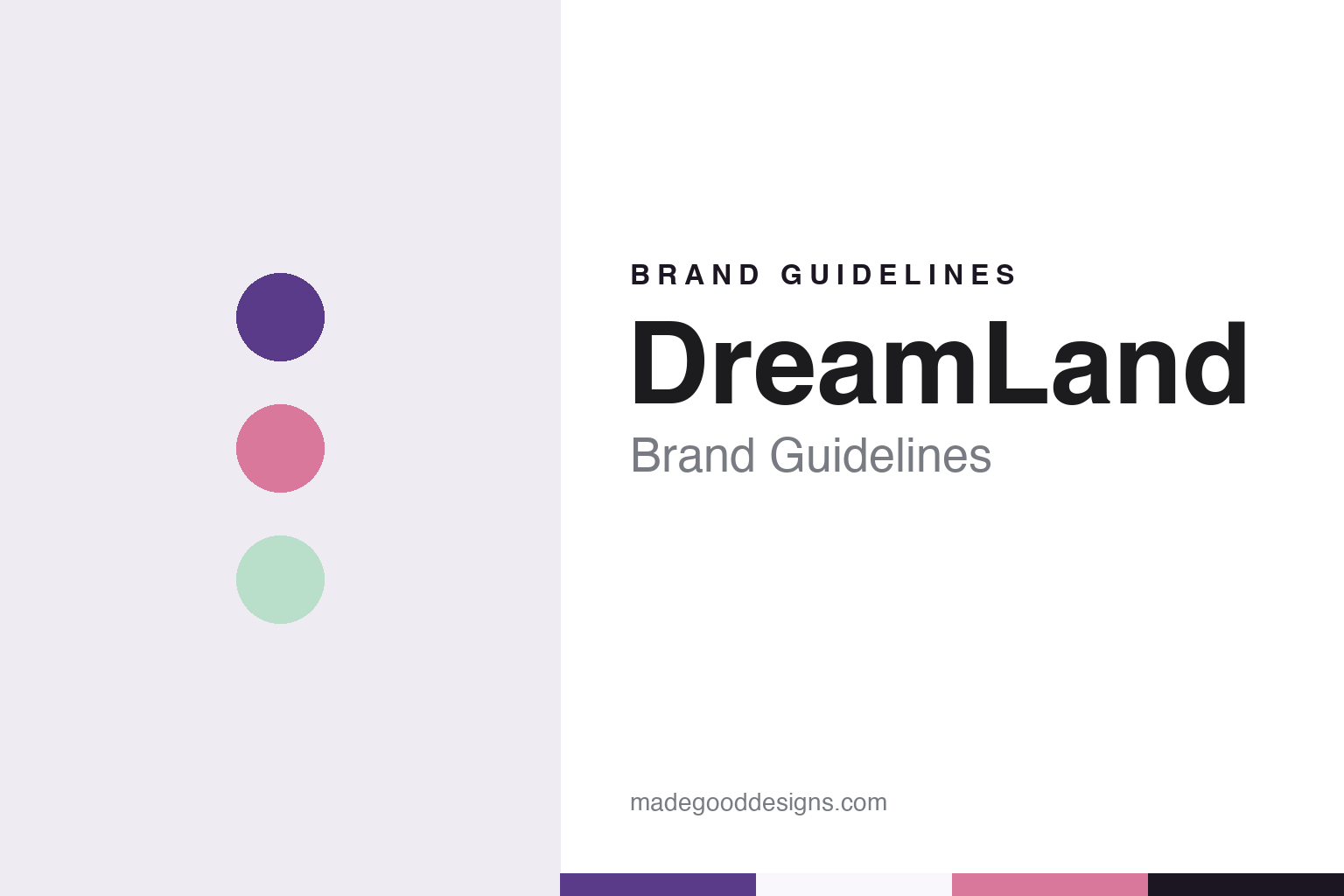
DreamLand Brand Guidelines
A Liedekerke supermarket that became a Benelux toy-shop name.
Aa
Two constants: a dusk violet, candy pink and mint palette and a Rounded sans register. Abstract homage — not a DreamLand sign or mark; no logo, shopfront or product is reproduced.
LIMA and Droomland
A neighbourhood supermarket that turned to toys.
DreamLand’s roots lie in a neighbourhood supermarket. Dutch Wikipedia says the story began in 1956 in Liedekerke, in Belgium, when the De Backer family opened a local supermarket called LIMA, short for Liedekerkse Magazijnen. Toys were only a sideline in those years. In 1978 the family sold the supermarket business and turned LIMA into a toy shop, and within a short time three more branches followed, in Lede, Zottegem and Groot-Bijgaarden. In 1987 the name LIMA gave way to Droomland, Dutch for “dreamland”.
In 1994 the Belgian retail group Colruyt Group took over the four Droomland leisure shops, with a fifth under construction in Lochristi, according to Dutch Wikipedia. Under Colruyt the chain changed its name again in 2002, becoming DreamLand, an English form of the Dutch name, spelled with a capital L. The range grew well beyond toys: Dutch Wikipedia lists multimedia, gaming, school supplies and outdoor play, along with bicycles, sports goods, books and comics, and a baby department in some branches. A sister chain, DreamBaby, sold baby products.
The chain tried France once. DreamLand crossed the border in 2009 with a shop in Leers; results fell short, and the last French DreamLand closed in 2018, according to Dutch Wikipedia, which cites the regional daily La Voix du Nord. For most of its history the network stayed in Belgium: VRT NWS counted 48 DreamLand branches in Belgium in April 2023, alongside about 30 DreamBaby shops, with about 1,100 staff across the two chains.
Colour
Colruyt sells three quarters to a Limburg family.
The break with Colruyt came on 19 April 2023. At a special works council at the group’s head office, Colruyt Group announced a restructuring of DreamLand and DreamBaby, VRT NWS reported: six shops would close, one DreamLand in Hasselt and five DreamBaby stores, and up to 192 jobs were at risk. All DreamLand shops stayed closed that day so that staff could be informed. Colruyt also announced an agreement in principle under which the toy chain ToyChamp would take over three quarters of DreamLand’s shares and so gain control of the chain, while Colruyt kept a quarter and DreamLand’s management stayed on. Dutch Wikipedia adds that Colruyt kept the property of most of the shops, and that DreamLand items could no longer be delivered to Colruyt or OKay stores after the sale.
The sale was completed in October 2023, when ToyChamp took over three quarters of the shares, according to a later VRT NWS report. DreamBaby took a separate path: in March 2024 Colruyt announced the sale of 27 DreamBaby shops to the West Flemish retailer Supra Bazar, with the shops and the brand name kept, VRT NWS reported.
The buyer was a family business from Limburg. ToyChamp was founded in 2001 by the Nolmans family and run from Genk, VRT NWS and Dutch Wikipedia say. The family had sold an earlier toy-shop business, Nolmans Familiewinkels, to the investment company Mitiska in 2000, and ToyChamp began in the Netherlands with a Dutch partner before a Belgian company followed in 2004, with shops in Lanaken and Sint-Truiden, according to Dutch Wikipedia. NRC reported in October 2024 that ToyChamp then had 26 shops in the Netherlands and 15 in Belgium. ToyChamp also took over 11 branches of the bankrupt Belgian toy chain FUN, VRT NWS reported. The trade title Toys n Playthings described Koen Nolmans in September 2026 as chief executive of both DreamLand and ToyChamp.
Typography
Signs, catalogues and owners.
Toy-shop chains in Europe, Latin America and Australia usually introduce themselves through a shop sign and a seasonal catalogue. Some of their names began as something else entirely: the Belgian chain DreamLand started as a neighbourhood supermarket called LIMA in Liedekerke in 1956 and turned to toys in 1978, according to Dutch Wikipedia. Logos, colour schemes and shop signs change over time, and each guide in this series describes the current sign only as the company itself shows it.
Store networks take several forms: high-street shops, large stores on retail parks, franchise branches and online shops. Branch, staff and country counts in these guides are given only with their source and date, because toy-shop networks grow and shrink through takeovers, rebrands, bankruptcies and closures, and a chain that has closed is described as closed.
A number of chains began as buying groups or associations of independent toy shops. Intertoys in the Netherlands grew out of a purchasing organisation that started buying toys in 1976, and NRC reported in October 2024 that about half of its shops were still run by franchisees. Where a name covers a network of independently owned shops rather than branches of one company, these guides say so plainly, and they describe owners, from retail groups and investors to founding families, as dated facts.
Chains also name their own ranges, catalogues and seasonal campaigns, such as the Intertoys Speelboek, published each September since 1987, and these guides name them only as the companies do. Corporate pages and company histories describe founders and owners; each guide sets out what can be checked against dated, independent sources, with any gap in the record stated plainly.
Aa
A soft rounded sans for a toy-shop chain. (Specimen set in Fredoka, a sans STAND-IN; NOT the DreamLand logo.)
DreamLand
Intertoys, and one name for two chains.
The group grew again a year later. In October 2024 ToyChamp agreed to buy the Dutch toy chain Intertoys from Mirage Retail Group, the former Blokker Holding, and by the end of that year it had taken over more than 200 Intertoys shops, VRT NWS reported. NRC noted at the time of the announcement that the chains would continue side by side while buying together.
Then the group chose a single name for its Belgian and Dutch toy shops outside Intertoys. On 29 April 2025 VRT NWS reported that the ToyChamp name would disappear and that its shops would continue as DreamLand, with a new logo, a complete make-over of the brand and a new shop concept. Dutch Wikipedia dates the change to 13 September 2025 for the ToyChamp shops and website in the Netherlands and to 13 October 2025 in Belgium. De Gelderlander, reporting in May 2025 on the ToyChamp shop in Apeldoorn, which had opened in 2014, said the store would get a new name, a new logo and a make-over, and that nothing would change for the Intertoys branches.
The result is that a name used only in Belgium for most of its history now hangs over shops in both countries. Dutch Wikipedia gives, for 2025, a total of 90 DreamLand shops, 63 in Belgium and 27 in the Netherlands, with a Dutch website alongside the Belgian one. Intertoys continued under its own name.
For a design guide, DreamLand shows how a retail name can travel: from LIMA to Droomland, from Droomland to an English-language DreamLand under Colruyt, and finally onto the shopfronts of a chain whose own name was retired. Compare Intertoys, which shares its owner, and King Jouet, a French toy-shop chain. For this guide we use dusk violet, candy pink and mint on paper with a rounded sans, an unofficial interpretation; no product or logo is reproduced.
Explore & save
Keep DreamLand’s identity on hand — save it to a board in the Made Good inspiration library.
DreamLand identity set
Save the DreamLand dusk violet, candy pink and mint palette and the Rounded sans register to your own board.
Source & notes
Frequently Asked Questions
What font can I use to match the DreamLand look?
This guide describes DreamLand’s type as “A soft rounded sans for a toy-shop chain”. Its type specimen is set in Fredoka from Google Fonts as a stand-in; Fredoka is not DreamLand’s own lettering.
What colours are in the DreamLand palette?
This guide’s DreamLand palette is Dusk violet #5A3B8A, Ink #1B1622, Candy pink #D9789B, Mint #B9DFCB and Paper #FAF7FC. The tones are the guide’s own unofficial interpretation, not official DreamLand hex codes.
When was DreamLand founded?
DreamLand was founded in 1956 (as LIMA); toys from 1978, in Liedekerke, Belgium.
Who founded DreamLand?
DreamLand was founded by De Backer family in 1956 (as LIMA); toys from 1978.
Who owns DreamLand?
DreamLand is owned by Nolmans family group (75%, 2023); Colruyt Group kept 25%.