Juguettos Brand Guidelines
A Villena toy-shop cooperative with 37 partners and one shared sign.
Aa
Two constants: an orange, teal and cream palette and a rounded sans register. Abstract homage — not a Juguettos product or mark; no sign, logo or packaging is reproduced.
Juguettos
A cooperative of toy sellers in Villena.
Juguettos is a Spanish chain of toy shops run as a cooperative. Alicante Plaza, the business paper of the province of Alicante, described it in August 2025 as a company founded in Villena, inland Alicante, in 1975 and operating as a cooperative, and reported that 2025 marked its 50th year of activity. Cinco Días described it in October 2025 as the Alicante cooperative of toy shops and put its membership at 37 partners.
The cooperative model shapes the brand. Member companies own and run shops under the shared Juguettos name. In a July 2026 interview with the trade magazine Interempresas, the administrator of one member, the family company Santos Rivera, said it ran 15 shops across Castilla-La Mancha, Extremadura, Andalusia and Madrid, and that it had opened a Juguettos shop at the Luz del Tajo shopping centre in Toledo in September 2004, as the centre itself opened. The administrator described how members are represented on the cooperative’s governing council, the Consejo Rector, which works with its committees and with the management, and how the cooperative supports shops in logistics, purchasing, technology, communication and sales, with each shop following general guidelines the cooperative sets.
The network grew steadily through the 2010s. The trade publication Alimarket reported in February 2013 that Juguettos opened 11 shops in 2012, taking its network to 226, after eight openings in 2011 in places including Las Palmas, Lleida, Marbella, Málaga, Sitges, Tenerife, Toledo and Villarrobledo. The 2012 openings reached Valencia, Valladolid, Seville, Zaragoza and Madrid, as well as Andorra la Vella and Sa Pobla in Mallorca, and the chain had sold online since 2009, extending its web shop to customers abroad in mid-2012, Alimarket said.
Colour
Shopping centres, own brands and a fan zone.
Juguettos shops sit both on high streets and in shopping centres. Alicante Plaza reported in August 2025 on a new shop in the Sevilla Factory shopping centre in Seville, following openings at the end of 2024 in the Marineda City centre in A Coruña and the Meridiano centre in Tenerife, and wrote that in its anniversary year the cooperative had begun a project to renew the image of all its shops. The same report put its catalogue at more than 6,000 references, about 900 of them own-brand products, and its network at more than 280 points of sale in Spain and Andorra.
Alimarket reported in April 2026 that Juguettos ended 2025 with 273 shops, against 275 a year earlier, as it relocated and concentrated shops in more efficient sites, and that shopping centres remained a driver for the chain. The same report described the weight of the “kidult” range for teenage and adult collectors, built on collecting categories and licences such as Funko and Pokémon. Merca2 wrote in December 2023 that the chain had been building “Fan Zone” areas for that audience, alongside an own-brand range of more than 900 references.
Two purchases in 2024 added brands to that range. Juguettos bought the commercial assets of Imaginarium, the Zaragoza toy brand whose shops made famous a small door for children beside a door for adults, after Imaginarium closed; Alicante Plaza lists its brands, images, patents, designs and website among them. About a month later it bought the Poly Juguetes brand and nine of its shops at auction, after Poly, then owned by Teal Group Holdings, entered insolvency proceedings in spring 2024, the paper reported.
Imaginarium returned in October 2025. Cinco Días reported that Juguettos brought the brand back as a section inside about 90% of its shops, with its own range of 193 references, from small modules up to spaces of 50 to 60 square metres in the larger shops, and that in those larger shops children could still walk under Imaginarium’s small door. Alimarket later counted about 190 Imaginarium references back on sale.
Typography
How toy chains present themselves.
Toy-shop chains in Europe, Latin America and Australia usually introduce themselves through a shop sign and a seasonal catalogue. Some of their names began as something else entirely: the Belgian chain DreamLand started as a neighbourhood supermarket called LIMA in Liedekerke in 1956 and turned to toys in 1978, according to Dutch Wikipedia. Logos, colour schemes and shop signs change over time, and each guide in this series describes the current sign only as the company itself shows it.
Store networks take several forms: high-street shops, large stores on retail parks, franchise branches and online shops. Branch, staff and country counts in these guides are given only with their source and date, because toy-shop networks grow and shrink through takeovers, rebrands, bankruptcies and closures, and a chain that has closed is described as closed.
A number of chains began as buying groups or associations of independent toy shops. Intertoys in the Netherlands grew out of a purchasing organisation that started buying toys in 1976, and NRC reported in October 2024 that about half of its shops were still run by franchisees. Where a name covers a network of independently owned shops rather than branches of one company, these guides say so plainly, and they describe owners, from retail groups and investors to founding families, as dated facts.
Chains also name their own ranges, catalogues and seasonal campaigns, such as the Intertoys Speelboek, published each September since 1987, and these guides name them only as the companies do. Corporate pages and company histories describe founders and owners; each guide sets out what can be checked against dated, independent sources, with any gap in the record stated plainly.
Aa
A soft, rounded sans for a shared shop sign. (Specimen set in Nunito, a sans STAND-IN; NOT the Juguettos logo.)
Juguettos
One name over many owners.
Juguettos has no single outside owner. It is a cooperative based in Villena whose partners are themselves businesses, such as the Toledo family company that spoke to Interempresas in 2026. That structure explains how one sign can cover shops from A Coruña and Tenerife to Seville, Madrid and Andorra while each is run by a member company. In that interview the member described the division of labour: the cooperative’s central services handle logistics, purchasing, technology and communication, the online shop is set up so that each shop serves its own area, and the members operate the shops under the shared name and its general guidelines.
The 2024 purchases changed what the shared sign holds. Since October 2025 the shops have carried a second consumer brand with its own history and its own visual signature. Cinco Días described the Imaginarium sections as spaces inside Juguettos shops, sized to the room each branch has, from small modules to 60 square metres, rather than separate Imaginarium shops, and reported that the cooperative remained open to separate Imaginarium shops if customers asked for them, without any decision having been taken.
The figures in the trade press move with each report, so each should be read with its date: 226 shops at the end of 2012 according to Alimarket, more than 280 points of sale in August 2025 according to Alicante Plaza, and 273 shops at the end of 2025 according to Alimarket in April 2026.
For a design guide, Juguettos shows how a cooperative turns dozens of separately owned toy shops into one recognisable chain: a single name with a doubled “t”, a shared catalogue and own-brand range, a shop-image renewal rolled out across the network, and room inside the shops for another brand’s small door. Compare Imaginarium, the brand it brought back in 2025, and Toys Center, a chain run by a single retail group in Italy. For this guide we use a warm orange, a deep teal and a soft cream with a rounded sans, an unofficial interpretation; no product or logo is reproduced.
Explore & save
Keep Juguettos’s identity on hand — save it to a board in the Made Good inspiration library.
Juguettos identity set
Pin the orange, teal and cream palette and the rounded sans register to your own board.
Source & notes
Frequently Asked Questions
What font can I use to match the Juguettos look?
This guide describes Juguettos’ type as “A soft, rounded sans for a shared shop sign”. Its type specimen is set in Nunito from Google Fonts as a stand-in; Nunito is not Juguettos’ own lettering.
What colours are in the Juguettos palette?
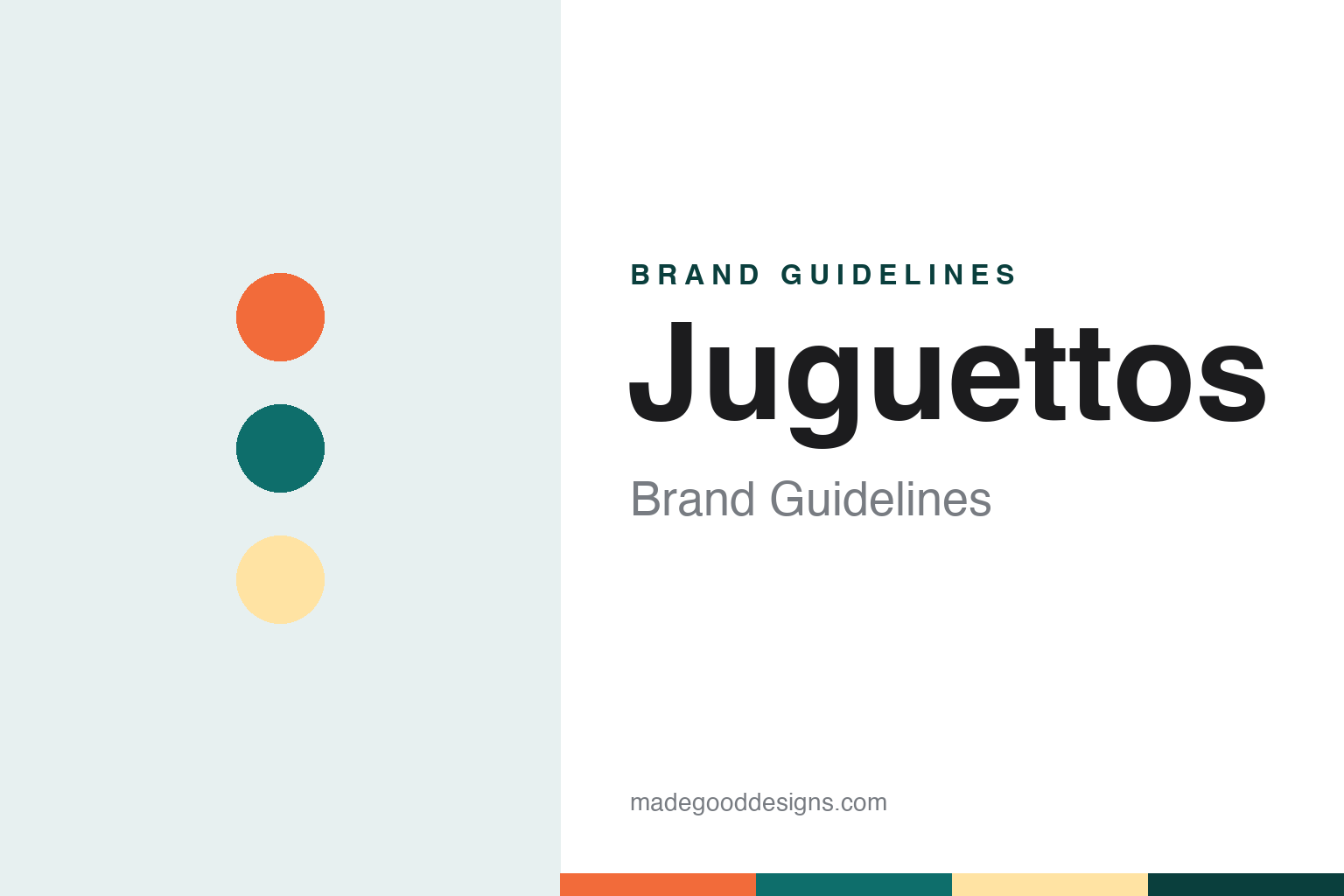
This guide’s Juguettos palette is Villena orange #F26B3A, Deep teal #0E6E6B, Warm cream #FFE3A3, Ink green #0A3F3D and Paper #FBF7EF. The tones are the guide’s own unofficial interpretation, not official Juguettos hex codes.
When was Juguettos founded?
Juguettos was founded in 1975, in Villena, Alicante, Spain. Juguettos is known for Shared shop banner, own-brand range, Imaginarium sections.