Toys Center Brand Guidelines
The Italian toy chain that began as Toys“R”Us shops renamed in 1999.
Aa
Two constants: a red, blue and yellow palette and a rounded sans register. Abstract homage — not a Toys Center product or mark; no sign, logo or packaging is reproduced.
Toys Center
An American chain’s Italian shops, renamed in 1999.
Toys Center is an Italian toy-shop chain whose shops began life under another name. Italian Wikipedia says the American chain Toys“R”Us arrived in Italy in 1996, intending to open at least 30 shops, and that rival toy distributors, wary of how far it might spread, looked at buying the chain. The Florentine distributor GiG bought all of its Italian shops, a purchase that Italian Wikipedia says led GiG into failure. In 1999 the business passed to Giochi Preziosi, which renamed the shops Toys Center.
GiG’s own story explains how a toy maker came to run a chain of shops. Italian Wikipedia describes GiG, short for Grossisti Italiani Giocattoli, as a toy wholesaler founded in 1968 at Osmannoro, outside Florence, which distributed toys through a consortium of regional firms in Milan, Turin, Padua, Bologna, Rome and Naples. It formed an alliance with Giochi Preziosi in 1994, with Giochi Preziosi taking a minority stake, listed on the stock exchange in 1995 and was ceded to Giochi Preziosi in 1999. Giochi Preziosi, a toy producer and distributor, thus found itself with a national network of large toy shops alongside its own brands.
The group that runs the chain today keeps the story short: its Toys Center page says simply that the chain was born in the 1990s. What the shops became is easier to trace than what they were. By 2015 there were about 130 Toys Center shops, according to Italian Wikipedia, and GDOWeek, the Italian retail trade magazine, counted the Rome shop it visited in June 2021 as the 130th under the banner. In November 2026 the group’s Toys Center page listed 140 shops.
Colour
Five named worlds under one roof.
The clearest picture of a Toys Center shop comes from the Italian retail trade press. GDOWeek reported in June 2021 that the new Toys Center in Rome, opened in the second half of that month, covered about 1,000 square metres, split into five themed “worlds” and stocking 18 exclusive brands, with a 200-square-metre Bimbostore corner for nursery goods: modular systems, prams, car seats, baby food, cosmetics, children’s clothing and products for expectant mothers.
The five worlds were named rather than numbered. “Gioca con me” (play with me) held toys for the youngest children in a forest-like setting with the sound of running water and the scent of trees; “Cosa farò da grande” (what I will be when I grow up) gathered costumes, accessories and make-up, with large blue and pink wardrobes, a wall of soft toys and a pretend restaurant with a blackboard for the menu; “Giochi da super Eroi” rebuilt a Formula 1 track with start lights and chequered flags; “Corri all’avventura” (run to adventure) held bicycles and ride-on toys; and “Impariamo giocando” was a reading room with 760 titles and small armchairs, GDOWeek said.
In October 2022 the same magazine described a larger pairing at the Assago Milanofiori shopping district near Milan, where Prénatal and Toys Center opened two shops, one on the ground floor and one on the floor above, covering about 3,000 square metres in all, of which about 1,600 went to Toys Center. GDOWeek presented them as two distinct spaces joined by one idea: a family store running from pregnancy until a child is about ten.
The group’s own Toys Center page describes the standard format in the same terms. It says the shops cover about 1,000 square metres, sit where they are easy to reach by car and offer large car parks, and that the newer, colourful formats are built around themed portals and “experience” areas, such as a nursery corner, a doll make-up area, a toy-car workshop and large blackboards for drawing and writing. The page lists a range running from traditional toys to outdoor games, gadgets, books and seasonal lines for Carnival, Easter, back to school and Halloween, alongside 16 exclusive brands, and names services such as Ordina & Ritira (order online, collect in a shop), a loyalty card, “Scaffale Infinito” (the endless shelf, home delivery of items a shop does not hold) and a Gift Finder.
Typography
How toy chains present themselves.
Toy-shop chains in Europe, Latin America and Australia usually introduce themselves through a shop sign and a seasonal catalogue. Some of their names began as something else entirely: the Belgian chain DreamLand started as a neighbourhood supermarket called LIMA in Liedekerke in 1956 and turned to toys in 1978, according to Dutch Wikipedia. Logos, colour schemes and shop signs change over time, and each guide in this series describes the current sign only as the company itself shows it.
Store networks take several forms: high-street shops, large stores on retail parks, franchise branches and online shops. Branch, staff and country counts in these guides are given only with their source and date, because toy-shop networks grow and shrink through takeovers, rebrands, bankruptcies and closures, and a chain that has closed is described as closed.
A number of chains began as buying groups or associations of independent toy shops. Intertoys in the Netherlands grew out of a purchasing organisation that started buying toys in 1976, and NRC reported in October 2024 that about half of its shops were still run by franchisees. Where a name covers a network of independently owned shops rather than branches of one company, these guides say so plainly, and they describe owners, from retail groups and investors to founding families, as dated facts.
Chains also name their own ranges, catalogues and seasonal campaigns, such as the Intertoys Speelboek, published each September since 1987, and these guides name them only as the companies do. Corporate pages and company histories describe founders and owners; each guide sets out what can be checked against dated, independent sources, with any gap in the record stated plainly.
Aa
A rounded, friendly sans for a family toy shop. (Specimen set in Fredoka, a sans STAND-IN; NOT the Toys Center logo.)
Toys Center
From Giochi Preziosi to Artsana.
Ownership has changed twice since 2015. Italian Wikipedia says that in 2015 Giochi Preziosi agreed with Artsana, the Catelli family’s baby-products group behind Chicco, to combine the two groups’ shops in a new company: about 230 Prénatal shops, 130 Toys Center shops, 40 Bimbo Store shops and the 150 King Jouet shops Giochi Preziosi held in France, more than 550 in all. The new company, Prénatal Retail Group, was owned half and half. Artsana had bought the Prénatal chain from the French group Pinault Printemps Redoute in 1996, Italian Wikipedia adds.
The private-equity firm Investindustrial took a 60% stake in Artsana in April 2016. In July 2017, BeBeez reported, Artsana signed an agreement to buy Giochi Preziosi’s 50% of the retail joint venture, which would give it the whole company; Italian Wikipedia and the group’s own timeline both record that Artsana took full control in 2017. The group now trades as PRG Retail Group, the name GDOWeek used in 2022, and its timeline says it launched a new logo that year.
The same timeline lists later steps. Maxi Toys joined the group in 2021; an agreement with Three Sixty Group brought a FAO Schwarz shop to Milan; in 2022 the group acquired the assets of Toys“R”Us in Spain and Portugal; and in 2023 it set up Toki Lab, a joint venture with King Jouet. The group’s brand list now includes Toys“R”Us alongside Toys Center, so the owner of the banner that replaced Toys“R”Us in Italy in 1999 also runs that name in Spain and Portugal. In November 2026 its Toys Center page also pointed to a Greek Toys Center site.
For a design guide, Toys Center shows how a chain born from a takeover built its identity inside the shop itself: themed worlds with names of their own, set pieces such as a racing track and a reading room, and a large, car-park-served format shared with sister banners. Compare King Jouet, part of the 2015 group, and Toys“R”Us, whose Italian shops became Toys Center. For this guide we use a cherry red, a deep blue and a sunny yellow with a rounded sans, an unofficial interpretation; no product or logo is reproduced.
Explore & save
Keep Toys Center’s identity on hand — save it to a board in the Made Good inspiration library.
Toys Center identity set
Pin the red, blue and yellow palette and the rounded sans register to your own board.
Source & notes
Frequently Asked Questions
What font can I use to match the Toys Center look?
This guide describes Toys Center’s type as “A rounded, friendly sans for a family toy shop”. Its type specimen is set in Fredoka from Google Fonts as a stand-in; Fredoka is not Toys Center’s own lettering.
What colours are in the Toys Center palette?
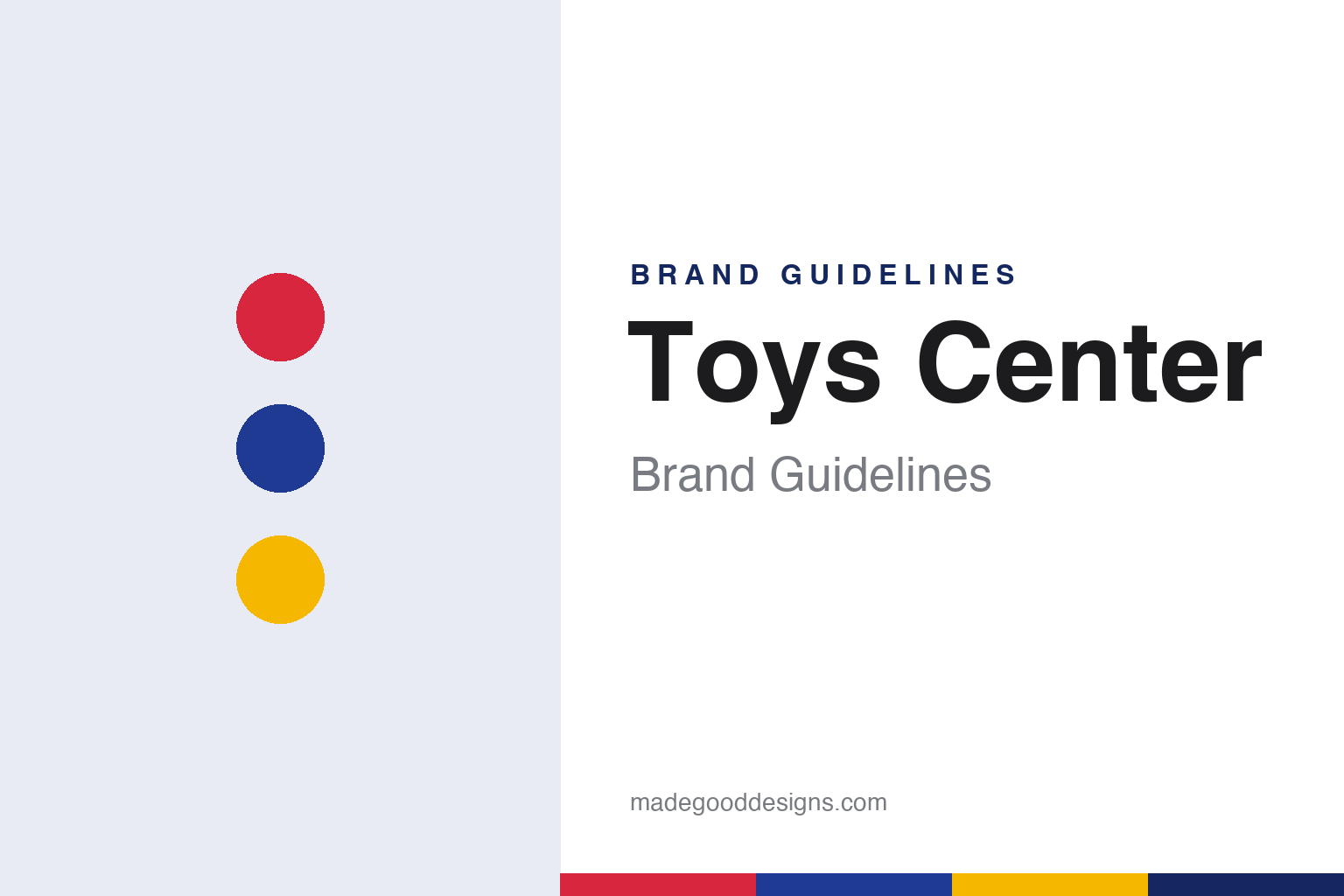
This guide’s Toys Center palette is Cherry red #D7263D, Deep blue #1F3A93, Sunny yellow #F5B700, Ink blue #14275F and Playroom white #FBF8F1. The tones are the guide’s own unofficial interpretation, not official Toys Center hex codes.
When was Toys Center founded?
Toys Center was founded in 1999 (as Toys Center), in Italy.