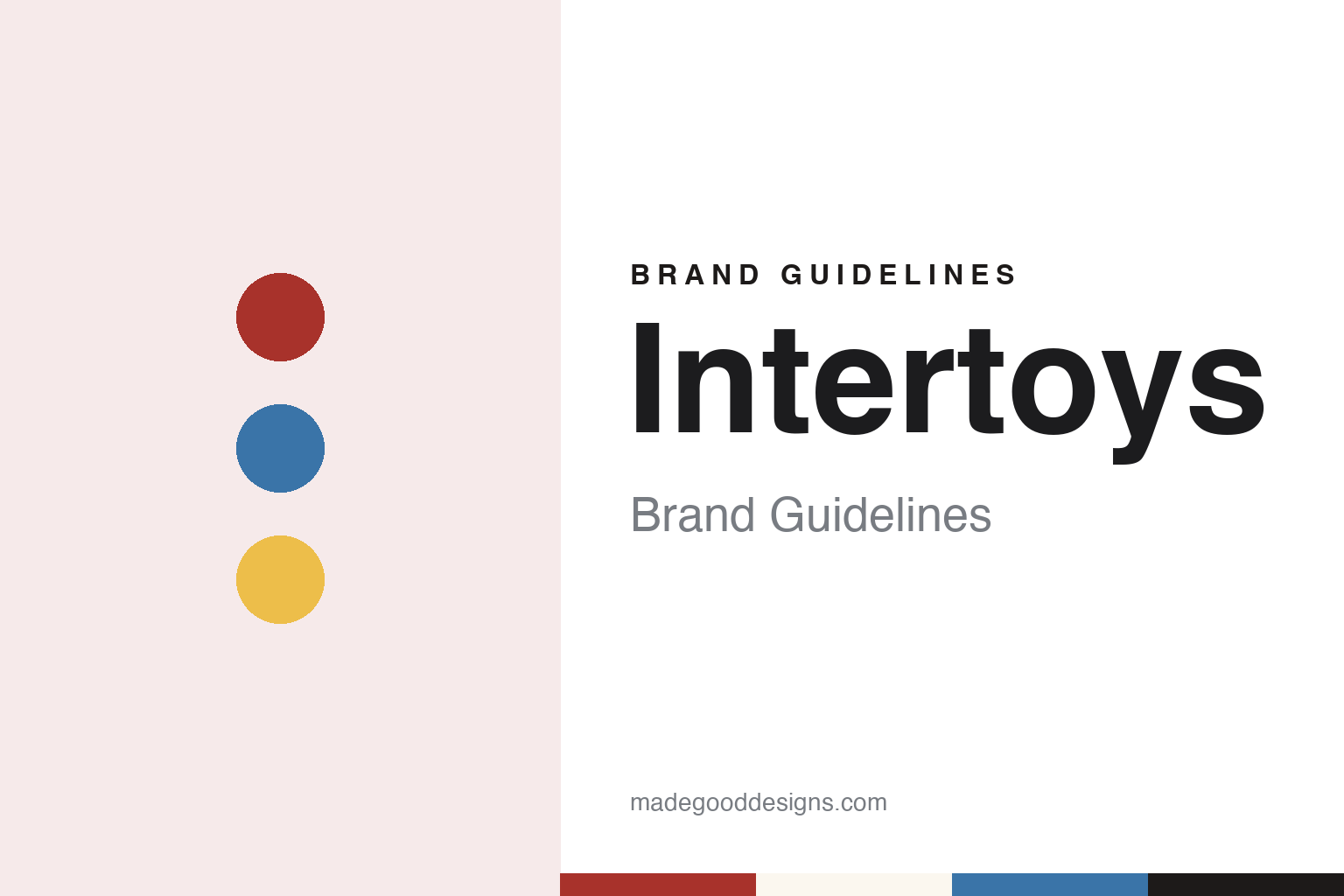
Intertoys Brand Guidelines
A 1976 buying group that became one Dutch toy-shop name.
Aa
Two constants: a toy-box red, sky blue and sunshine yellow palette and a Rounded sans register. Abstract homage — not an Intertoys sign or mark; no logo, mascot, shopfront or product is reproduced.
Hobo Faam
A buying group, a shared name and a play book.
Intertoys began as a buying organisation rather than a single shop. Dutch Wikipedia says the purchasing organisation Hobo Faam started buying toys on 25 June 1976 and set up a series of its own toy shops; by the end of that year seven businesses belonged to it, in towns including Hoorn, Veghel, Enkhuizen and Eindhoven. NRC, reporting in October 2024, describes Intertoys as founded in 1976 by independent toy retailers, and notes that about half of its shops were still run by franchisees at that time.
For its early years the name was shared rather than imposed. Until 1979 the member shops kept their own buying and their own names alongside the common name Intertoys, Dutch Wikipedia says; in 1979 the Intertoys logo appeared and buying was pooled for all the shops. The same article gives the cost of marketing each shop on its own as a main reason for creating an umbrella organisation at the end of the 1970s.
The answer to that cost was a catalogue. In 1987 Intertoys created the Speelboek, literally the “play book”, and since then a new edition has appeared each September, aimed mainly at the Sinterklaas and Christmas season, according to Dutch Wikipedia. The book usually carries a competition in which readers search for and count items hidden in its pages or in the shop.
The chain also had a mascot. An elephant called Toy Toy, designed by the studio Comic House, appeared on the cover of the 1987 Speelboek and became the official symbol of Intertoys in 1994, Dutch Wikipedia says. Toy Toy had its own television programme, the Toy Toy Show, on the Kindernet channel in 1993 and 1994, and around 1995 the shops sold stickers, cups and soft toys carrying the character.
Colour
Blokker, one name for three chains, and a 2019 restart.
For many years Intertoys belonged to the Dutch retail group Blokker Holding, NRC says. Blokker also owned two other toy chains, Bart Smit and Toys XL, and on 28 June 2016 NRC reported that the holding had decided to bring all three under the single name Intertoys, with one web shop at intertoys.nl. At that point, the paper said, Bart Smit had 234 company-owned shops in the Netherlands, Belgium and Luxembourg, Intertoys had 176 company-owned branches and 125 franchise shops in the Benelux, and Toys XL had 14 shops in the Netherlands. Dutch Wikipedia says the Dutch Bart Smit shops were converted to Intertoys from early 2017, and that the large former Toys XL stores reopened in early 2018 as IntertoysXL, a name chosen because they were bigger and carried more toys than a standard branch.
The merger changed the look as well. A Speelboek published in September 2017 no longer showed Toy Toy and, in its format, closely recalled the old Bart Smit play books, Dutch Wikipedia says; a test shop opened in Amersfoort in November 2016 had already left the elephant out.
Ownership then changed quickly. On 12 October 2017 Blokker announced the sale of Intertoys, then with about 4,000 staff, to the British investor Alteri Investors, and the deal was completed in early December 2017, according to Dutch Wikipedia, which puts the chain at about 500 shops in 2017, some 450 of them in the Netherlands. In early February 2019 Intertoys applied for a suspension of payments, and on 21 February 2019 it was declared bankrupt. The shops stayed open at the request of the court-appointed administrators. The Portuguese toy specialist Green Swan then bought the business and restarted it in a smaller form on 8 March 2019. NRC later summed up the sequence: the chain went bankrupt 14 months after its sale to the British owner, a short-lived restart under a Portuguese owner followed, and after a few months Intertoys was sold back to Blokker, which by then was called Mirage Retail Group. Dutch Wikipedia dates that return to early September 2019.
Back inside Mirage, the chain was rebuilt around a mix of owned and franchised shops. Dutch Wikipedia counts 123 company-owned shops and 80 franchise branches in the Netherlands in March 2020, with about 1,100 staff and a head office in Amsterdam. Toy Toy returned to the shops, the Speelboek and the website in November 2019, the same article says, before giving way in the 2022 Speelboek to five new pictogram-style characters called Hippo, Space, Kite, Meis and Bot.
Typography
Signs, catalogues and owners.
Toy-shop chains in Europe, Latin America and Australia usually introduce themselves through a shop sign and a seasonal catalogue. Some of their names began as something else entirely: the Belgian chain DreamLand started as a neighbourhood supermarket called LIMA in Liedekerke in 1956 and turned to toys in 1978, according to Dutch Wikipedia. Logos, colour schemes and shop signs change over time, and each guide in this series describes the current sign only as the company itself shows it.
Store networks take several forms: high-street shops, large stores on retail parks, franchise branches and online shops. Branch, staff and country counts in these guides are given only with their source and date, because toy-shop networks grow and shrink through takeovers, rebrands, bankruptcies and closures, and a chain that has closed is described as closed.
A number of chains began as buying groups or associations of independent toy shops. Intertoys in the Netherlands grew out of a purchasing organisation that started buying toys in 1976, and NRC reported in October 2024 that about half of its shops were still run by franchisees. Where a name covers a network of independently owned shops rather than branches of one company, these guides say so plainly, and they describe owners, from retail groups and investors to founding families, as dated facts.
Chains also name their own ranges, catalogues and seasonal campaigns, such as the Intertoys Speelboek, published each September since 1987, and these guides name them only as the companies do. Corporate pages and company histories describe founders and owners; each guide sets out what can be checked against dated, independent sources, with any gap in the record stated plainly.
Aa
A friendly rounded sans for a toy-shop chain. (Specimen set in Baloo 2, a sans STAND-IN; NOT the Intertoys logo.)
Intertoys
From Mirage to a Belgian family owner.
Mirage put Intertoys up for sale in August 2023, Dutch Wikipedia says, citing Het Financieele Dagblad and RTL Nieuws; NRC reported that this attempt did not lead to a sale. The next approach came from Belgium. On 28 October 2024 Mirage and the Belgian family firm ToyChamp announced that ToyChamp would take over Intertoys, subject to approval by the Dutch competition authority ACM, NU.nl reported. No financial details were disclosed. ToyChamp, founded in 2001 by the Nolmans family, had 41 branches in Belgium and the Netherlands at the time and was already majority shareholder of the Belgian toy chain DreamLand. The companies said the existing shop formats would not change and that the Intertoys management would stay. NRC put Intertoys at more than 200 shops and 1,400 staff, and wrote that the chains would continue side by side while buying together.
The takeover went through. VRT NWS reported in April 2025 that ToyChamp had taken over more than 200 Intertoys shops at the end of 2024. The group then retired its own ToyChamp name: its shops became DreamLand in the autumn of 2025, while Intertoys kept its name. De Gelderlander reported in May 2025 that nothing would change for the Intertoys branches for the time being. In November 2026 the trade title Marketing Report described an Intertoys Sinterklaas campaign built around an Intertoys PLAY app launched in October 2026, and a partnership with the film series De Grote Sinterklaasfilm that was announced in July 2025, under which Intertoys also holds the licence for the films’ official merchandise.
The name has stayed in use through every change of owner. In five decades Intertoys has been a buying group, a Blokker chain, a Bart Smit and Toys XL replacement, a bankrupt business, a restart under Portuguese ownership, a Mirage chain again and, since the end of 2024, part of a Belgian family group.
For a design guide, Intertoys shows how a shared name can outlast the shops that adopted it: a 1976 buying group became a single brand, absorbed two sister chains, came through a 2019 bankruptcy and now sits beside DreamLand under one family owner. Compare Smyths Toys, a toy superstore chain that began in Ireland. For this guide we use toy-box red, sky blue and sunshine yellow on paper with a rounded sans, an unofficial interpretation; no product or logo is reproduced.
Explore & save
Keep Intertoys’s identity on hand — save it to a board in the Made Good inspiration library.
Intertoys identity set
Save the Intertoys toy-box red, sky blue and sunshine yellow palette and the Rounded sans register to your own board.
Source & notes
Frequently Asked Questions
What font can I use to match the Intertoys look?
This guide describes Intertoys’ type as “A friendly rounded sans for a toy-shop chain”. Its type specimen is set in Baloo 2 from Google Fonts as a stand-in; Baloo 2 is not Intertoys’ own lettering.
What colours are in the Intertoys palette?
This guide’s Intertoys palette is Toy-box red #A8322B, Ink #1D1A19, Sky blue #3A74A8, Sunshine yellow #EDBE4A and Paper #FBF7EF. The tones are the guide’s own unofficial interpretation, not official Intertoys hex codes.
When was Intertoys founded?
Intertoys was founded in 1976 (as buying group Hobo Faam), in Netherlands.
Who owns Intertoys?
Intertoys is owned by Nolmans family group (ToyChamp deal, end of 2024).