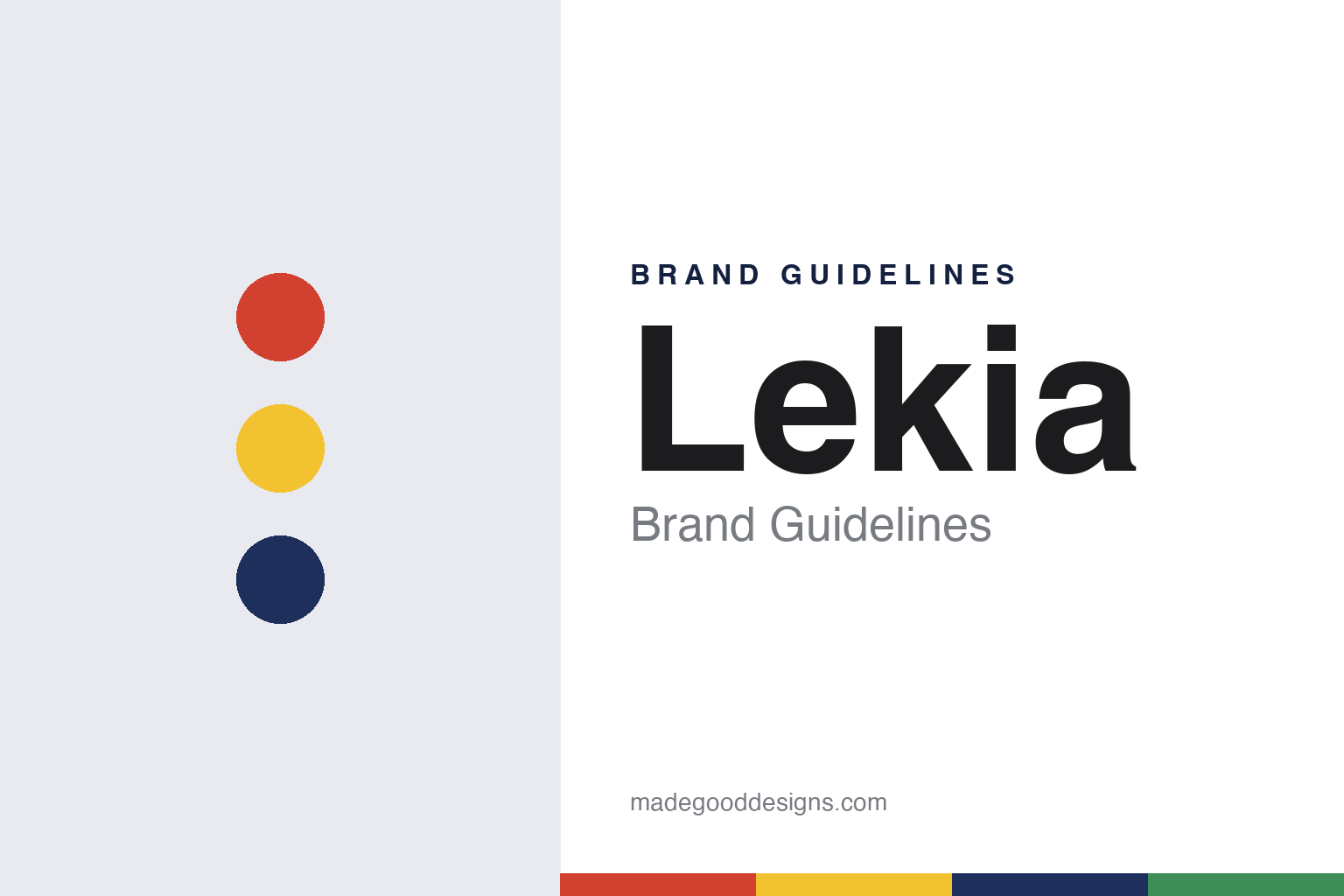
Lekia Brand Guidelines
A Swedish toy chain built from independent shopkeepers under one name.
Aa
Two constants: a red, yellow and ink-blue palette and a rounded sans register. Abstract homage — not a Lekia product or mark; no logo, sign or packaging is reproduced.
Lekia AB
One name, many shopkeepers.
Lekia is a Swedish toy-shop chain built from independent retailers. Swedish Wikipedia describes Lekia AB as a company that handles buying, marketing and training for toy retailers, gives its founding year as 1991, and counted around 150 toy retailers across Sweden in 2021, spread from Kiruna in the far north to Trelleborg on the southern coast. In January 2019 the Stockholm business title Realtid described Lekia as a chain whose shops “are run by independent retailers.” The company’s own pages give its address in Malmö, and name a second company, Lekia online AB, alongside Lekia AB.
That model is visible on the high street. Lekia says its shops can look different inside, but all carry the Lekia name, the same core range and the same customer policy, so that a toy bought in Malmö can be exchanged in Kiruna. The shops sit in small towns, in large shopping centres and in city centres, the company says, and the local retailers run in-store events for families, from building sessions to visits by familiar characters. Swedish Wikipedia illustrates the chain with a shop in the Framnäs shopping centre in Lidköping and another in Norrtälje.
The chain’s recent growth is often measured from 2009. The Swedish retail magazine Market reported in November 2022 that when Magnus Berthling joined Lekia in 2009 the chain had 30 shops, and that by the time he stepped down as chairman it had six times as many. He was followed in the chair by Christian Wijkström, a former head of the Swedish retail group Coop, Market reported.
Colour
Growth after a rival’s exit.
Lekia grew quickly when a larger rival left the market. The Nordic toy group Top-Toy, which ran the BR chain and the Nordic Toys“R”Us shops and whose major owner was the private-equity firm EQT, went bankrupt at the turn of 2018 and 2019. In January 2019 Realtid reported that Lekia then had 140 shops in Sweden and Norway, against Top-Toy’s 150 in the same two countries.
Norway is the chain’s second country, and the company now counts its network across both. As of November 2026 Lekia’s website said it had more than 170 individual shops in Sweden and Norway, and described the business as a wholesaler of play and baby products as well as a retailer. It sells international brands such as LEGO, BRIO, Schleich and Barbie, and its own ranges, which it names as Humble & Heart, PAP and KID; Lekia says these own ranges are not sold anywhere else. Its range, the company says, runs across role play, action figures, games, crafts and outdoor play, with toys for birthdays, party goods and Christmas presents, and the latest toys tied to current cinema releases.
Two further concepts sit beside the toy shops. Babya, which the website presents as “a part of Lekia,” is a baby-goods format that sells prams from the Swedish maker Emmaljunga, with staff on hand to help parents choose one; gift cards work in both Lekia and Babya shops, the company says. Online, Lekia says it centralised its e-commerce in 2023 so that the company itself took full charge of digital sales, with a click-and-collect service that lets customers reserve a toy online and pick it up in a nearby shop. The website also carries a customer club, a Christmas catalogue for 2026 and a video channel called Lekia TV.
Typography
Toy shops and their signs.
Toy-shop chains in Europe, Latin America and Australia usually introduce themselves through a shop sign and a seasonal catalogue. Some of their names began as something else entirely: the Belgian chain DreamLand started as a neighbourhood supermarket called LIMA in Liedekerke in 1956 and turned to toys in 1978, according to Dutch Wikipedia. Logos, colour schemes and shop signs change over time, and each guide in this series describes the current sign only as the company itself shows it.
Store networks take several forms: high-street shops, large stores on retail parks, franchise branches and online shops. Branch, staff and country counts in these guides are given only with their source and date, because toy-shop networks grow and shrink through takeovers, rebrands, bankruptcies and closures, and a chain that has closed is described as closed.
A number of chains began as buying groups or associations of independent toy shops. Intertoys in the Netherlands grew out of a purchasing organisation that started buying toys in 1976, and NRC reported in October 2024 that about half of its shops were still run by franchisees. Where a name covers a network of independently owned shops rather than branches of one company, these guides say so plainly, and they describe owners, from retail groups and investors to founding families, as dated facts.
Chains also name their own ranges, catalogues and seasonal campaigns, such as the Intertoys Speelboek, published each September since 1987, and these guides name them only as the companies do. Corporate pages and company histories describe founders and owners; each guide sets out what can be checked against dated, independent sources, with any gap in the record stated plainly.
Aa
A friendly rounded sans for a family shop sign. (Specimen set in Nunito, a rounded sans STAND-IN; NOT the Lekia logo.)
Lekia
A shared sign over many owners.
Lekia’s identity has to work as a shared sign. Each shop is run by its own retailer, yet the customer is meant to see one name, one core range and one set of policies, from a small-town shop to a branch in a large shopping centre. The common elements the company stresses are the name over the door, the core range, the exchange policy that runs across the whole chain, and the shared catalogue, customer club and website, rather than a single shop fit-out. The website follows the same logic: a dedicated LEGO shop section, gift guides sorted by age from the first year to eight and over, and stock shown shop by shop, so that a customer can see which nearby Lekia holds a toy before reserving it. Pram purchases at Babya include assembly, the company says.
The structure also explains how the chain changes. Growth comes from retailers opening new shops or moving to stronger sites under the Lekia name, which is how Realtid and Market described the chain’s expansion after 2009 and again after Top-Toy’s exit; leadership at the centre has changed several times, with a new chief executive from 2019 and a new chairman from late 2022, according to Realtid and Market. Lekia AB itself works as the buying, marketing and training body behind the shops, Swedish Wikipedia says.
For a design guide, Lekia shows how one shop name can hold together a chain of independently run toy shops across two countries. Compare Toyworld, an Australian group of independently owned toy shops, and Juguettos, a Spanish group of associated toy shops. For this guide we use a red, a sunny yellow and an ink blue with a rounded sans, an unofficial interpretation; no product or logo is reproduced.
Explore & save
Keep Lekia’s identity on hand — save it to a board in the Made Good inspiration library.
Lekia identity set
Pin the Lekia red, yellow and ink-blue palette and the rounded sans register to your own board.
Source & notes
Frequently Asked Questions
What font can I use to match the Lekia look?
This guide describes Lekia’s type as “A friendly rounded sans for a family shop sign”. Its type specimen is set in Nunito from Google Fonts as a stand-in; Nunito is not Lekia’s own lettering.
What colours are in the Lekia palette?
This guide’s Lekia palette is Shopfront red #D2402F, Ink blue #1F2F5C, Sunny yellow #F2C230, Meadow green #3E8E5A and Paper #FAF7F0. The tones are the guide’s own unofficial interpretation, not official Lekia hex codes.
When was Lekia founded?
Lekia was founded in 1991 (Lekia AB), in Sweden.