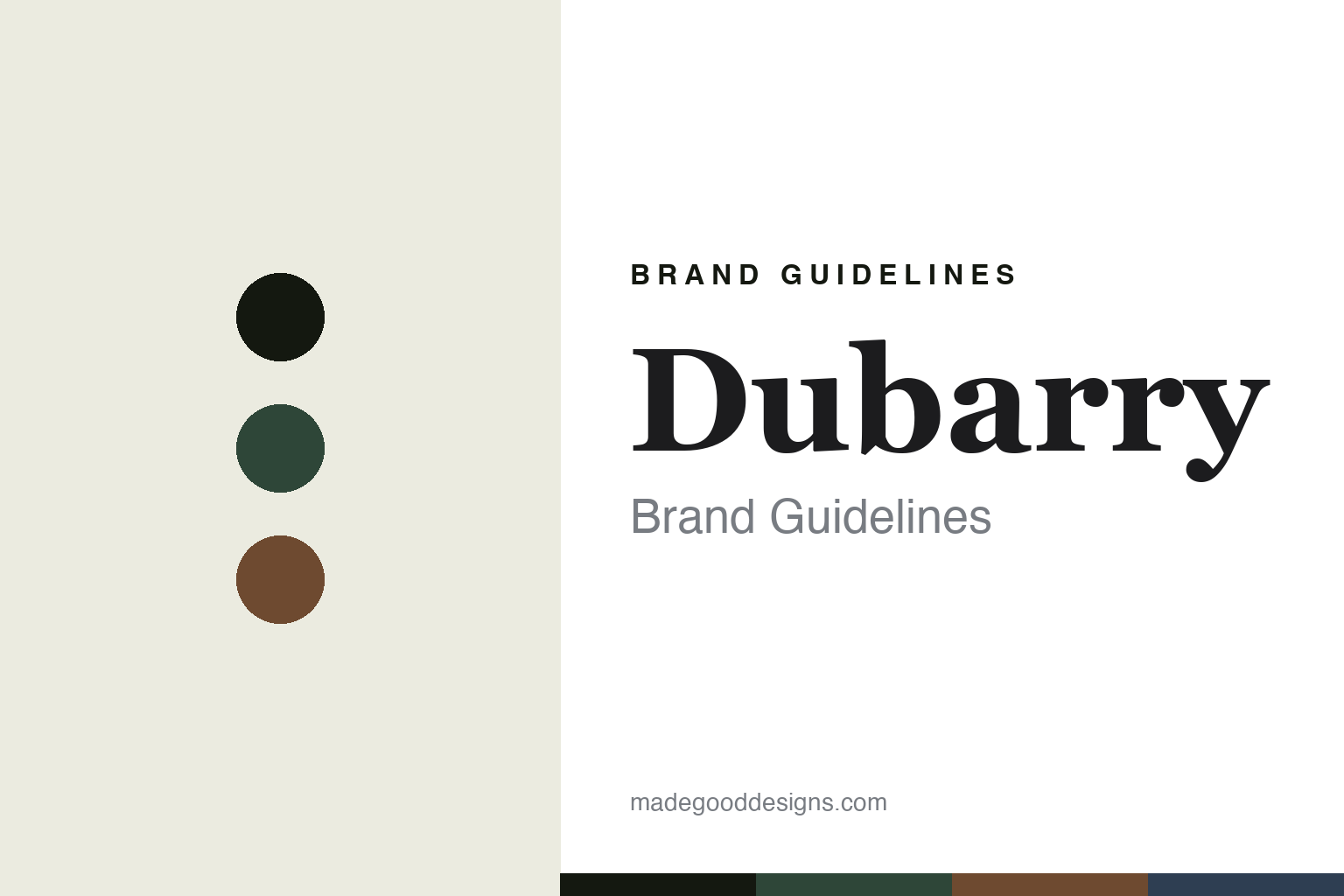
Dubarry Brand Guidelines
The Galway.
Aa
Two constants: a field-green-and-walnut palette and a country serif register. Abstract homage — not the Dubarry footwear.
The Galway
Dubarry built a country and sailing brand on two waterproof icons.
Dubarry is a lesson in a dual heritage as identity. Founded in 1937 in Ballinasloe, County Galway, as a local-employment leather-shoe maker, it repositioned over the decades into premium country and sailing footwear. It is an independent, privately held Irish company (a 1983 management buyout was a turning point), and its name comes from Madame du Barry, chosen to give the Irish maker a continental flavour.
Its identity rests on two icons. The Galway is a leather-and-GORE-TEX tall country/equestrian boot — the flagship land-side icon. And its sailing heritage is the technical origin: the NonSlip-NonMarking deck sole (1983) and the Shamrock 2000 (1990), which Dubarry bills as the world’s first GORE-TEX sailing boot. The models carry Irish place-names — Galway, Kildare, Crosshaven — and nautical names.
(Honest notes: the founding-ownership story is contested in the sources, so we keep it to “a 1937 local-employment venture, independent and privately held today.” The Shamrock 2000 “first” is Dubarry’s own claim. And Dubarry is designed in Ireland but made offshore (production moved abroad from the 1990s/2000s), so it’s not “Irish-made.” There’s no official brand hex, so these tones are an unofficial interpretation.)
Colour
Dubarry lives in a field-green-and-walnut palette. Click a swatch to copy the hex.
Dubarry’s identity is country, Irish and refined — an ink, a field green, a walnut, a sail navy, and a cream. The palette pairs a country field green with a walnut leather, with a sail navy for the marine side — the register of field-sports and sailing. It signals the countryside and the water rather than fashion. The honest caveat: with no published brand hex, these tones are an original, unofficial interpretation, not first-party values.
The lesson is a field green with a walnut leather signals a country boot. Dubarry’s world is a leather country boot and a deck shoe. For designers, it is a reminder that a green-and-walnut palette reads as country and refined — right for a field-sports and sailing brand. The takeaways: source the palette from the field and the sea (green, walnut, navy); keep it refined; hold the two heritages (country and sailing); and treat any single hex as unofficial.
Typography
The register is a country serif — refined, Irish, heritage.
Dubarry’s identity carries a refined, Irish, heritage spirit — a country boot and a sailing history. A country serif captures the mood: it is warm and traditional, the register of a field-sports house. Set in a field-green-and-walnut palette, the country serif feels refined and Irish — exactly the personality Dubarry carries. It is heritage rather than flashy, mirroring a leather country boot. (Dubarry’s real footwear is work we describe but do not reproduce, and the exact typeface is not ours to use.) Because it is not ours to use, the honest description is “a country serif spirit,” shown here in a stand-in. The type behaves like the brand: refined, Irish and heritage.
Aa
A country serif spirit — refined and Irish. (Specimen set in Lora, a heritage serif STAND-IN; NOT the Dubarry footwear.)
A dual heritage as identity
Dubarry stands for the field and the sea.
Dubarry is a lesson in making a dual heritage the identity. A field-green-and-walnut palette, a country serif and two waterproof icons make country-and-sailing the whole brand — refined, Irish, heritage. The dual heritage is the differentiator. The differentiator is a Galway-boot and Shamrock-sailing identity.
For designers and brand-builders, Dubarry offers a clear takeaway: own two worlds with one craft. The lessons: build a land icon (the Galway) and a water icon (the Shamrock 2000); anchor the mark in a story (Madame du Barry); name from the place (Irish counties and harbours); and be honest about where it’s made. It is also a reminder to stay accurate: the founding story is contested, it’s made offshore, and the palette here is an unofficial interpretation. Dubarry made a dual heritage the brand — proof that two worlds can be the difference.
Explore & save
Keep Dubarry’s identity on hand — save it to a board in the Made Good inspiration library.
Dubarry identity set
Pin the field-green-and-walnut palette and the country-serif register to your own board.