Electric Daisy Carnival Brand Guidelines
Insomniac’s dusk-to-dawn carnival, from a Los Angeles hall to a Las Vegas speedway.
Aa
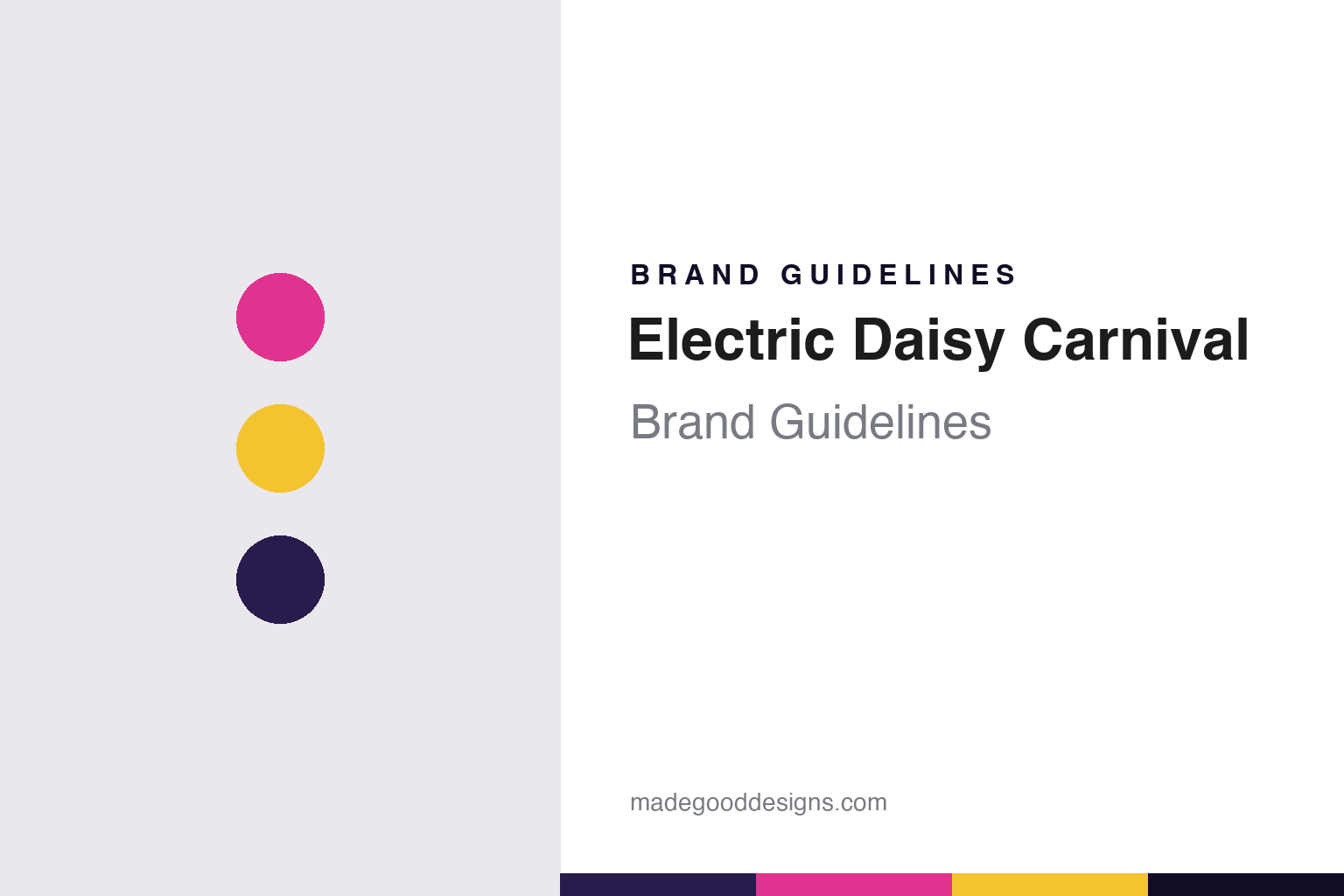
Two constants: an EDC night violet, electric pink and daisy yellow palette and a Rounded display sans register. Abstract homage — not an Electric Daisy Carnival asset or mark; no logo, stage or artwork is reproduced.
From warehouse to carnival
A Los Angeles promoter’s signature event.
Electric Daisy Carnival, shortened to EDC, is a series of electronic dance music festivals run by the Los Angeles promoter Insomniac. Its flagship, EDC Las Vegas, is held each May at the Las Vegas Motor Speedway, where it has traditionally run over three nights from dusk until sunrise, according to English Wikipedia. The festival marked its 30th anniversary there on May 15–17, 2026, the Las Vegas Sun reported that month, under the edition theme “kineticJOURNEY.”
The name is older than the Las Vegas show. English Wikipedia and Pollstar both trace it to Southern California events held under that name from 1991, and Wikipedia records that Insomniac staged its own first Electric Daisy Carnival in 1997 at the Shrine Expo Hall in Los Angeles. The 30th anniversary celebrated in 2026 counts from that 1997 edition.
Insomniac itself began as a weekly party. In a January 2024 profile marking the company’s 30th year, Pollstar described how its founder and chief executive, Pasquale Rotella, started it with a rave in a South Central Los Angeles warehouse and then held it in a different warehouse every Friday, so that each week was, in his words, “a different adventure.”
For more than a decade the festival moved around Southern California. Wikipedia lists Lake Dolores Waterpark in Newberry Springs in 1999, the International Agri-Center in Tulare in 2000, and Hansen Dam in 2001 — the year it first spread across several stages, with names such as the Merry Go Round, the Fun House and Clown Alley. It was at the Queen Mary Events Park in Long Beach in 2002, at the NOS Events Center in San Bernardino from 2003 to 2006, and from 2007 at the Los Angeles Memorial Coliseum and Exposition Park. It became a two-day event in 2009.
Colour
Las Vegas, Live Nation and the editions abroad.
The festival changed city in 2011. After the 2010 edition, Insomniac moved EDC to the Las Vegas Motor Speedway, Pollstar reported in 2024; Wikipedia dates the first Las Vegas edition to June 24–26, 2011, and records that the festival became a three-day event that year. In 2018 the Las Vegas dates moved from June to May, and on-site camping, with rentable campers and RV parking, was added. The 2020 edition did not take place, and the 2021 edition was held in October, Wikipedia says; it was billed as the 25th anniversary and the tenth year in Las Vegas.
Ownership changed in 2013. On June 19 that year, at the EDMbiz conference in Las Vegas, Rotella announced a “creative partnership” with Live Nation, Pollstar reported the next day; he said Insomniac would keep creative control of its events and remain “a stand-alone company.” Pollstar’s 2024 profile states that Live Nation acquired a 50% stake in Insomniac in 2013. Speaking to Variety in August 2014, Rotella described the company as “completely autonomous” within Live Nation while having access to its resources. The same interview covered Insomniac Records, a label set up with Interscope, and Under the Electric Sky, a documentary about the 2013 Las Vegas festival that premiered at the Sundance Film Festival in 2014.
EDC has also travelled. When the Live Nation partnership was announced, Pollstar listed Insomniac events in Colorado, Florida, New York, New Jersey, Texas and Puerto Rico alongside Las Vegas. Wikipedia dates EDC Orlando to 2011, at Tinker Field beside the city’s football stadium, EDC Mexico in Mexico City to 2014, and editions in England from 2013, with later debuts in Japan and China in 2018, South Korea in 2019 and Thailand in 2025. As of 2026, it lists EDC in Las Vegas and Orlando, with international editions in China, Colombia, Mexico, South Korea and Thailand.
The Las Vegas site shapes the event’s scale. Wikipedia describes nine stages, each aimed at a different strand of electronic music, and the 2026 edition brought together about 200 artists and more than 500,000 attendees over three days, Las Vegas Weekly reported in May 2026.
Typography
Festivals and their faces.
Music festivals in the United States usually take their names from somewhere or something particular: a city, a park, an island, a television programme, an idea or a short coined word. Austin City Limits Music Festival borrowed the name of a public-television concert series; Governors Ball kept the name of the island where it began even after it moved. Long names are soon cut down to initials or nicknames — ACL Fest, Gov Ball — and posters, wristbands and websites often pair that short form with a year.
Behind the names stand different kinds of organiser. Some festivals are run by promoters and festival companies, a number of which sit inside larger live-entertainment groups; others are run by non-profit foundations or produced in partnership with park foundations and city departments, which grant the use of public land each year. The organiser is rarely the face of the festival, but its name appears in the small print and in the trade press.
The setting is part of the identity. A festival may fill a city park, a polo ground, a motor speedway, a waterfront or a fairground for one weekend or several, laid out with a number of stages, food areas drawn from local restaurants, art installations and markets, and often a children’s area. When a festival changes venue, the new place name usually joins the dates in the line that sits beside the festival name.
Each year brings a new lineup poster, with headliners set in large type above rows of smaller names, and an edition key visual that changes from year to year. Around these, a steady wordmark, the place and the dates hold the identity together. This guide looks at how each festival handles that balance, using only what dated sources and the festivals’ own pages show.
Aa
A rounded display sans — the stage-world register. (Specimen set in Righteous, a display sans STAND-IN; NOT the Electric Daisy Carnival logo.)
Electric Daisy Carnival
Stage worlds under the night sky.
The identity is built from stage worlds as much as from a single wordmark. Each Las Vegas edition carries a theme, and the stages have their own names: the Las Vegas Sun printed the main stage as “kineticFIELD” and the 2026 theme as “kineticJOURNEY” in May 2026. That main stage, Kinetic Field, can hold about 70,000 people for headliners, Wikipedia says, and in 2015 its set used a blinking owl as the background theme. In 2026, Las Vegas Weekly described a “hulking, spaceship-inspired” Kinetic Field among nine main stage setups, with others including Circuit Grounds, Basspod and Neon Garden — the last under a translucent roof — and a Pixel Forest arcade area. A house-oriented stage, Bionic Jungle, appeared at EDC Mexico in 2022 and reached Las Vegas later that year, according to Wikipedia.
The carnival in the name is literal. Wikipedia describes art installations, carnival entertainers and amusement rides across the grounds, with roaming art cars between the stages; the 2001 stage names — a merry-go-round, a fun house, a mirror maze — show that the fairground idea was there long before the speedway. The Las Vegas Weekly writer in 2026 also described a supper club inside the festival where acrobats and jazz musicians performed during dinner.
The daisy in the name gives designers an easy motif, and the night-time schedule sets the colour mood: performances that start late in the evening and finish at sunrise, as Wikipedia describes the traditional Las Vegas format, under stage lighting and fireworks.
For a design guide, Electric Daisy Carnival shows how a festival can carry one name across three decades, many venues and several countries by turning each edition into a themed world. Compare Ultra Music Festival, the Miami electronic music festival held each March, and Goldenvoice, the Southern California promoter whose head worked with Rotella on the Organic rave in 1996, according to Pollstar. For this guide we use a night violet, an electric pink and a daisy yellow with a rounded display sans, an unofficial interpretation; no product or logo is reproduced.
Explore & save
Keep Electric Daisy Carnival’s identity on hand — save it to a board in the Made Good inspiration library.
Electric Daisy Carnival identity set
Pin the EDC night violet, electric pink and daisy yellow palette and the Rounded display sans register to your own board.
Source & notes
Frequently Asked Questions
What font can I use to match the Electric Daisy Carnival look?
This guide describes Electric Daisy Carnival’s type as “A rounded display sans — the stage-world register”. Its type specimen is set in Righteous from Google Fonts as a stand-in; Righteous is not Electric Daisy Carnival’s own lettering.
What colours are in the Electric Daisy Carnival palette?
This guide’s Electric Daisy Carnival palette is Night violet #2A1B4D, Electric pink #E0338F, Daisy yellow #F4C430, Midnight #120C24 and Paper #F7F4FA. The tones are the guide’s own unofficial interpretation, not official Electric Daisy Carnival hex codes.