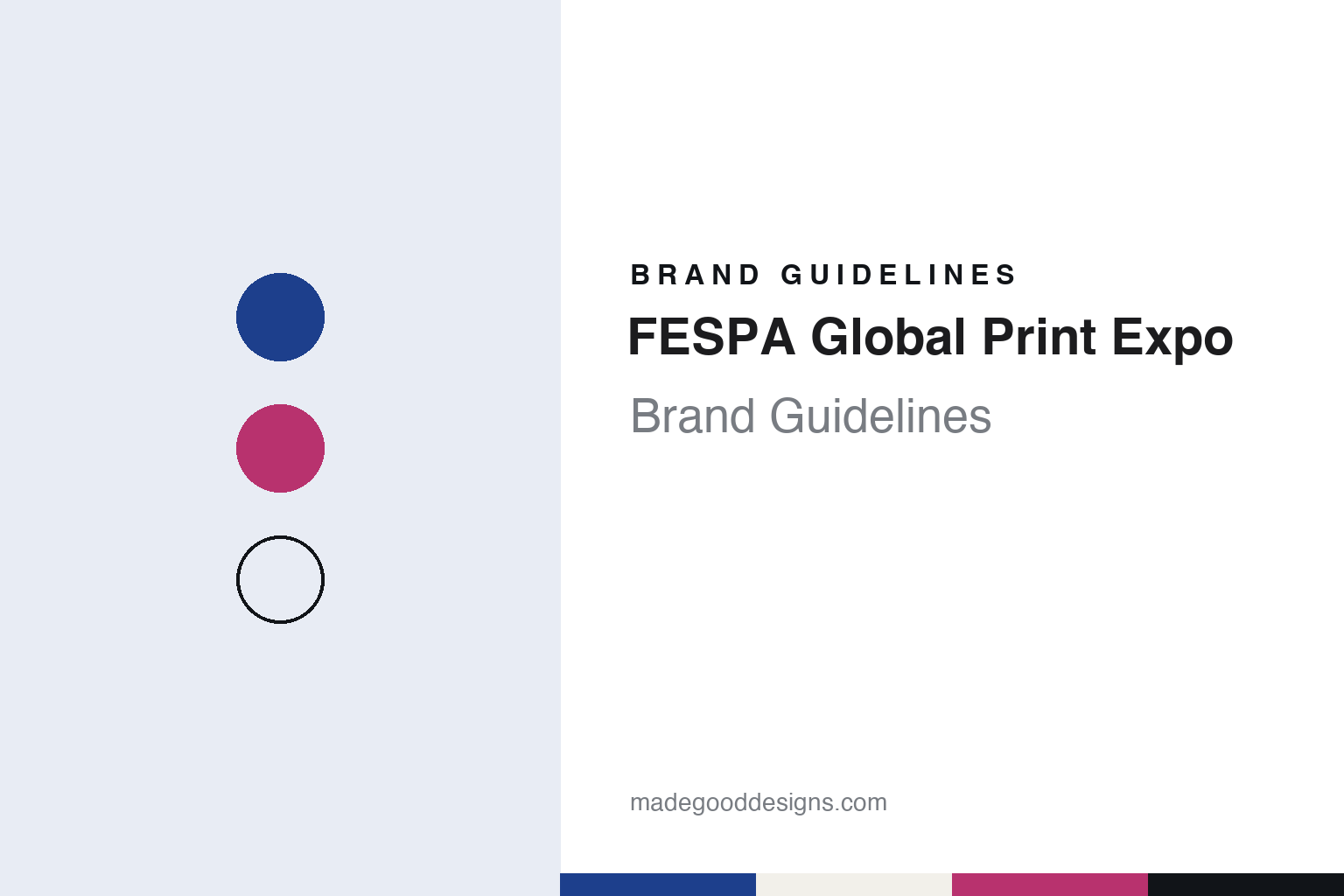
FESPA Global Print Expo Brand Guidelines
The screen-print federation’s show that moves city.
Aa
Two constants: a press blue, proof magenta and ink black palette and a geometric sans register. Abstract homage — not a FESPA asset or mark; no logo, key visual or print is reproduced.
A federation of printers
Screen-printing associations, 1962.
FESPA Global Print Expo is the main exhibition of FESPA, a federation of national printing associations. English Wikipedia expands the name as the Federation of European Screen Printers Associations and says it was formed as a non-profit organisation in 1962 by a group of screen-printing associations that wanted a platform to share knowledge of screen-printing technology in Europe. Wikipedia describes FESPA today as two things at once: a federation that gives member associations a forum to exchange information on recruitment, training and technical studies, and an organiser of exhibitions and conferences for the wide-format, screen, textile and digital printing community. It puts current membership at around 40 national associations.
In February 2012 Large Format Review published an interview in which FESPA’s then managing director, Neil Felton, marked the federation’s golden jubilee that year. He traced its foundation to “a small group of highly committed national screen printing associations” that came together to network and share knowledge as the sector moved away from its craft base, gave the member base as spanning 37 countries, and cited the strapline “United We Print.” He also said the event portfolio had grown and diversified since 2005, with exhibitions in Europe, Asia and the Americas.
The exhibitions began almost at once. Middle East Printer wrote in August 2013 that one year after the organisation was formed, the first FESPA show was held in Paris in 1963, at a time when only analogue equipment, such as cylinder printing, semi-automatic presses and screen-printing machines, was on display. A digital-only sister show followed much later: Large Format Review reported on 1 March 2012 that FESPA Digital 2012, at Fira Barcelona Gran Via, drew more than 12,000 visitors from over 111 countries to 350 exhibitors, figures from the show report, and referred to FESPA Digital’s five-year existence.
Colour
A show that changes city.
FESPA’s flagship exhibition has no fixed home. It moves between European exhibition centres, a pattern the Spanish trade magazine Interempresas described in June 2026 as FESPA’s itinerant model. Dated reports trace the sequence. Middle East Printer reviewed FESPA 2013 in London, where the show was co-located with the European Sign Expo. Print21, an Australian print magazine, reported in April 2024 that FESPA Global had been held in Amsterdam the month before, with 12,700 visitors from 120 countries, and named Messe Berlin as the next venue.
The Berlin edition ran at Messe Berlin from 6 to 9 May 2025, beside the European Sign Expo and Personalisation Experience. textile network reported on 4 June 2025 the organiser’s figures of 14,036 unique visitors and a total attendance of 23,061, with visitors from 126 countries and the largest groups from Germany, Poland and Italy. It quoted Michael Ryan, head of FESPA Global Print Expo, comparing German and Polish attendance with the previous German edition, held in Munich in 2023.
In 2026 the show went to Barcelona. Fira de Barcelona said in a release of 14 May 2026 that its Gran Via venue would host FESPA Global Print Expo from 19 to 22 May, fourteen years after the show was last held in the city, with more than 500 exhibitors from 40 countries. Interempresas called it the first flagship FESPA fair in southern Europe since 2012. Print21 reported on 26 June 2026 that the Barcelona event combined six co-located exhibitions and three conference programmes: FESPA Global Print Expo, European Sign Expo and Personalisation Experience returned; two new events, Corrugated and Textile, were added; and WrapFest joined the flagship portfolio for the first time. FESPA counted 24,798 total visits and 15,495 unique visitors from 126 countries, a 10 percent rise in unique visitors on 2025, the magazine reported. The largest visitor groups in Barcelona came from Spain, Italy and the UK, where in Berlin a year earlier Germany, Poland and Italy had led.
Those co-located names map the segments. Print21 listed visitors from speciality print, signage, packaging, personalisation, wrapping and textiles, and described the Corrugated event as aimed at makers of corrugated packaging and display products and their machinery, software and materials suppliers.
Typography
Design and documentation.
Industrial, print and packaging trade fairs tend to present themselves through a short coined name rather than a description. Some compress two words into one, as drupa does with the German for print and paper; others are written entirely in lower case or entirely in capitals, and some add the host city to the name, as with EMO Hannover. The name is usually the most stable part of the identity, carried from one edition to the next for decades while organisers, halls and themes change around it.
The second constant is the calendar. Rather than meeting every year, many of these fairs keep a fixed cycle of two, three or four years, set to suit industries whose machines take years to develop, and an edition is known by its year in a way that buyers and exhibitors plan around. Behind most of them stands an exhibition company working with an industry association or an exhibitor committee whose recommendations the organiser takes into account.
The halls themselves are part of the language. These fairs fill very large exhibition grounds and arrange them by segment, such as prepress, printing, finishing, packaging materials or machine tools, so that a visitor reads the show hall by hall. Stands often carry working machines rather than models, which gives the halls the look of a temporary factory floor alongside conference stages and themed special areas.
Visually, the pattern is a fixed wordmark with a changing key visual. Each edition receives its own campaign image, edition line or set of themes, presented in the year or two before opening, while the name and the venue stay put. For a design guide, the lesson is that balance between a permanent mark and a temporary campaign.
Aa
A geometric sans for an acronym and two plain words. (Specimen set in Work Sans, a sans STAND-IN; NOT the FESPA logo.)
FESPA
An acronym that outgrew its first words.
The FESPA name is an acronym kept while its scope widened. The federation that English Wikipedia traces to European screen-printing associations now serves digital, textile and wide-format printers as well, and Felton described its shows in 2012 as reaching Europe, Asia and the Americas. The exhibition’s full title pairs the acronym with plain descriptive words, Global Print Expo, and it sits beside other plainly named events, such as European Sign Expo, Personalisation Experience and, from 2026, Corrugated and Textile, under the one FESPA name.
What fills the halls is printed output and the machines that make it. Middle East Printer’s review of the 2013 London show described inkjet printers for display graphics and signage, digital textile presses and digital signage on the stands, a long way from the cylinder and screen presses of 1963. Because the show changes city, each edition also borrows the setting of its host venue, from the RAI in Amsterdam to the Gran Via halls in Barcelona.
For a design guide, FESPA Global Print Expo shows how an organisation can keep a 1960s acronym as its constant while the show around it moves from one European city to the next. Compare drupa, the Düsseldorf print fair that opened eight weeks after FESPA’s 2024 Amsterdam show, according to Print21, and Messe Berlin, host of the 2025 edition. For this guide we use a deep press blue, a magenta and an ink black with a sans, an unofficial interpretation; no product or logo is reproduced.
Explore & save
Keep FESPA Global Print Expo’s identity on hand — save it to a board in the Made Good inspiration library.
FESPA Global Print Expo identity set
Pin the FESPA Global Print Expo press blue, proof magenta and ink black palette and the geometric sans register to your own board.
Source & notes
Frequently Asked Questions
What font can I use to match the FESPA Global Print Expo look?
This guide describes FESPA Global Print Expo’s type as “A geometric sans for an acronym and two plain words”. Its type specimen is set in Work Sans from Google Fonts as a stand-in; Work Sans is not FESPA Global Print Expo’s own lettering.
What colours are in the FESPA Global Print Expo palette?
This guide’s FESPA Global Print Expo palette is Press blue #1D3F8C, Ink black #111418, Proof magenta #B8326E, Stock white #F2F0EA and Paper #FAFAF7. The tones are the guide’s own unofficial interpretation, not official FESPA Global Print Expo hex codes.