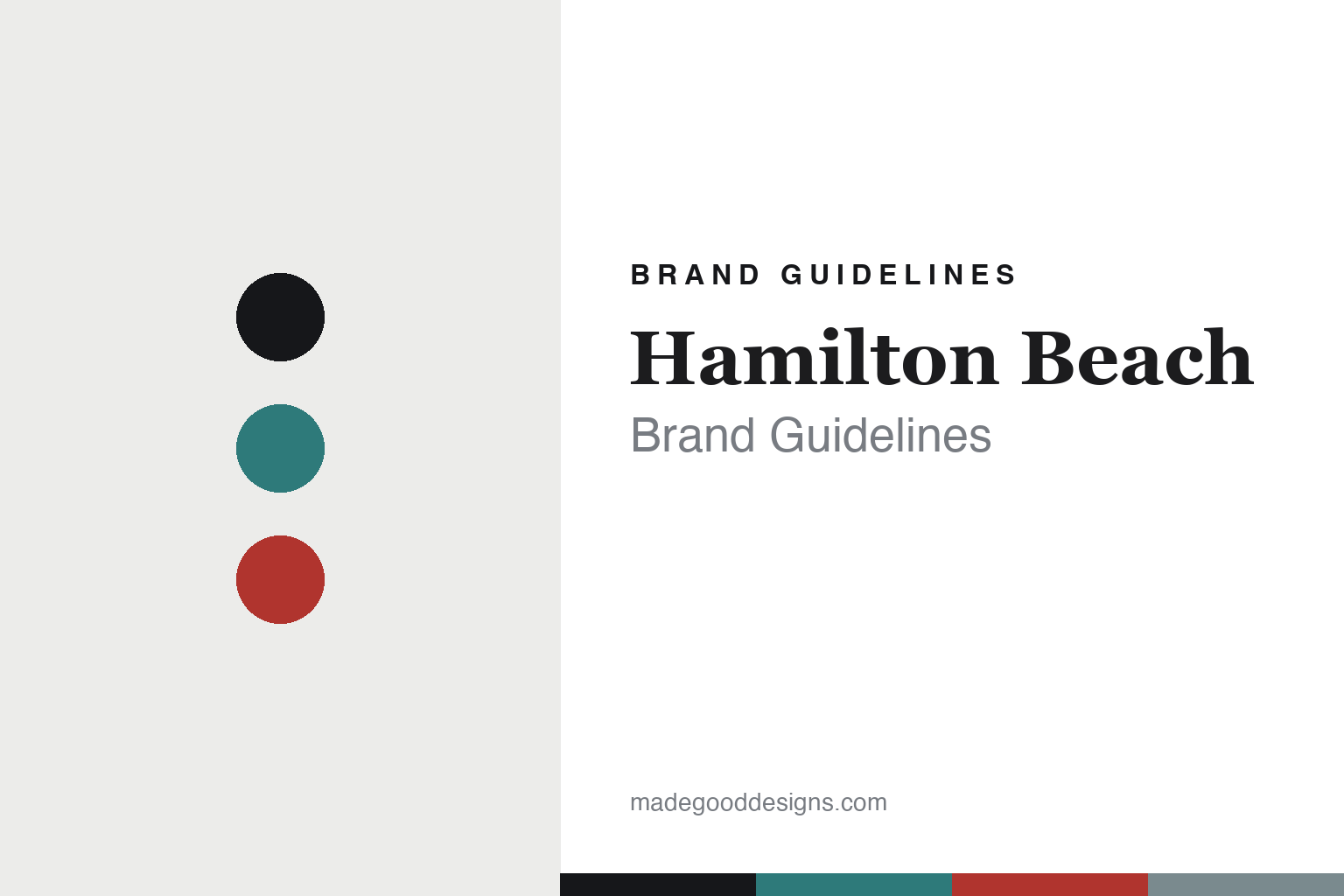
Hamilton Beach Brand Guidelines
The drink mixer.
Aa
Two constants: a soda-fountain palette and a diner slab register. Abstract homage — not the Hamilton Beach machine or wordmark.
The drink mixer
Hamilton Beach grew from the soda-fountain spindle mixer.
Hamilton Beach is a lesson in the affordable workhorse as the identity. Founded around 1910 in Racine, Wisconsin, it grew from the soda-fountain drink mixer into a maker of practical, affordable countertop appliances for every American kitchen.
Its identity is the drink mixer. Hamilton Beach’s origin product — the Cyclone spindle mixer that whipped up malt-shop milkshakes — set the tone for a broad, value-focused range of blenders, mixers, coffee makers and toasters. Affordable, practical, everywhere. A workhorse, not a status object.
(Honest notes: Hamilton Beach was founded around 1910 in Racine, Wisconsin. Importantly, the founder was the inventor Frederick J. Osius, not Hamilton and Beach: Osius hired Louis Hamilton (an advertising manager) and Chester Beach (a mechanic, whose fractional-horsepower “universal” motor was key) and paid each about $1,000 for the right to use their names — so the brand is named for Hamilton and Beach, who were namesake employees rather than founders, and both left by 1913. The soda-fountain Cyclone drink mixer (1910) is a genuine origin product. On production, essentially all appliances are now made offshore by third-party subcontractors, principally in China (with some in Mexico) — it is a US design-and-marketing company, not a US manufacturer, so we don’t imply “Made in USA.” On ownership, it is Hamilton Beach Brands Holding Company (NYSE: HBB), headquartered in Glen Allen, Virginia, spun off from NACCO Industries in 2017 (and merged with Proctor-Silex in 1990). There’s no official brand hex — these tones are an unofficial interpretation. This is design commentary and does not promote any product.)
Colour
Hamilton Beach lives in a soda-fountain palette. Click a swatch to copy the hex.
Hamilton Beach’s identity is practical, nostalgic and American — a teal, an ink, a diner red, a chrome, and a chalk. The palette leans soda fountain — the register of a malt-shop drink mixer and a value-focused kitchen brand. It signals nostalgia and utility rather than novelty. The honest caveat: with no published brand hex, these tones are an original, unofficial interpretation, not first-party values.
The lesson is a soda-fountain palette signals an affordable American workhorse. Hamilton Beach’s world is a practical, nostalgic, chromed object. For designers, it is a reminder that a genuine origin product — the drink mixer — can flavour a whole brand, and that a nostalgic, diner-toned palette signals accessible utility. Because a teal can fail as small text, keep type dark and let the colour live in the accents, palette and band. The takeaways: honour the origin; signal value; keep it practical; and treat any single hex as unofficial.
Typography
The register is a diner slab — sturdy, nostalgic, plain.
Hamilton Beach’s identity carries a sturdy, nostalgic, plain spirit — a practical, everyday object. A slab serif captures the mood: it is solid and Americana, the register of a malt-shop-era workhorse. Set in a soda-fountain palette, the diner slab feels sturdy and nostalgic — exactly the personality Hamilton Beach carries. It is plain rather than fancy, mirroring an affordable machine. (Hamilton Beach’s real machine and wordmark are works we describe but do not reproduce, and the exact typeface is not ours to use.) Because it is not ours to use, the honest description is “a diner slab spirit,” shown here in a stand-in. The type behaves like the brand: sturdy, nostalgic and plain.
Aa
A diner slab spirit — sturdy and nostalgic. (Specimen set in Bitter, a slab serif STAND-IN; NOT the Hamilton Beach wordmark.)
The affordable workhorse as identity
Hamilton Beach stands for the drink mixer.
Hamilton Beach is a lesson in making the affordable workhorse the identity. A soda-fountain palette, a diner slab and a drink-mixer heritage make practical value the whole brand — sturdy, nostalgic, American. The accessibility is the differentiator. The differentiator is a broad range of dependable appliances priced for every kitchen.
Put to work, the identity is honest utility. A designer building in this spirit would keep the product practical and the price low, and let a genuine heritage — the soda-fountain drink mixer — give an otherwise value-focused brand warmth and character. The lesson Hamilton Beach teaches is that an origin story humanises a workhorse: the malt-shop spindle mixer connects a modern range of budget appliances to a nostalgic American moment, and a diner-toned design language keeps that warmth alive.
For designers and brand-builders, Hamilton Beach offers a clear takeaway: let heritage warm a value brand. The lessons: honour the origin; signal value; keep it practical; and be honest about the story. It is also a reminder to stay accurate: it was founded around 1910 in Racine, but — importantly — by the inventor Frederick J. Osius, with Hamilton and Beach as namesake employees rather than founders — the palette here is an unofficial interpretation. And it is a reminder that made-where honesty matters even for a heritage American name: describing production as offshore, principally in China, rather than implying US manufacture, keeps the story trustworthy. It is a reminder, too, that a founding city and a current headquarters can differ: Racine, Wisconsin is the origin, but the company is now based in Virginia and publicly listed — details worth getting right. Hamilton Beach made the drink mixer the brand — proof that an affordable workhorse can be the difference.
Explore & save
Keep Hamilton Beach’s identity on hand — save it to a board in the Made Good inspiration library.
Hamilton Beach identity set
Pin the soda-fountain palette and the diner-slab register to your own board.