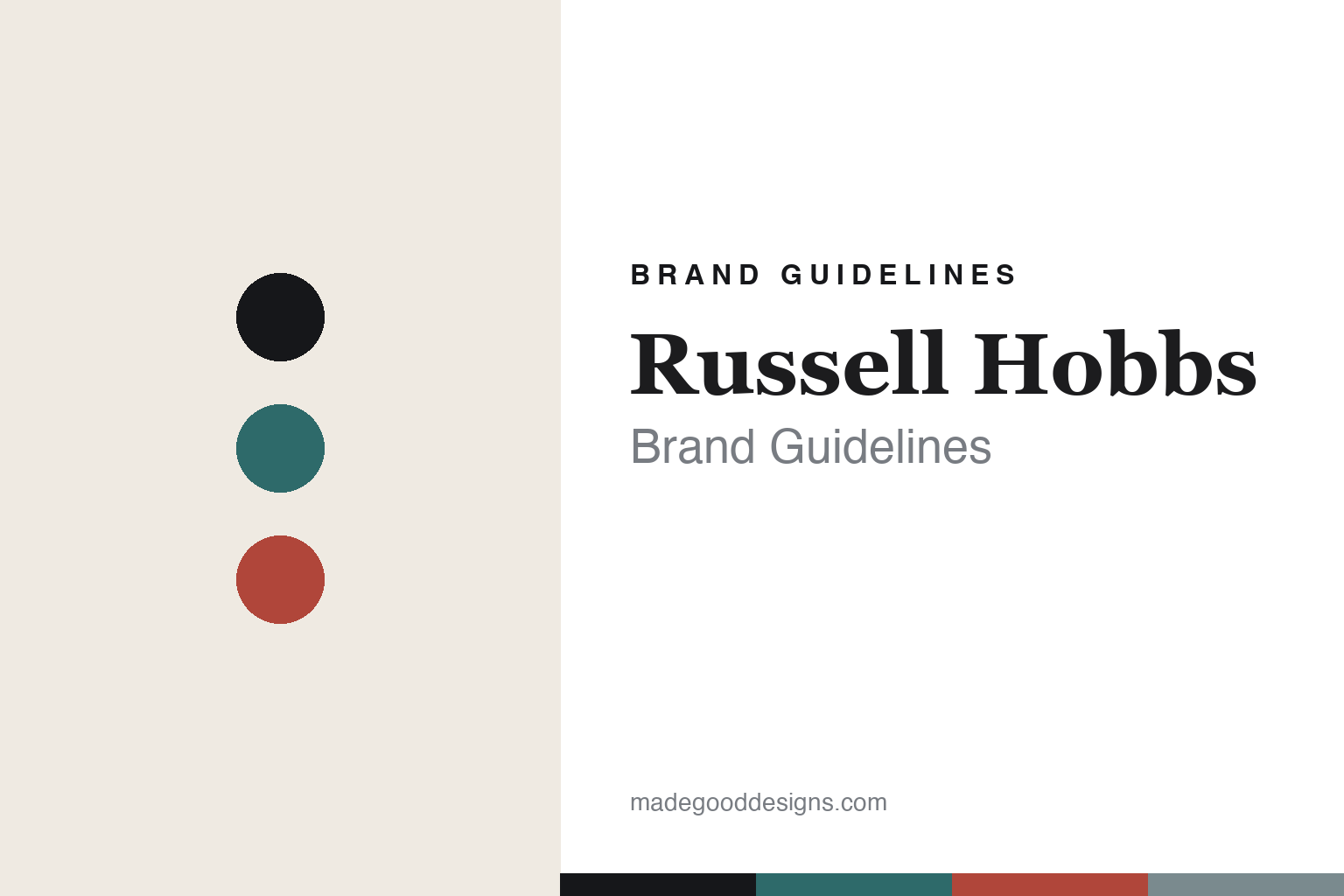
Russell Hobbs Brand Guidelines
The electric kettle.
Aa
Two constants: a heritage-chrome palette and a heritage serif register. Abstract homage — not the Russell Hobbs kettle or wordmark.
The electric kettle
Russell Hobbs built its name on the kettle that switches itself off.
Russell Hobbs is a lesson in a pioneering invention as the identity. Founded in 1952 in the UK by Bill Russell and Peter Hobbs, it built its name on the automatic electric kettle — the one that switches itself off when the water boils.
Its identity is the electric kettle. Russell Hobbs makes kettles, toasters, coffee makers and irons, but the automatic kettle is the object it is known for — a British kitchen staple that traces back to a genuine engineering first. A kettle you can walk away from. A design that quietly became universal.
(Honest notes: Russell Hobbs was founded in 1952 in the UK — Croydon, Surrey — by William “Bill” Russell and Peter Hobbs. Its signature heritage is the automatic electric kettle: the K1 (1955) was the first kettle to switch itself off automatically when the water boiled, and the K2 (1960) became its best-known product; the CP1 (1952) is described as the first automatic coffee percolator — “world-first” framings we treat as brand heritage claims rather than audited facts. On production, it is largely made offshore in China today (its head office is in Failsworth, England), so we don’t imply UK manufacture. On ownership, it is owned by Spectrum Brands (US), which acquired it in 2010, after a genuinely complicated corporate history (Tube Investments, Polly Peck, Pifco, Salton, then Spectrum). There’s no official brand hex, and we reproduce no kettle or logo — these tones are an unofficial interpretation. This is design commentary and does not promote any product.)
Colour
Russell Hobbs lives in a heritage-chrome palette. Click a swatch to copy the hex.
Russell Hobbs’ identity is classic, British and chromed — a teal, an ink, a warm red, a chrome, and a cream. The palette leans heritage chrome — the register of a mid-century automatic kettle. It signals dependability and history rather than novelty. The honest caveat: with no published brand hex, these tones are an original, unofficial interpretation, not first-party values.
The lesson is a heritage-chrome palette signals a design that became a standard. Russell Hobbs’ world is a classic, chromed, familiar object. For designers, it is a reminder that a genuine invention — the auto-shutoff kettle — can anchor a brand for generations, and that a mid-century, chrome-toned palette makes that heritage legible. Because a teal can fail as small text, keep type dark and let the colour live in the accents, palette and band. The takeaways: honour the invention; keep it classic; chrome the object; and treat any single hex as unofficial.
Typography
The register is a heritage serif — classic, dependable, British.
Russell Hobbs’ identity carries a classic, dependable, British spirit — a chromed, historic object. A refined text serif captures the mood: it is steady and established, the register of a brand with a real first to its name. Set in a heritage-chrome palette, the heritage serif feels classic and dependable — exactly the personality Russell Hobbs carries. It is established rather than trend-driven, mirroring a design that became a standard. (Russell Hobbs’ real kettle and wordmark are works we describe but do not reproduce, and the exact typeface is not ours to use.) Because it is not ours to use, the honest description is “a heritage serif spirit,” shown here in a stand-in. The type behaves like the brand: classic, dependable and British.
Aa
A heritage serif spirit — classic and dependable. (Specimen set in Spectral, a refined text serif STAND-IN; NOT the Russell Hobbs wordmark.)
A pioneering invention as identity
Russell Hobbs stands for the electric kettle.
Russell Hobbs is a lesson in making a pioneering invention the identity. A heritage-chrome palette, a heritage serif and an automatic kettle make an engineering first the whole brand — classic, dependable, British. The invention is the differentiator. The differentiator is a genuine first — the kettle that switches itself off — that the brand still trades on.
Put to work, the identity is a first you keep telling. A designer building in this spirit would anchor the brand to its real innovation and let a classic design language carry it, so a modern kettle inherits the credibility of the original. The lesson Russell Hobbs teaches is that a true invention compounds trust: the auto-shutoff kettle made the name a British household word, and a heritage design language keeps that story alive across a broad, everyday range.
For designers and brand-builders, Russell Hobbs offers a clear takeaway: anchor to a real first. The lessons: honour the invention; keep it classic; chrome the object; and be honest about the story. It is also a reminder to stay accurate: it was founded in 1952 by Russell and Hobbs, the K1 auto-shutoff kettle dates to 1955, and — importantly — it is owned by Spectrum Brands after a tangled corporate history — the palette here is an unofficial interpretation. And it is a reminder that made-where honesty matters even for a heritage British name: describing production as offshore today, rather than implying it is still British-made, keeps the story trustworthy. It is a reminder, too, that “world-first” claims deserve careful wording: framing the auto-kettle and the automatic percolator as the brand’s heritage claims, rather than as audited facts, keeps the invention story credible. Russell Hobbs made the electric kettle the brand — proof that a pioneering invention can be the difference.
Explore & save
Keep Russell Hobbs’s identity on hand — save it to a board in the Made Good inspiration library.
Russell Hobbs identity set
Pin the heritage-chrome palette and the heritage-serif register to your own board.