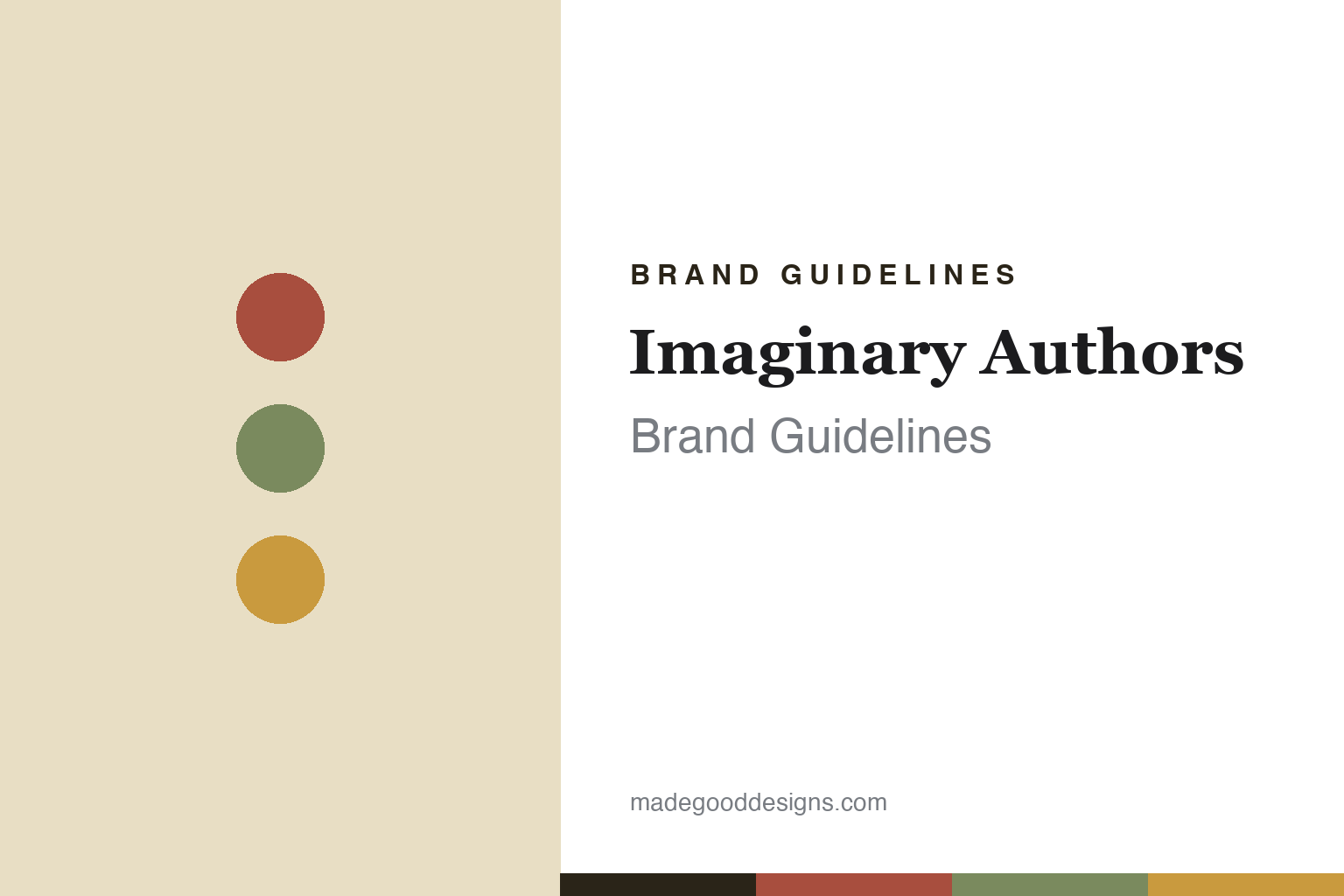
Imaginary Authors Brand Guidelines
Scent as fiction.
Aa
Two constants: a vintage, literary palette and a literary serif spirit. Abstract homage — not the Imaginary Authors covers or artwork.
The scent of a fictional book
Imaginary Authors bottles invented novels.
Imaginary Authors is a lesson in a literary conceit as a brand. Founded in 2012 in Portland, Oregon by self-taught perfumer Josh Meyer (with co-founder and creative director Ashod Simonian), it presents each fragrance as the scent of a fictional book by a fictional (“imaginary”) author — complete with invented author names, titles, publication years, plot excerpts and mock reviews. Its flagship, Memoirs of a Trespasser (2012), is credited to the recurring fake author “Philip Sava.”
The design is the concept made physical: packaging styled like vintage book covers — boxes that look like little hardbacks (with a magnetic flap), a sober rectangular bottle, and distinctive, colourful cover art per “book,” all in a mid-century, pulp-paperback aesthetic. The design is led by Ashod Simonian, an award-winning illustrator; Meyer supplies the scent and the story.
(Honest notes: Imaginary Authors is a genuinely independent, founder-owned indie — no parent company. The fictional authors, titles and publication years are invented brand lore, part of the conceit, not real bibliography. And colours vary per “book,” so there’s no single house palette or official hex.)
Colour
Imaginary Authors lives in vintage, literary tones. Click a swatch to copy the hex.
Imaginary Authors’ identity is vintage, literary and warm — a faded red, a sage, an ochre, a paper cream, and an ink. Rather than one house colour, it uses vintage, per-“book” palettes drawn from mid-century paperback cover art. It signals a literary, storytelling, indie world rather than clinical luxury. The honest caveat: with no published brand hex, these tones are an original, unofficial interpretation, not first-party values.
The lesson is vintage, literary palettes suit a storytelling conceit. Imaginary Authors’ world is a shelf of old paperbacks. For designers, it is a reminder that when each product is a “book,” the palette can vary per cover — held together by a consistent vintage-paperback language. The takeaways: let each product carry its own vintage colourway; unify with a consistent book-cover style; and treat any single hex as unofficial — using a book-brown for small text so the palette stays vintage.
Typography
The wordmark spirit is a literary serif — vintage and bookish.
Imaginary Authors’ identity carries a literary, vintage, bookish spirit — packaging styled like old novels, with invented titles and excerpts. A refined literary serif captures the mood: it is editorial and a little vintage, the register of a mid-century paperback. Set against warm, faded tones, the serif feels literary and bookish — exactly the fictional-book personality Imaginary Authors carries. It is editorial rather than clinical, mirroring a printed book cover. (Imaginary Authors’ real covers and artwork — by Ashod Simonian — are trademarks and trade dress we describe but do not reproduce, and the exact typeface is not published, so we don’t assert it.) Because the specific mark is not ours to use, the honest description is “a literary serif spirit,” not the Imaginary Authors logo. The type behaves like the brand: literary, vintage and bookish.
Aa
A literary serif spirit — vintage and bookish. (Specimen set in Spectral, a literary serif; NOT the Imaginary Authors artwork, which is a trademark.)
Fiction as identity
Imaginary Authors stands for the scent of a story.
Imaginary Authors is a lesson in a conceit carried all the way through. Each scent is a fictional book, each package a vintage novel, each “author” invented — the storytelling isn’t decoration, it’s the whole identity. The fiction is the product. The differentiator is a fully-committed literary conceit.
For designers and brand-builders, Imaginary Authors offers a clear takeaway: a strong conceit, committed to completely, becomes the brand. The lessons: pick a world (fictional books) and build every detail into it (authors, titles, excerpts, covers); let each product be its own story with its own cover art; and unify with a consistent vintage language. It is also a reminder to stay accurate: the fictional authors and dates are invented lore, the design is credited to Ashod Simonian, and the brand is an independent indie — with the palette here an unofficial interpretation. Imaginary Authors bottled fiction — proof that a committed conceit can be the difference.
Explore & save
Keep Imaginary Authors’s identity on hand — save it to a board in the Made Good inspiration library.
Imaginary Authors identity set
Pin the vintage literary palette and the literary-serif spirit to your own board.