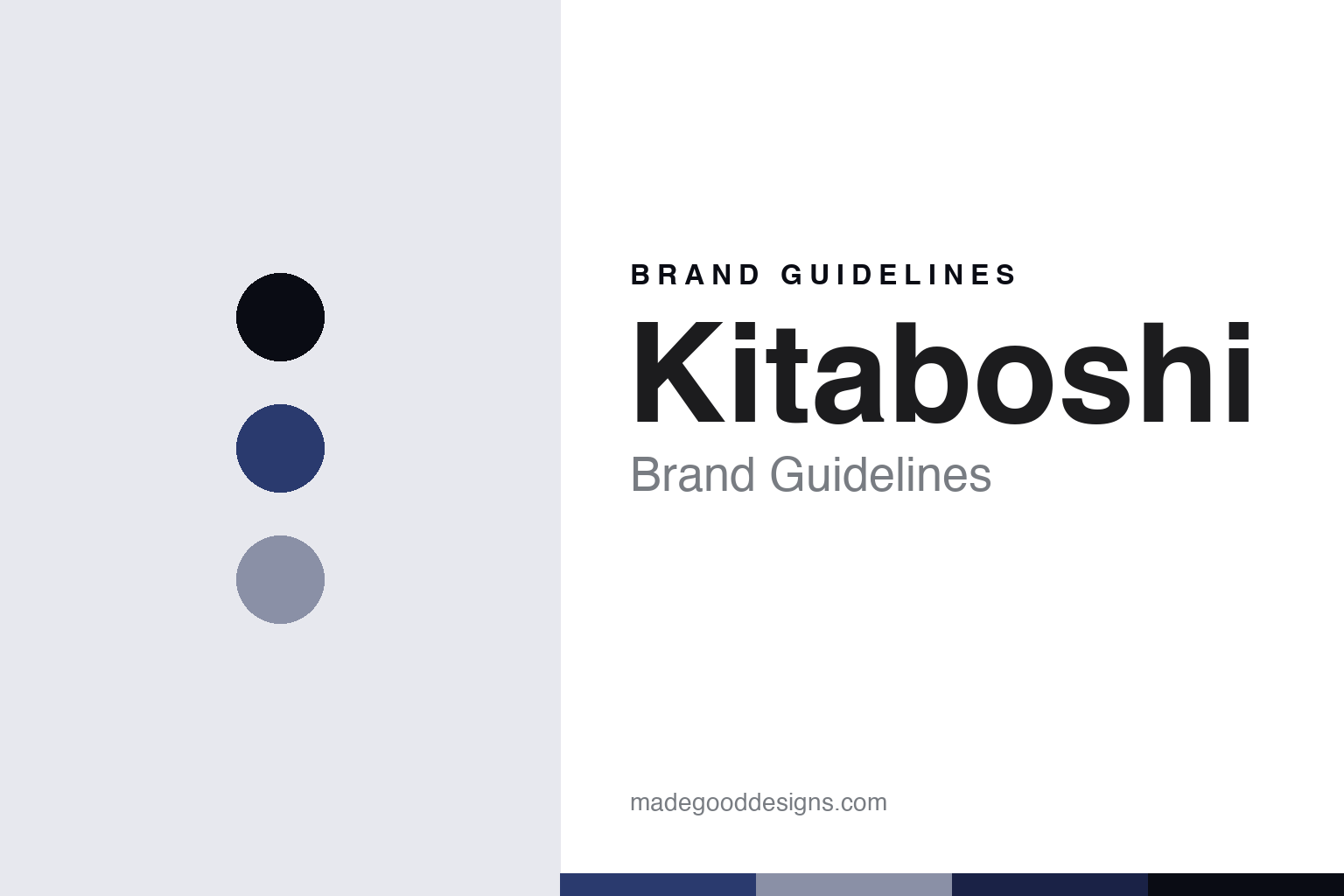
Kitaboshi Brand Guidelines
Tokyo’s wood pencil.
Aa
Two constants: an indigo palette and a craft-sans register. Abstract homage — not a Kitaboshi colour, label, barrel or star mark.
Tokyo’s wood pencil
Kitaboshi is the small heritage Tokyo wood-pencil house, family-run and sustainability-minded, that also makes traditional coloured and marking pencils.
Kitaboshi is a lesson in how a small wood-pencil house makes a virtue of the wood itself. A tiny, family-run maker in Tokyo, Kita-Boshi — the name means “North Star” — makes traditional wood-cased pencils and has built a quiet reputation on craft and sustainability, even turning its wood offcuts into a modelling dough. Its answer to how a colour is made a pencil is respectful of the material: case a good core in cedar, waste nothing, and keep the craft small. A colour core from a house that honours the wood.
Its identity is the small Tokyo wood-pencil house. Kitaboshi’s wood-cased pencils, its Otona-no-Enpitsu lead holder, and its traditional coloured and marking pencils are the work it is known for. A core, made small and mindful. A heritage maker that wastes nothing.
(Honest notes, so the story stays precise. Kita-Boshi Pencil Co. makes its pencils in Katsushika, Tokyo — genuine Japanese manufacture — and it is a small heritage firm of around thirty people, still run by the Sugitani family. On dates: the company was incorporated in 1951 (the family lumber business took over the Kita-Boshi brand in 1943); a “1919” origin is sometimes cited for the family’s pencil-wood roots but we could not verify it, so we say its roots in the pencil-wood trade are said to reach back to the early twentieth century. It is not Japan’s oldest pencil maker — Mitsubishi and Tombow are older. Its distinctive Otona-no-Enpitsu (“adult pencil”) is a 2 mm lead holder made to look and sharpen like a wooden pencil — so it mimics a wood pencil rather than being one. Honestly, its coloured-pencil range is limited: it centres on traditional vermillion, red and red-blue marking pencils and graphite drawing sets, so we frame it as a heritage wood-pencil house that also makes traditional coloured and marking pencils, not a broad artist coloured-pencil range. Its name, the star mark and product names are its IP, described but never reproduced, and there is no official brand hex — these tones are an unofficial interpretation. This is design commentary and does not promote any product.)
Colour
Kitaboshi lives in an indigo palette. Click a swatch to copy the hex.
Kitaboshi’s identity is craft, quiet and Japanese — an indigo, an ink, a slate, a navy, and a paper. The palette leans indigo and slate: the register of a traditional Japanese pencil and a small, mindful workshop. It signals craft and restraint over scale. The honest caveat: with no published brand hex, these values are an original, unofficial interpretation, not first-party colours — an abstract nod to Japanese indigo, not a sampled pencil.
The lesson is an indigo palette signals a small-craft, made-in-Tokyo identity. Kitaboshi’s world is a heritage, hand-scaled, Japanese object. For designers, it is a reminder that a deep indigo and a soft slate can carry a brand built on wood and restraint — the blue of Japanese craft and the grey of graphite. Because these tones can fail as small text, keep type dark and let the colour live in the accents, palette and band. The takeaways: honour the material; waste nothing; keep it small; and treat any single hex as unofficial.
Typography
The register is a craft sans — quiet, precise, mindful.
Kitaboshi’s identity carries a quiet, precise, mindful spirit — a small craft house, not a mass brand. A craft sans captures the mood: even, restrained and considered, the register of a maker that honours its wood. Set in an indigo palette, the craft sans feels quiet and precise — exactly the personality Kitaboshi carries. It is mindful rather than loud, mirroring a small, sustainable workshop. (Kitaboshi’s real labels, the star mark and product names are things we describe but do not reproduce, and the exact typeface is not ours to use.) Because it is not ours to use, the honest description is “a craft-sans spirit,” shown here in a stand-in. The type behaves like the house: quiet, precise and mindful.
Aa
A craft-sans spirit — quiet and precise. (Specimen set in Zen Kaku Gothic New, a craft-sans STAND-IN; NOT the Kitaboshi wordmark, star mark or any label.)
The pencil around the world
Kitaboshi stands for the small house that honours the wood.
Kitaboshi is a lesson in how a small house makes the material its message. An indigo palette, a craft sans and a wood-cased core make one thing — a pencil from a small maker that wastes nothing — the whole house: craft, quiet and Japanese. The reverence for wood is the differentiator, and the sustainability story is the meaning. The point is a tiny Tokyo firm that turns its offcuts into modelling dough and treats the pencil as an object of craft, not just a commodity.
Put to work, the identity is material respect as design. A colour house in this spirit would honour its raw material, waste as little as possible, and be honest about its scale and scope — a small heritage maker whose coloured range is genuinely limited. A brand learning from it would see that craft and a real sustainability practice are a durable identity — that a small maker who turns sawdust into a product tells a story a giant cannot — and that being precise, incorporated 1951 not “founded 1919,” not Japan’s oldest, a wood-pencil house rather than a broad artist coloured-pencil range, keeps the story honest. A brand learning from it would also describe its cleverest product accurately: an “adult pencil” that is really a lead holder mimicking a wood pencil is a charming idea best told straight. The lesson Kitaboshi teaches is that material respect can hold an identity: the reverence for wood gives it meaning, and the honest small scale gives it credibility. The craft is the personality, and the wood-cased pencil is the proof.
For designers and brand-builders, Kitaboshi closes this round of the pencil around the world, from Japan: make the material your message, and be honest about scale and scope. The lessons: honour the wood; waste nothing; describe your products accurately; own a limited range plainly; and never reproduce a protected mark. It is also a reminder to stay precise: Kitaboshi is a small heritage Tokyo wood-pencil house, family-run and sustainability-minded, that also makes traditional coloured and marking pencils — with the palette here an unofficial interpretation. Kitaboshi made the wood the identity — proof that material respect, honestly told, can be the difference.
Explore & save
Keep Kitaboshi’s identity on hand — save it to a board in the Made Good inspiration library.
Kitaboshi identity set
Pin the indigo palette and the craft-sans register to your own board.