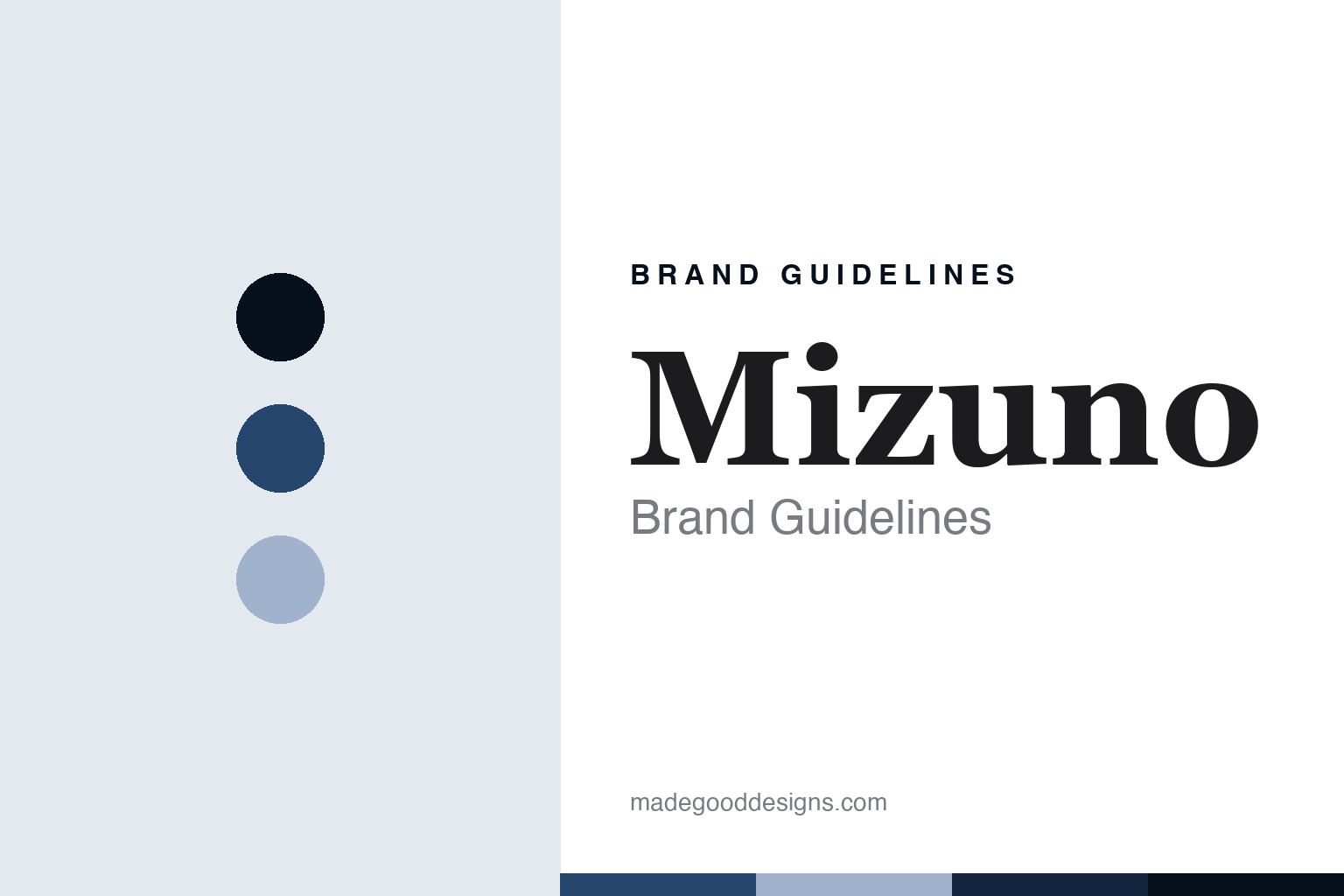
Mizuno Brand Guidelines
The forged iron from Japan.
Aa
Two constants: a steel-blue palette and a forged-serif register. Abstract homage — not a Mizuno product or mark.
The forged iron from Japan
Mizuno is the Osaka sporting house of 1906 — forged irons Grain Flow Forged from a single billet in Japan.
Mizuno opens the round as the forged-iron house — the century-old Osaka sporting-goods company whose Grain Flow Forged irons, forged from a single billet in Japan, are revered by the best players in the game. Mizuno makes forged golf irons, and its answer to a round about club makers is craft you can feel: a Japanese forging so good it has its own saying, “nothing feels like a Mizuno.” An iron, forged in Japan.
Its identity is the forged iron from Japan. Mizuno’s Grain Flow Forging, its Osaka heritage and its Japanese ownership are the story here. An iron, from Hiroshima steel. The forged iron from Japan.
(Honest notes, so the story stays precise. Mizuno — its golf division at mizunogolf.com — makes forged golf irons as its flagship, with the Mizuno Pro and JPX forged families, alongside drivers, wedges and balls; its parent, Mizuno Corporation, is a broad Japanese sporting-goods house, but this is about the forged-iron identity. Mizuno Corporation was founded in 1906 in Osaka, Japan by Rihachi Mizuno and his brother Rizo, making golf clubs from the 1930s. On where it is made — the theme of this round — Mizuno’s premium irons are Grain Flow Forged from a single billet of steel in Japan, at its Hiroshima forging, a celebrated made-in-Japan story; honestly, some assembly happens in North America and cast or non-forged lines are not Japan-forged, so we say the premium irons are forged in Japan. On ownership, the golf business is a division of Mizuno Corporation, publicly listed in Tokyo, still associated with the founding Mizuno family. Its marks — Mizuno, Grain Flow Forged — are IP we describe but do not reproduce, and there is no official brand hex; these tones are an unofficial interpretation. This is design commentary and does not promote any product.)
Colour
Mizuno lives in a steel blue. Click a swatch to copy the hex.
Mizuno’s identity is forged, made and revered — a steel blue, an ink, a mist, a deep blue, and a paper. The palette leans steel blue and mist: a cool, metallurgical register that nods to forged carbon steel and Japanese precision. It signals a forging house that makes at home. The honest caveat: with no published brand hex, these values are an original, unofficial interpretation, not first-party colours.
The lesson is a steel blue signals a forged, made-in-Japan identity. Mizuno’s world is a forged, made object. For designers, it is a reminder that a cool steel blue and a soft mist can carry a club maker — the tone of billet steel. Because these tones can fail as small text, keep type dark and let the colour live in the accents, palette and band. The takeaways: forge at home; make feel the differentiator; keep the where-made honest; and treat any single hex as unofficial.
Typography
The register is a forged serif — precise, classic, made.
Mizuno’s identity carries a precise, classic, made spirit — a century-old forger, not a fashion. A forged serif captures the mood: exact, established and refined, the register of an iron forged from a single billet by Japanese hands. Set in a steel-blue palette, the forged serif feels precise and classic — exactly the personality Mizuno carries. It is metallurgy rather than a logo, mirroring forged steel and grain. (Mizuno’s real wordmark, and Grain Flow Forged, are things we describe but do not reproduce, and the exact typeface is not ours to use.) Because it is not ours to use, the honest description is “a forged-serif spirit,” shown here in a stand-in. The type behaves like the iron: precise, classic and made.
Aa
A forged-serif spirit — precise and classic. (Specimen set in Playfair Display, a forged-serif STAND-IN; NOT the Mizuno logo.)
The club makers
Mizuno stands for the forged iron from Japan.
Mizuno opens the round as the forged-iron house. A steel-blue palette, a forged serif and a forged iron make one thing — the forged iron from Japan — the whole identity: forged, made and revered. The Grain Flow Forging is the differentiator, and the Japanese making is the meaning. The point is a century-old Osaka house whose forged irons, made from a single billet in Japan, feel like nothing else.
Put to work, the identity is a forging craft told straight, as design. A maker in this spirit would forge the premium at home and let feel be the argument, while being honest that some assembly is elsewhere. A reader in this spirit would keep the facts right: it was founded in 1906 in Osaka by Rihachi Mizuno; its premium irons are Grain Flow Forged in Japan; and it is a division of the publicly listed Mizuno Corporation. Mizuno opens the round’s where-made thread at the made-at-home-craft end with Miura and Honma, the three Japanese makers, and it anchors the forged-iron icon with Miura. The honest editorial moves are to credit Rihachi Mizuno, to state the Grain Flow Forging in Japan, to note the North American assembly honestly, and to keep the family to public facts. The lesson Mizuno teaches is that a manufacturing process — a forging — can be the whole identity: the feel of a Japan-forged iron is the brand.
For designers and brand-builders, Mizuno opens the club makers: forge at home — and let the feel be the argument. The lessons: make the process the identity; keep the premium made at home; be honest about assembly; keep individuals to public facts; and never reproduce a logo. It is also a reminder to stay precise: Mizuno is the Osaka sporting house of 1906, forged irons Grain Flow Forged from a single billet in Japan — with the palette here an unofficial interpretation. Read that way, Mizuno is less an iron than a forging: a Japanese process, a century old, that players can feel. The lesson for a brand is that a genuine manufacturing craft, kept at home, is a durable identity — feel cannot be offshored — and honesty about where each line is made keeps the forging claim clean. Mizuno made the-forged-iron-from-Japan the identity — proof that a process can be a brand.
Explore & save
Keep Mizuno’s identity on hand — save it to a board in the Made Good inspiration library.
Mizuno identity set
Pin the steel-blue palette and the forged-serif register to your own board.