Mountain Dew Brand Guidelines
A drink named after moonshine, sold by a hillbilly — then reinvented as the fuel of extreme sports.
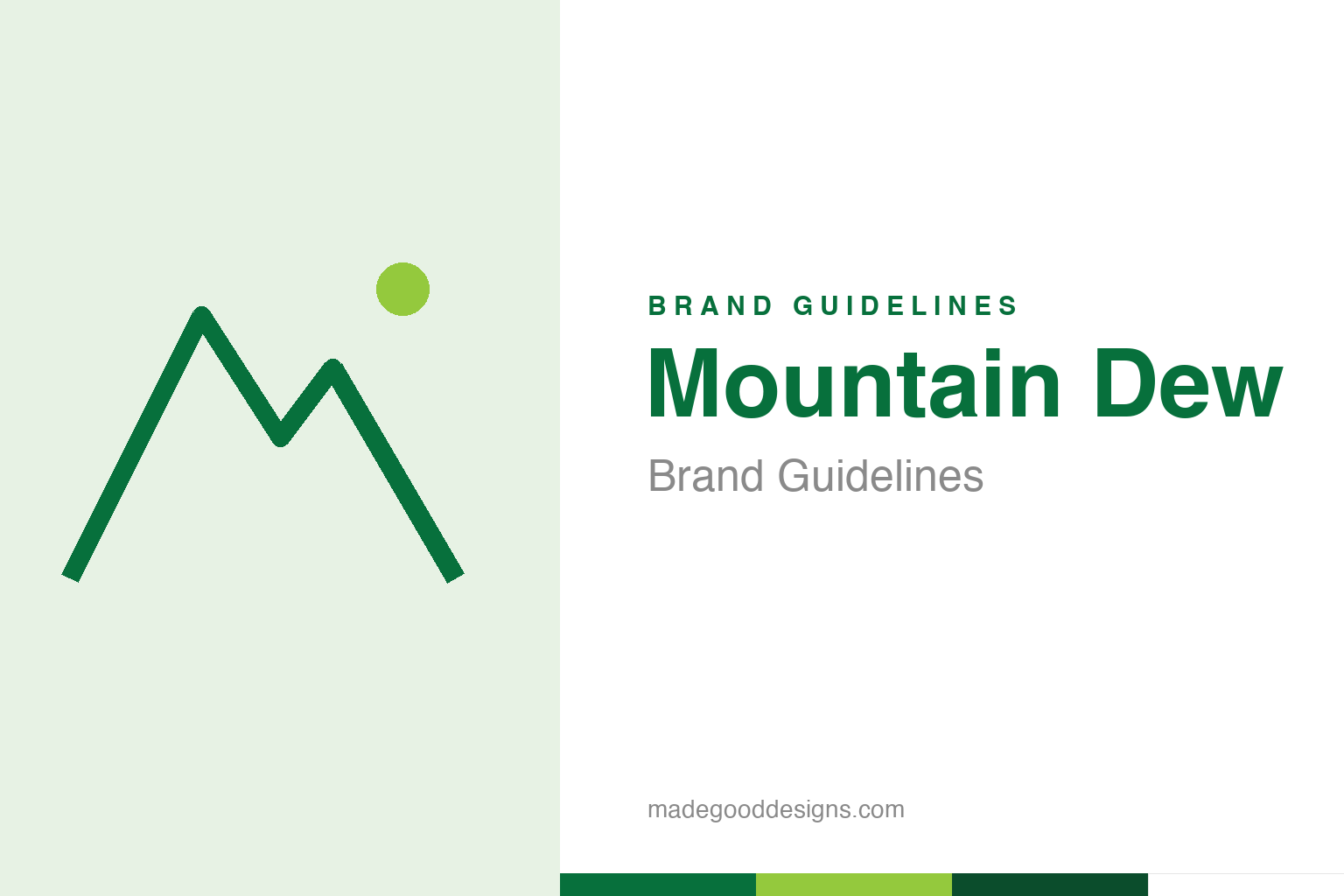
An abstract mountain and dewdrop — the name, not the wordmark. Deliberately not the Mtn Dew mark.
A name straight out of the still
Mountain Dew was literally slang for moonshine.
Mountain Dew has one of the most colourful origin stories in soft drinks. “Mountain Dew” was Appalachian slang for moonshine — homemade, illicit whiskey — and the drink was created in the 1940s in Tennessee by brothers Barney and Ally Hartman, originally as a whiskey mixer (it was trademarked in 1948). Its early branding leaned all the way into that hillbilly, backwoods-moonshine theme: a cartoon mascot named “Willy the Hillbilly” and the yell-it-out slogan “Ya-Hoo! Mountain Dew” (the fuller early tagline, under Pepsi, was “It’ll tickle yore innards”). It’s a wonderfully specific, rural-American beginning — a citrus soda built entirely around the folklore of mountain moonshine. Our homage nods to that with a mountain and a dewdrop.
A total reinvention
Mountain Dew reinvented itself for a new era.
The brand’s genius was a complete reinvention. After PepsiCo acquired it in 1964, and especially from the 1990s onward, Mountain Dew shed the old hillbilly imagery entirely and rebranded around extreme sports, youth energy and adrenaline — skateboarding, BMX, snowboarding — with the now-iconic slogan “Do the Dew” (coined 1993). The high-caffeine, high-sugar, electric-green soda became the drink of choice for teenagers, gamers and thrill-seekers. It’s one of the most successful brand pivots there is: same product, same name, radically different meaning — from rural moonshine folklore to edgy, adrenaline-fuelled youth culture. That reinvention let the brand escape a dated, niche image and become a huge mainstream force with a young, energetic identity.
Electric green and full-throttle energy
Mountain Dew’s look matches its extreme positioning.
Everything about Mountain Dew’s modern identity screams energy and intensity. The vivid, almost radioactive green is unmistakable — loud, electric and impossible to ignore, exactly matching the drink’s caffeinated, high-octane personality. The dynamic, jagged, energetic logo styling (all sharp angles and motion) and the extreme-sports marketing all reinforce a single idea: this is a drink for people who want maximum stimulation and excitement. The brand leans hard into being bold, edgy, a little rebellious and unapologetically over-the-top — the antithesis of a calm, wholesome beverage. That intense, high-energy positioning has given Mountain Dew a fiercely loyal following, especially among young men, gamers and action-sports fans, and a cultural presence far bigger than a regional citrus soda has any right to have.
The power of reinvention
Mountain Dew shows a brand can completely remake itself.
Mountain Dew’s story is a powerful lesson in brand reinvention. Few brands have transformed their identity as completely and successfully: from a niche, hillbilly-themed whiskey mixer to a mainstream icon of extreme-sports youth culture, all without changing the actual product or name. It proves that a brand’s meaning is not fixed — that with bold, committed rebranding, a company can shed an outdated image and connect with an entirely new generation and culture.
The keys were boldness and total commitment. Mountain Dew didn’t half-heartedly modernise; it fully embraced a new, edgy, high-energy identity and poured itself into extreme-sports culture, going all-in on “Do the Dew.” That wholehearted commitment is what made the reinvention believable and powerful rather than awkward. The brand also shows the value of a distinctive, ownable asset — that electric green is so specific it does much of the identifying work by itself. From moonshine folklore to adrenaline and gaming, Mountain Dew has stayed relevant for over eighty years by being willing to completely remake what it stands for — a reminder that heritage is worth honouring, but it should never become a cage. Sometimes the boldest, most successful brand move is to reinvent yourself entirely, and mean it.
It’s worth restating the throughline, because it reaches far beyond Mountain Dew: the marks that endure are the ones built on a single clear idea, drawn with restraint, and repeated faithfully long enough to mean something. Fashions fade and technologies change, but a distinctive, well-chosen symbol backed by real substance only grows more valuable with time. The lesson for anyone building an identity is not to be the loudest or the newest, but to be the most consistent and the most authentic — and then to hold that line for as long as it takes.
Type & the wordmark
Jagged, energetic, high-motion lettering.
Mountain Dew’s wordmark is dynamic and jagged — all sharp angles and energy. The specimen below stands in with a bold italic sans.
Do the Dew
Sharp, jagged, electric — type with adrenaline in it. (Specimen set in Archivo italic, a neutral stand-in.)
Electric green
Loud, energetic green. Click a swatch to copy the hex.
Mountain Dew’s identity is anchored by a vivid green #07703C with a bright lime accent #94C93D, plus red and white. Lead with the greens below.
Explore & save
Keep the reinvention idea on hand — save the mountain homage and the green to a board.
Mountain Dew identity set
Pin the mountain-and-dew homage, the electric green and the reinvention lesson to your own board.