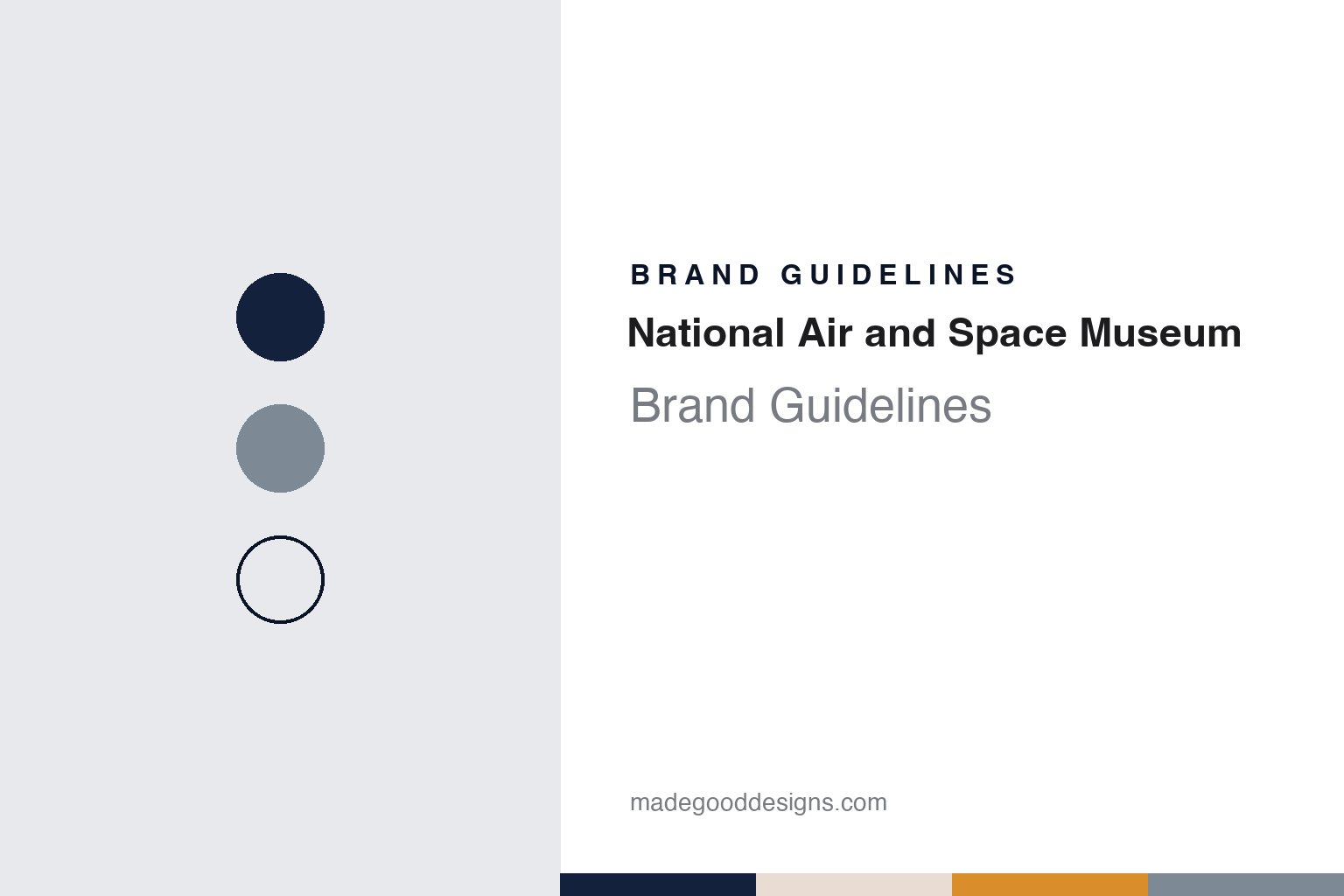
National Air and Space Museum Brand Guidelines
The Smithsonian museum of flight and spaceflight, in marble, steel and glass on the National Mall.
Aa
Two constants: a marble, steel and night-navy palette and a civic sans register. Abstract homage — not a National Air and Space Museum or Smithsonian mark; no object, logo or sign is reproduced.
The National Air Museum
An act of Congress, a metal shed and a wait of thirty years.
The National Air and Space Museum is part of the Smithsonian Institution in Washington, D.C. English Wikipedia says it was formed on 12 August 1946 by an act of Congress under the name National Air Museum, and that some objects in its care are older than the museum itself: a group of kites came to the Smithsonian after the 1876 Centennial Exposition in Philadelphia, and later formed part of the air collection.
For three decades the collection had no single home. Wikipedia describes objects shown in the Arts and Industries Building, aircraft kept in a large temporary metal shed in the south yard of the Smithsonian Castle, and large rockets displayed outdoors, while much of the collection stayed in storage. In 1952 the Smithsonian gained a wooded site in Suitland, Maryland, for storing and restoring aircraft; it is now the Paul E. Garber Preservation, Restoration, and Storage Facility. The museum was later renamed the National Air and Space Museum, a change Wikipedia ties to the space race of the 1950s and 1960s, and Congress then funded a new exhibition hall on the National Mall.
That building opened on 1 July 1976, during the celebrations of the United States Bicentennial. A second site followed more than a quarter of a century later: the Steven F. Udvar-Hazy Center, which opened on 15 December 2003 at Dulles International Airport in Chantilly, Virginia. English Wikipedia describes it as a 760,000-square-foot annex for the aircraft, spacecraft and rockets too large for the Mall, connected to the airport’s runways by a private taxiway so that some aircraft can arrive under their own power instead of being taken apart. Restoration and conservation work moved there in 2010, into a hangar with observation windows through which visitors can watch the work in progress.
Colour
Four marble blocks, three glass halls.
The Mall building was designed by the St. Louis architect Gyo Obata of HOK. English Wikipedia says the Smithsonian wanted a building that would be architecturally strong without standing out too boldly against the nearby United States Capitol. The answer was four simple marble-clad blocks for the smaller and more theatrical exhibits, joined by three steel-and-glass halls for the large aircraft, rockets and spacecraft. The mass of the building is similar to that of the National Gallery of Art across the Mall, and it is faced in the same pink Tennessee marble. The west glass wall works as a giant door, so that aircraft can be brought in for installation. Gilbane Building Company built it, and it was completed in 1976.
The collection is easiest to describe in general terms: aircraft, spacecraft, rockets, engines, instruments and a large number of smaller objects. Wikipedia says that almost all of the craft on display are original flown or backup vehicles rather than copies. Among the objects it names are the Wright brothers’ Wright Flyer near the entrance, the Spirit of St. Louis and the Apollo 11 command module Columbia on the Mall, while the Udvar-Hazy Center houses the Space Shuttle Discovery among the objects too large for the city building.
The museum is also a research centre. Wikipedia lists the history and science of aviation and spaceflight, planetary science, and terrestrial geology and geophysics as its fields. It offers research fellowships, including a senior chair in aerospace history first held in 1978, and it runs the Phoebe Waterman Haas Public Observatory, which opened in 2009 during the International Year of Astronomy. Its public programmes include talks with guests from aviation and space history and STEM in 30, a television programme for middle-school students that began in 2014 and uses objects in the museum to teach science, technology, engineering, mathematics, art and history.
Typography
How aviation and space museums present themselves.
Aviation and space museums usually present themselves through the body behind the name. Some are national institutions, such as a museum that belongs to the Smithsonian Institution in Washington, D.C.; others are private non-profit museums, trusts, foundations or associations that grew out of a group of enthusiasts; and some visitor centres are run by a company on behalf of a space agency. The name on the door often says which: “national”, “royal”, a city or a founding society.
Their buildings tend to carry much of the identity. Many sit on or beside airfields, and several occupy structures that had another life first: a hangar, an early aircraft factory, an airport terminal or an exposition hall, and in some cases a ship that became a museum. Others are purpose-built galleries with clear spans and glass roofs large enough to hang aircraft in mid-air, or open-sided shelters that keep the weather off airliners parked in rows.
The collections are described in general terms: aircraft, spacecraft, rockets, engines, instruments, models and archives of photographs and drawings, usually with a handful of objects that the museum and the press return to again and again. Restoration workshops, libraries and observatories sit alongside the galleries, and most of these museums run school and family programmes, learning centres and summer camps.
The graphic language is often borrowed from aviation itself: stencilled lettering, registration marks and roundels, runway and taxiway markings, instrument dials and the plain sans-serif type of signage on airfields and launch sites. In this guide we look at how each museum uses its building, its objects and its name, described plainly and in our own unofficial colours and stand-in typefaces.
Aa
A civic sans for a national museum. (Specimen set in Archivo, a sans STAND-IN; NOT the National Air and Space Museum logo.)
A building renewed in stages
Terrazzo, media bands and a pulsar map.
By the 2010s the Mall building needed more than routine repair. English Wikipedia reports that in 2015 the Smithsonian hired Quinn Evans Architects to design the renovation, a scheme that included a new façade, again in Tennessee marble, new glass curtain walls and better access, and that in October 2018 the museum announced a seven-year renovation and began closing galleries in stages. The western side of the building, with eight new galleries, the planetarium, the museum store and a café, reopened on 14 October 2022.
A second stage followed on 28 July 2025. That day, collectSPACE reported, five more renovated galleries opened, among them the Boeing Milestones of Flight Hall, now reached through a redesigned north entrance from the Mall, and a new gallery called Futures in Space, alongside a renovated large-format theatre. The report gives the clearest picture of how the building now looks. Most of the objects in the main hall are those shown before it closed in 2022, but the setting is new: the old maroon and dark grey carpet gave way to a light terrazzo floor, a 123-foot media band runs along the front of the mezzanine with a digest of the galleries beyond, medallions set into the corridor floors carry quotations, and lines of dashes converging on the centre of the hall form a revised version of the pulsar map carried by the Pioneer and Voyager probes, recalculated for 2026, the year of the building’s fiftieth anniversary.
The visual character this guide draws on comes from that architecture: pale pink marble outside, steel and glass inside, aircraft hung against daylight, and the dark of space in the galleries devoted to it. English Wikipedia gives a figure of 3.1 million visitors to the museum in 2023, and more than 1.2 million a year at the Udvar-Hazy Center.
For a design guide, the National Air and Space Museum shows how a national institution can let a building and a handful of objects carry its identity. Compare the Smithsonian, the institution it belongs to, and The Museum of Flight in Seattle, a private museum built around a historic factory. For this guide we use a night navy, a steel grey, a marble pink and an amber with a sans, an unofficial interpretation; no product or logo is reproduced.
Explore & save
Keep National Air and Space Museum’s identity on hand — save it to a board in the Made Good inspiration library.
National Air and Space Museum identity set
Pin the marble, steel and night-navy palette and the civic sans register to your own board.
Source & notes
Frequently Asked Questions
What font can I use to match the National Air and Space Museum look?
This guide describes National Air and Space Museum’s type as “A civic sans for a national museum”. Its type specimen is set in Archivo from Google Fonts as a stand-in; Archivo is not National Air and Space Museum’s own lettering.
What colours are in the National Air and Space Museum palette?
This guide’s National Air and Space Museum palette is Night navy #14213D, Atrium steel #7D8A96, Mall marble #E9DCD3, Signal amber #D98E2B and Paper #F7F5F2. The tones are the guide’s own unofficial interpretation, not official National Air and Space Museum hex codes.
When was National Air and Space Museum founded?
National Air and Space Museum was founded in 1946 (as the National Air Museum), in Washington, D.C.