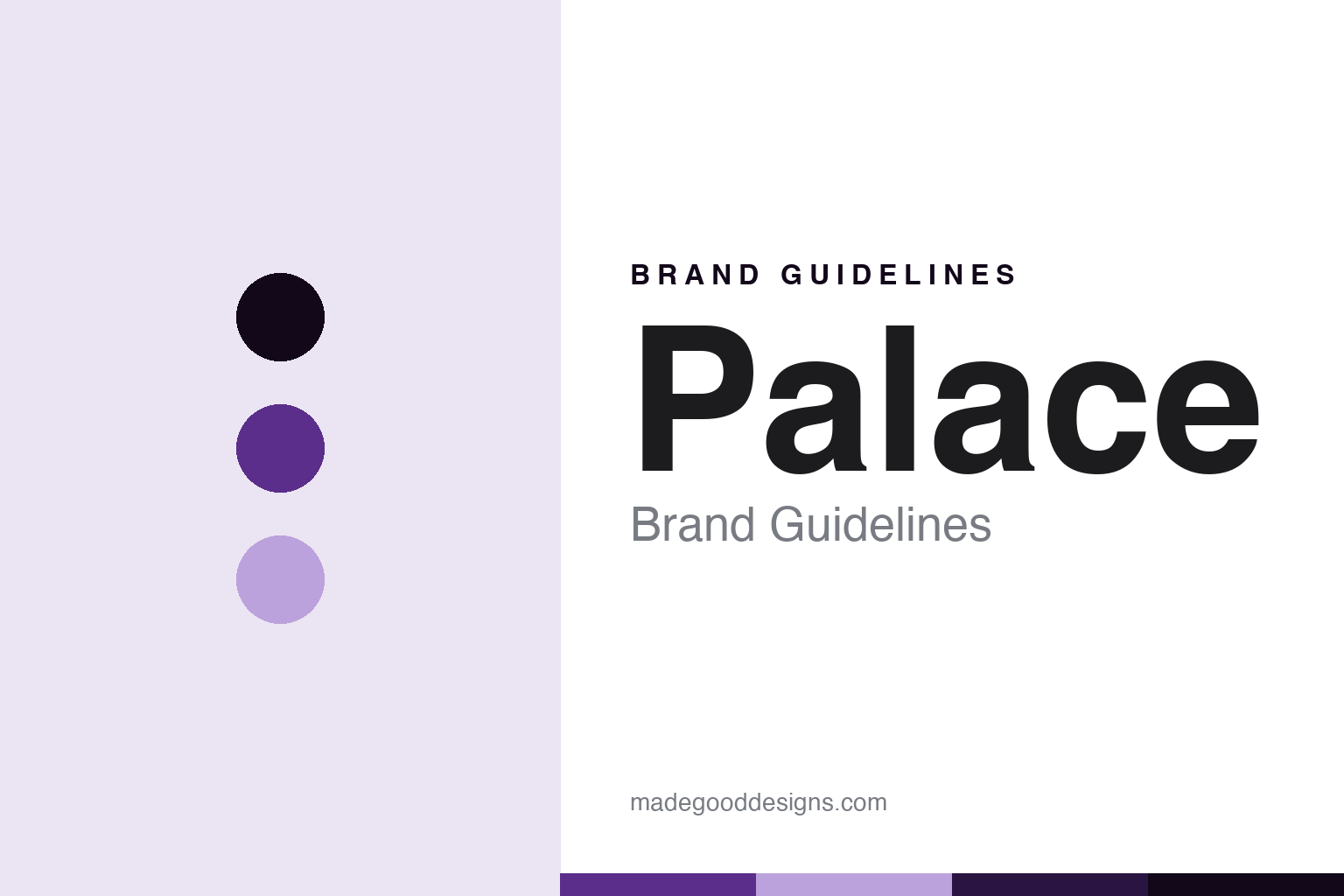
Palace Brand Guidelines
The London deck turned streetwear.
Aa
Two constants: a rave-violet palette and a drop-sans register. Abstract homage — not a Palace product or mark.
The London deck turned streetwear
Palace is the London skate house of 2009 — decks and drop-model streetwear from an independent, founder-led brand.
Palace brings the round to London — the skate house that grew from a UK skate crew into one of the biggest independent streetwear brands in the world, on the strength of decks, humour and the weekly drop. Palace makes skateboard decks, and, now, as much streetwear, and its answer to a round about deck builders is a brand that stayed independent while going global. A deck, and a phenomenon.
Its identity is the London deck turned streetwear. Palace’s Tri-Ferg, its drop model and its independence are the story here. A deck, from London. The London deck turned streetwear.
(Honest notes, so the story stays precise. Palace — at palaceskateboards.com — makes skateboard decks and a hugely successful streetwear line, marked by the “Tri-Ferg,” a triangle logo designed by Fergus Purcell. It was founded in 2009 in London by Lev Tanju, with Gareth Skewis and Marshall Taylor, out of the Palace Wayward Boys Choir skate crew, a crew origin that is widely reported. On where it is made — a theme of this round — Palace does not publish manufacturing locations; consistent with the industry, its maple decks are pressed at specialist mills and its apparel is made across various countries, so we do not name a country. On ownership, it is widely reported to remain independent and founder-led, trading as a private company with no acquisition on record, which we frame as reported. Its collaborations include long partnerships with adidas and Ralph Lauren. Its marks — and the Tri-Ferg, especially its Penrose-triangle form — are IP we describe but do not reproduce, and there is no official brand hex; these tones are an unofficial interpretation. This is design commentary and does not promote any product.)
Colour
Palace lives in a rave violet. Click a swatch to copy the hex.
Palace’s identity is independent, witty and global — a rave violet, an ink, a lilac, a deep violet, and a paper. The palette leans rave violet and lilac: a register that nods to the brand’s ’90s rave-and-VHS aesthetic rather than a stock skate palette. It signals an independent house with a streetwear reach. The honest caveat: with no published brand hex, these values are an original, unofficial interpretation, not first-party colours.
The lesson is a rave violet signals an independent, streetwear identity. Palace’s world is an independent, witty object with a global reach. For designers, it is a reminder that a rave violet and a soft lilac can carry a skate-and-streetwear house — the tone of a ’90s rave flyer. Because these tones can fail as small text, keep type dark and let the colour live in the accents, palette and band. The takeaways: stay independent; keep the wit; be honest about undisclosed making; and treat any single hex as unofficial.
Typography
The register is a drop sans — modern, witty, global.
Palace’s identity carries a modern, witty, global spirit — a streetwear phenomenon, not just a deck. A drop sans captures the mood: clean, contemporary and a little irreverent, the register of a brand built on the weekly drop and a sense of humour. Set in a rave-violet palette, the drop sans feels modern and witty — exactly the personality Palace carries. It is culture rather than a logo, mirroring maple ply and cotton. (Palace’s real wordmark, and the Tri-Ferg, are things we describe but do not reproduce, and the exact typeface is not ours to use.) Because it is not ours to use, the honest description is “a drop-sans spirit,” shown here in a stand-in. The type behaves like the brand: modern, witty and global.
Aa
A drop-sans spirit — modern and witty. (Specimen set in Manrope, a drop-sans STAND-IN; NOT the Palace logo.)
The deck builders
Palace stands for the London deck turned streetwear.
Palace brings the round to London. A rave-violet palette, a drop sans and a maple deck make one thing — the London deck turned streetwear — the whole identity: independent, witty and global. The Tri-Ferg is the differentiator, and the independence is the meaning. The point is a UK skate crew that became a global streetwear brand while staying, as widely reported, its own.
Put to work, the identity is an independent phenomenon told straight, as design. A maker in this spirit would grow globally on wit and the drop while keeping ownership, and would be honest that manufacturing is undisclosed. A reader in this spirit would keep the facts right: it was founded in 2009 in London by Lev Tanju, with Gareth Skewis and Marshall Taylor, from the Palace Wayward Boys Choir; the Tri-Ferg is Fergus Purcell’s design; it is reported independent; and where its decks and apparel are made is not disclosed. Palace sits in the round’s where-made thread at the undisclosed end with Polar, and in the ownership thread at the independent end with Powell and Polar — a modern-international counterpoint to the American core and corporate brands. The honest editorial moves are to credit the co-founders and Fergus Purcell, to frame the making as undisclosed, and to keep the independence as reported. The lesson Palace teaches is that a brand can go global and stay independent — and that humour and the drop can be as much a strategy as a graphic.
For designers and brand-builders, Palace continues the deck builders: stay independent — and be honest about what you do not disclose. The lessons: grow without selling out; build culture, not just product; credit the logo’s designer; do not name a country you cannot; and never reproduce a logo. It is also a reminder to stay precise: Palace is the London skate house of 2009, decks and drop-model streetwear from an independent, founder-led brand — with the palette here an unofficial interpretation. Read that way, Palace is less a deck than a phenomenon: a UK crew that turned wit and skating into a global brand and kept it their own. The lesson for a brand is that independence, held while scaling, is itself a story — and honesty about undisclosed making is more credible than a country claimed for effect. Palace made the-London-deck-turned-streetwear the identity — proof that a crew can go global without being bought.
Explore & save
Keep Palace’s identity on hand — save it to a board in the Made Good inspiration library.
Palace identity set
Pin the rave-violet palette and the drop-sans register to your own board.