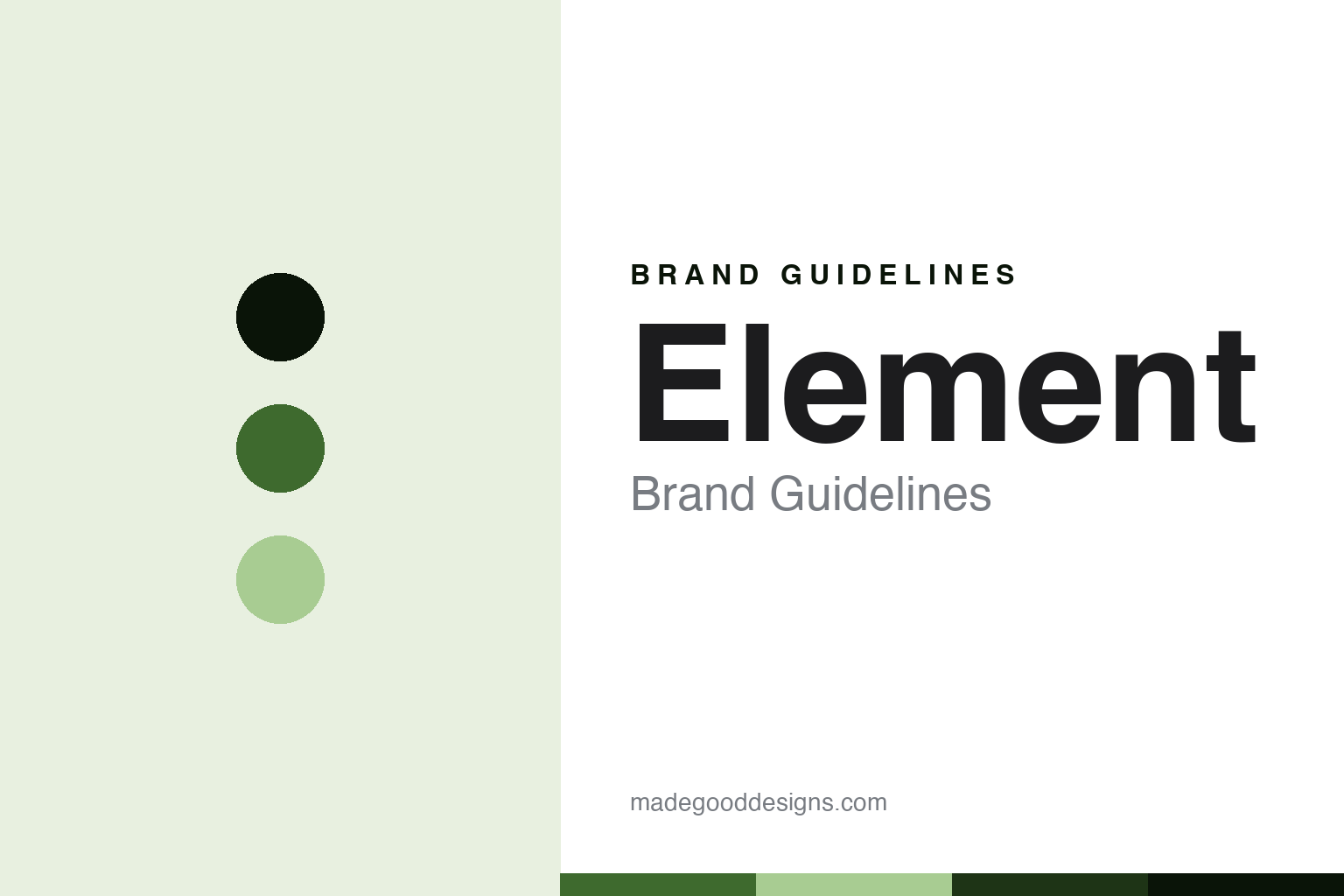
Element Brand Guidelines
The skate brand that went global.
Aa
Two constants: an Element-green palette and a lifestyle-sans register. Abstract homage — not an Element product or mark.
The skate brand that went global
Element is the American skate-and-lifestyle brand of 1992 — offshore-made and owned by Authentic Brands Group.
Element brings the round its consolidation story — the 1990s core skate brand that grew into a global lifestyle-and-apparel business and now belongs to a brand-management conglomerate. Element makes skateboard decks, but as much apparel and footwear, and its answer to a round about deck builders is the cautionary counterpoint: the arc from core brand to corporate asset. A deck, and a lifestyle line.
Its identity is the skate brand that went global. Element’s tree logo, its lifestyle scale and its corporate ownership are the story here. A deck, made offshore. The skate brand that went global.
(Honest notes, so the story stays precise. Element — at element.com — makes skateboard decks, completes and hardware, alongside a large apparel and footwear business, under its tree-in-circle logo. It was founded in 1992 by Johnny Schillereff in the United States, based for years in Irvine, California; the “Underworld Element” origin and the four-elements ethos are widely reported. On where it is made — a theme of this round — Element is a large lifestyle brand whose production is largely offshore, in Asia, and it does not publish a clean made-in statement; so we frame it as offshore and undisclosed in specifics, the deliberate contrast to the US-pressed core brands. On ownership — the heart of this entry — the chain is documented: Element was acquired into Billabong, which became part of Boardriders, which Authentic Brands Group acquired in 2023; the operating licensee, Liberated Brands, filed for Chapter 11 in early 2025 and wound down stores, so we frame the brand as alive under Authentic Brands Group with its operating structure in flux. Its team history includes Bam Margera and Nyjah Huston. Its marks are IP we describe but do not reproduce, and there is no official brand hex; these tones are an unofficial interpretation. This is design commentary and does not promote any product.)
Colour
Element lives in an Element green. Click a swatch to copy the hex.
Element’s identity is global, lifestyle and consolidated — a green, an ink, a leaf, a deep green, and a paper. The palette leans green and leaf: a nature register that nods to the brand’s earth-and-elements ethos and its tree logo. It signals a skate brand grown into a lifestyle label. The honest caveat: with no published brand hex, these values are an original, unofficial interpretation, not first-party colours.
The lesson is a green palette signals a global, lifestyle identity. Element’s world is a global, lifestyle object with a corporate owner. For designers, it is a reminder that a natural green and a soft leaf can carry a skate-lifestyle brand — the tone of an earth-and-elements label. Because these tones can fail as small text, keep type dark and let the colour live in the accents, palette and band. The takeaways: a core brand can scale; scale can mean offshore and corporate; say so honestly; and treat any single hex as unofficial.
Typography
The register is a lifestyle sans — broad, modern, global.
Element’s identity carries a broad, modern, global spirit — a lifestyle brand, not just a deck. A lifestyle sans captures the mood: clean, commercial and wide-reaching, the register of a skate name that became apparel, footwear and retail. Set in a green palette, the lifestyle sans feels broad and modern — exactly the personality Element carries. It is lifestyle rather than a logo, mirroring maple ply and cotton. (Element’s real wordmark, and the tree, are things we describe but do not reproduce, and the exact typeface is not ours to use.) Because it is not ours to use, the honest description is “a lifestyle-sans spirit,” shown here in a stand-in. The type behaves like the brand: broad, modern and global.
Aa
A lifestyle-sans spirit — broad and modern. (Specimen set in Space Grotesk, a lifestyle-sans STAND-IN; NOT the Element logo.)
The deck builders
Element stands for the skate brand that went global.
Element brings the round its consolidation story. A green palette, a lifestyle sans and a maple deck make one thing — the skate brand that went global — the whole identity: global, lifestyle and consolidated. The offshore production is the differentiator, and the corporate ownership is the meaning. The point is a 1990s core brand that became a lifestyle label and then a line item in a brand-management portfolio.
Put to work, the identity is a consolidation arc told straight, as design. A maker in this spirit would scale a core brand into apparel and footwear, and a reader would recognise that scale often means offshore production and corporate ownership. A reader in this spirit would keep the facts right: it was founded in 1992 by Johnny Schillereff; it is made largely offshore; and its ownership runs Element to Billabong to Boardriders to Authentic Brands Group, with the operator Liberated Brands entering Chapter 11 in 2025. Element sits at the offshore-and-corporate end of the round’s where-made and ownership threads — the deliberate foil to Powell’s in-house US press and the rider-owned core brands — and it echoes the consolidation stories of other veins, where familiar names sit inside brand-management groups. The honest editorial moves are to credit Schillereff, to frame the making as offshore, to state the ownership chain plainly, and to note the operating turbulence. The lesson Element teaches is that a core identity can survive scaling and consolidation, but the honest brand says where it is now made and who now owns it.
For designers and brand-builders, Element continues the deck builders: a core brand can go global — say who owns it now. The lessons: understand that scale changes making and ownership; do not claim a core-brand origin as a current production truth; state the corporate chain; keep living individuals to public facts; and never reproduce a logo. It is also a reminder to stay precise: Element is the American skate-and-lifestyle brand of 1992, offshore-made and owned by Authentic Brands Group — with the palette here an unofficial interpretation. Read that way, Element is less a deck than a trajectory: core skate brand, global lifestyle label, corporate asset — all true, in sequence. The lesson for a brand is that consolidation is a fact worth stating, not hiding, and a reader trusts the brand that names its owner over the one that trades on a core past it no longer lives. Element made the-skate-brand-that-went-global the identity — proof that the honest version of a consolidation story is still a story worth telling.
Explore & save
Keep Element’s identity on hand — save it to a board in the Made Good inspiration library.
Element identity set
Pin the Element-green palette and the lifestyle-sans register to your own board.