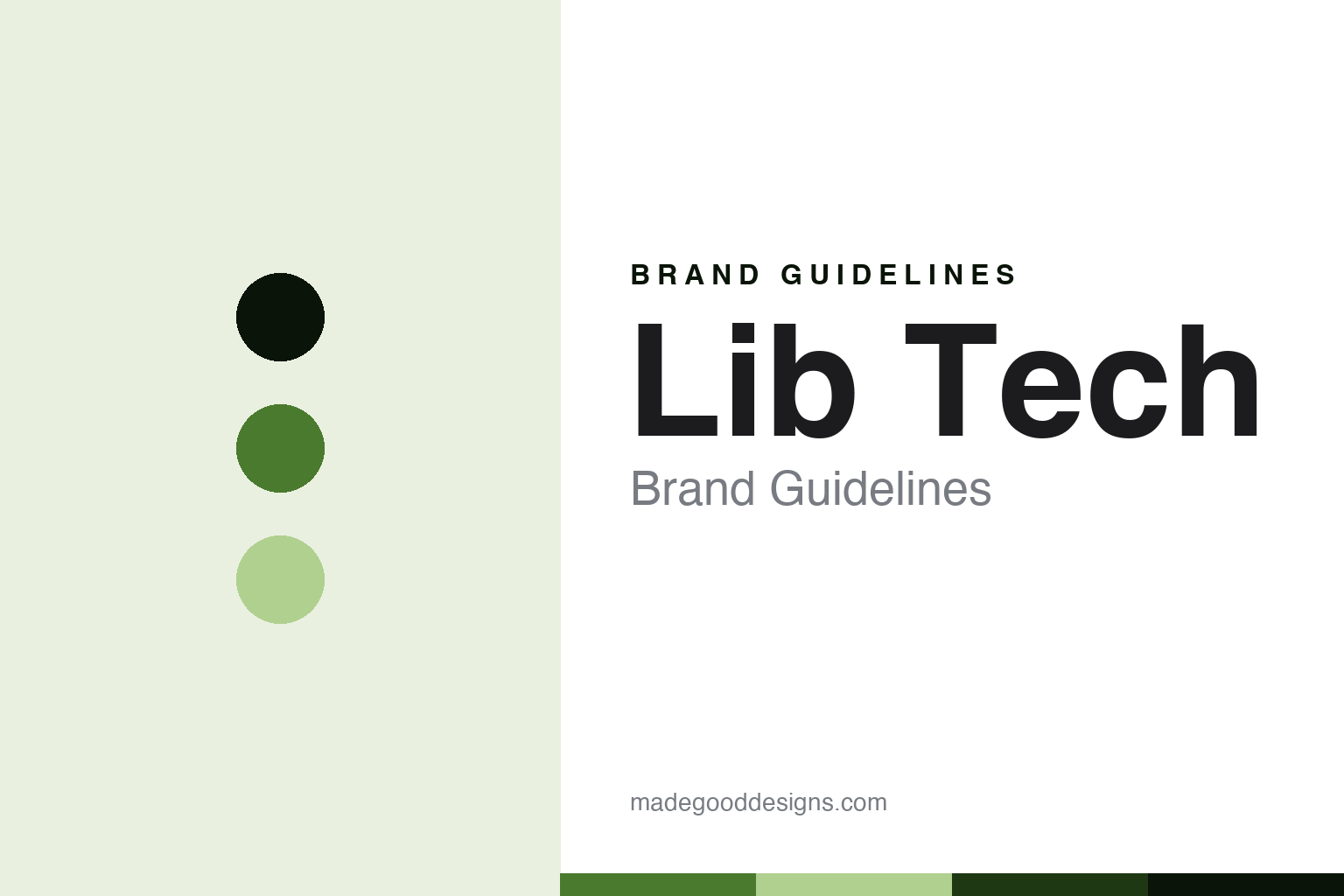
Lib Tech Brand Guidelines
The last big US board factory.
Aa
Two constants: an eco-green palette and an eco-sans register. Abstract homage — not a Lib Tech product or mark.
The last big US board factory
Lib Tech is the Washington-made snowboard house — Mervin-built in Sequim with an eco factory, owned by Altamont.
Lib Tech brings the round its made-in-USA-and-green anchor — the Mervin-built brand that presses its boards in Washington State, bills its plant the last major board factory in the country, and calls it the world’s most environmental. Lib Tech makes snowboards, skis and even surfboards, and its answer to a round about board makers is a factory it stands behind: made at home, made clean. A board, Mervin-made.
Its identity is the last big US board factory. Lib Tech’s Sequim plant, its eco ethos and its Mervin manufacturing are the story here. A board, made in the USA. The last big US board factory.
(Honest notes, so the story stays precise. Lib Tech — at lib-tech.com, part of Mervin Manufacturing — makes snowboards, skis, surfboards and skateboards, known for its Magne-Traction serrated edges and the Banana rocker profile. It was founded in 1977 by Mike Olson and Pete Saari in Washington State — not solo, and not 1990; the reading of “Mervin” as Mike plus a partner is lore rather than documented fact. On where it is made — the theme of this round — Lib Tech is “Mervin Made” in the USA, at the factory in the Sequim and Carlsborg area of Washington, which Mervin calls the last major board-building factory in the country and the world’s most environmental, hand-building on-site with eco material sourcing; this is a genuine made-in-USA-and-green story. On ownership, a correction matters: Mervin was owned by Quiksilver from 1997 but was sold to the private-equity firm Altamont Capital Partners in 2013 — before Quiksilver’s later troubles and before the Boardriders and Authentic Brands Group deals — so Lib Tech is owned by Altamont, not by that conglomerate, and operates with strong autonomy from Sequim. Gnu is its sister brand. Its marks are IP we describe but do not reproduce, and there is no official brand hex; these tones are an unofficial interpretation. This is design commentary and does not promote any product.)
Colour
Lib Tech lives in an eco green. Click a swatch to copy the hex.
Lib Tech’s identity is made-in-USA, green and independent-minded — an eco green, an ink, a leaf, a deep green, and a paper. The palette leans eco green and leaf: a register that nods to the brand’s environmental factory ethos rather than a cold mountain palette. It signals a maker that presses at home and clean. The honest caveat: with no published brand hex, these values are an original, unofficial interpretation, not first-party colours.
The lesson is an eco green signals a made-in-USA, environmental identity. Lib Tech’s world is a made, green object. For designers, it is a reminder that a vivid eco green and a soft leaf can carry a board maker — the tone of a low-waste factory. Because these tones can fail as small text, keep type dark and let the colour live in the accents, palette and band. The takeaways: press at home; make it clean; get the ownership straight; and treat any single hex as unofficial.
Typography
The register is an eco sans — clean, technical, made.
Lib Tech’s identity carries a clean, technical, made spirit — a working eco factory, not a fashion. An eco sans captures the mood: plain, environmental and technical, the register of a board hand-built in a low-waste Washington plant. Set in an eco-green palette, the eco sans feels clean and technical — exactly the personality Lib Tech carries. It is manufacturing rather than a logo, mirroring a wood core and a sintered base. (Lib Tech’s real wordmark, and Magne-Traction, are things we describe but do not reproduce, and the exact typeface is not ours to use.) Because it is not ours to use, the honest description is “an eco-sans spirit,” shown here in a stand-in. The type behaves like the board: clean, technical and made.
Aa
An eco-sans spirit — clean and technical. (Specimen set in Space Grotesk, an eco-sans STAND-IN; NOT the Lib Tech logo.)
The board makers
Lib Tech stands for the last big US board factory.
Lib Tech brings the round its made-in-USA-and-green anchor. An eco-green palette, an eco sans and a Mervin-made board make one thing — the last big US board factory — the whole identity: made-in-USA, green and independent-minded. The Sequim plant is the differentiator, and the environmental ethos is the meaning. The point is a Washington factory that presses its own boards at home and makes a virtue of doing it cleanly.
Put to work, the identity is a made-and-clean factory told straight, as design. A maker in this spirit would press at home and lead on environmental manufacturing, while being honest about who owns it. A reader in this spirit would keep the facts right: it was founded in 1977 by Mike Olson and Pete Saari; it is Mervin-made in Sequim, Washington; and Mervin is owned by Altamont Capital Partners since 2013, not by the conglomerate that owns some other board brands. Lib Tech sits with Never Summer at the genuinely-made-in-USA end of the round’s where-made thread, and it carries the round’s environmental thread with Capita, Nitro and Jones. The honest editorial moves are to correct the founding to Olson and Saari in 1977, to state the Mervin-made US factory, to fix the ownership to Altamont, and to keep the living founders to public facts. The lesson Lib Tech teaches is that owning a domestic factory and making it green can together be an identity — the plant is the point.
For designers and brand-builders, Lib Tech continues the board makers: press it at home — and make it clean. The lessons: keep a domestic factory; lead on environmental manufacturing; correct an ownership myth; get founders and dates right; and never reproduce a logo. It is also a reminder to stay precise: Lib Tech is the Washington-made snowboard house, Mervin-built in Sequim with an eco factory, owned by Altamont — with the palette here an unofficial interpretation. Read that way, Lib Tech is less a board than a factory: a Washington plant that stayed home and went green when the industry did neither. The lesson for a brand is that a domestic, environmental factory is a durable identity in an offshored category, and that honesty about the owner keeps the made-at-home story from being mistold. Lib Tech made the-last-big-US-board-factory the identity — proof that the plant can be the whole point.
Explore & save
Keep Lib Tech’s identity on hand — save it to a board in the Made Good inspiration library.
Lib Tech identity set
Pin the eco-green palette and the eco-sans register to your own board.