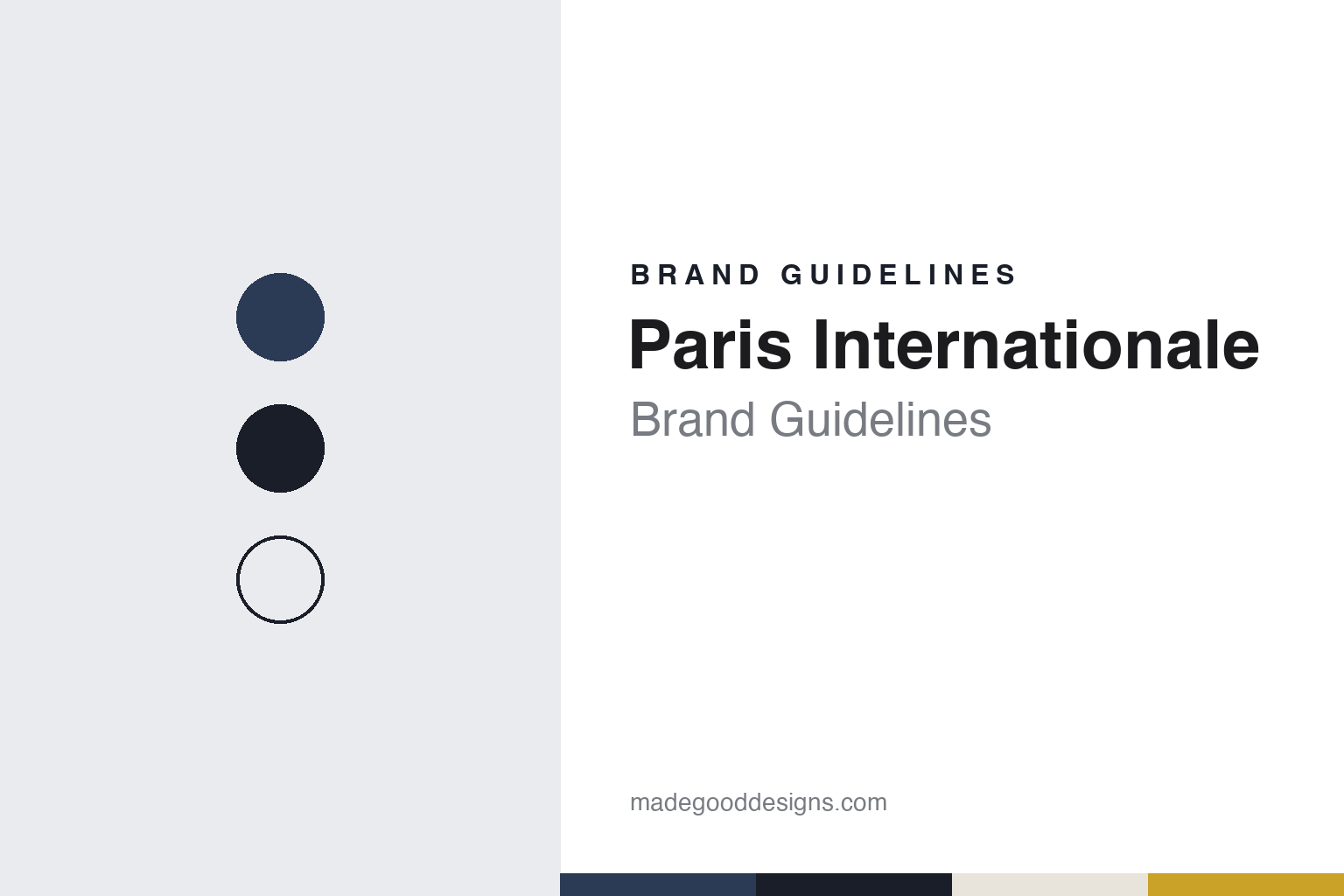
Paris Internationale Brand Guidelines
A gallery-founded fair of 2015 that takes over a different Paris building each autumn.
Aa
Two constants: a slate blue, plaster and gilt palette and a plain grotesque sans register. Abstract homage — not a Paris Internationale asset; no logo, poster or artwork is reproduced.
Avenue d’Iéna
A fair “made by galleries for galleries.”
Paris Internationale is a contemporary art fair held in Paris each October, during Paris Art Week. It opened in 2015. The Art Newspaper, reporting on 20 October 2015, described it as one of two newcomers to the satellite fair scene that year, running alongside the 42nd edition of Fiac at the Grand Palais. The Paris dealer Guillaume Sultana told the paper that he had co-founded the event with four other European galleries, including High Art and Crèvecœur of Paris, and that the aim was “a fair made by galleries for galleries which is not super-corporate.” The fair’s own archive calls the fair a joint initiative of five emerging galleries.
That first edition was held in a ramshackle mansion on Avenue d’Iéna, near the Palais de Tokyo, with 34 dealers and seven non-profit spaces, according to The Art Newspaper, which added that it was loosely modelled on Independent, the fair that launched in New York in 2010. The fair’s archive gives the same mix of 34 galleries and seven non-profit spaces, from 13 countries.
The fair has kept that gallery-run structure. Its website describes it as a collegial initiative founded in 2015 by a group of galleries, and lists a selection committee for the Paris edition made up of gallerists from London, Mexico City, Zurich and Paris. English Wikipedia notes that exhibitors are invited rather than chosen through an open application process. The website names Silvia Ammon as director.
Colour
A different building each year.
The fair has no fixed home, and the venue is part of each edition’s character. Its archive sets out the sequence. The second edition, in 2016, moved to another house on Avenue d’Iéna, a four-storey hôtel particulier, the archive says, with 54 galleries and seven project spaces from 21 countries. In 2017 the fair left the mansions for a converted multi-storey car park in the Haut-Marais that had housed the offices of the newspaper Libération, with 55 galleries and eight project spaces. In 2018 and 2019 it used a building near the Parc Monceau, and the archive says it chose to scale down there to around 42 galleries.
In 2020 the format changed: the archive says that year’s edition took the form of an exhibition, SuperSalon, in a vacant small supermarket in the 9th arrondissement, together with the fair’s first online edition and a redesigned website. In 2021 it returned as a fair in a residential building on avenue Victor Hugo, with 36 galleries from 21 countries showing solo or duo presentations. The 2022 edition, with 60 galleries from 26 countries, was held on boulevard des Capucines in a former photographer’s studio, the archive says.
For 2023 and 2024 the fair took over the Central Bergère, a former telephone exchange near the Grands Boulevards. FAD Magazine, covering the 2024 edition on 16 October that year, noted that the building has five floors and no lifts, so that climbing the stairs was part of the visit; English Wikipedia, citing The New York Times, gives 75 galleries from 19 countries for that year. The archive places the 2025 edition at the Rond-Point des Champs-Élysées, with 59 galleries and seven non-profit spaces. In October 2026, FAD Magazine reported, the 12th edition moved to a building on the Quai de Valmy by the Canal Saint-Martin, with 54 galleries and six non-profit spaces from 19 countries, mixing emerging and established galleries across the building rather than dividing it into sectors.
The calendar around it has shifted too. English Wikipedia says the fair ran alongside FIAC in its early years and, since 2022, alongside Art Basel Paris.
Typography
How satellite and newer fairs present themselves.
Many newer art fairs choose their dates in one of two ways. Some open in the same week as a larger fair in the same city, so that collectors and curators who are already in town can walk from one to the other: VOLTA was founded in Basel in 2005 as an alternative fair during the week of Art Basel, and Paris Internationale runs in Paris each October alongside what is now Art Basel Paris. Others take a slot of their own in the calendar and build an audience around it, without a larger neighbour to draw on.
Either way, the name is what holds steady. The city, the building and the edition number change, while the wordmark carries over. VOLTA writes its name in capitals and adds the city, as in VOLTA Basel and VOLTA New York; Paris Internationale kept its Paris name when it held its first edition in Milan in 2026, adding only Milano. A short name travels easily from one city to another and from one building to the next.
Who takes part is decided before the doors open. Some fairs invite their exhibitors; others take applications and pass them to a selection committee, often made up of gallerists, which chooses galleries for the projects they propose as well as for their programmes. The resulting exhibitor list, with each gallery’s city, is published ahead of each edition, as both VOLTA and Paris Internationale do.
The visit itself is designed. Floor plans and maps tell visitors how to move through a hall, a tent or a building of several floors; signage, printed guides, websites and apps carry the exhibitor list, the sections and the programme of talks and tours. At a fair that changes buildings, the signage and stand walls may be reused from year to year, while the campaign image and the venue give each edition its own look.
Aa
A plain grotesque sans — the register of neon and bare walls. (Specimen set in Work Sans, a sans STAND-IN; NOT the Paris Internationale logo.)
Paris Internationale
Walls instead of booths.
Since 2022 the fair’s exhibition design has been in the hands of the Swiss architects Christ & Gantenbein. The fair’s website says the architects replaced the closed, cube-shaped booth with a system of walls, keep their intervention in each historic building to a minimum, and reuse furniture, lighting and signage from earlier editions; it says neon lights and simple walls remain the main elements used to divide the spaces and show the works. FAD Magazine described the firm’s return for 2026 as part of a long-running relationship with the fair.
Around the stands sits a free public programme. The website dates its talks and events to 2015 and describes the Daily Dérives, guided tours through the fair led by curators, artists, museum directors and collectors; FAD Magazine reported in 2026 that the talks were organised with Fondation Pernod Ricard and that the École des Arts Décoratifs – PSL joined that year with a project room for recent graduates. A Kids Corner by Combo Toys, which the website says was designed by contemporary artists for children aged five and up, appeared on the fourth floor of the 2024 building, FAD Magazine noted.
In April 2026 the fair held its first edition outside France. FAD Magazine reported on 14 April 2026 that Paris Internationale Milano ran from 18 to 21 April in Palazzo Galbani, a modernist building of 1956–59 that was under restoration, with 34 galleries, during Milan Art Week and the opening days of Milan Design Week. The magazine said the exhibition design was again by Christ & Gantenbein, with NM3, and that many stands were conceived as exhibitions of one or two artists. The fair kept its Paris name for the Milan edition, adding only the city.
For a design guide, Paris Internationale shows how a fair can make the changing building its signature, holding its identity in a name, a gallery-run structure and a few constant materials. Compare Art Basel, whose Paris fair runs in the same week, and Independent, the New York fair it was loosely modelled on. For this guide we use a slate blue, a plaster white and a gilt with a grotesque sans, an unofficial interpretation; no product or logo is reproduced.
Explore & save
Keep Paris Internationale’s identity on hand — save it to a board in the Made Good inspiration library.
Paris Internationale identity set
Pin the Paris Internationale slate blue, plaster and gilt palette and the plain grotesque sans register to your own board.
Source & notes
Frequently Asked Questions
What font can I use to match the Paris Internationale look?
This guide describes Paris Internationale’s type as “A plain grotesque sans — the register of neon and bare walls”. Its type specimen is set in Work Sans from Google Fonts as a stand-in; Work Sans is not Paris Internationale’s own lettering.
What colours are in the Paris Internationale palette?
This guide’s Paris Internationale palette is Slate blue #2B3A55, Night ink #191E28, Plaster #E8E4DC, Gilt #C9A227 and Paper #F6F5F1. The tones are the guide’s own unofficial interpretation, not official Paris Internationale hex codes.
When was Paris Internationale founded?
Paris Internationale was founded in 2015, in Paris, France.
Who founded Paris Internationale?
Paris Internationale was founded by a group of five galleries in 2015.