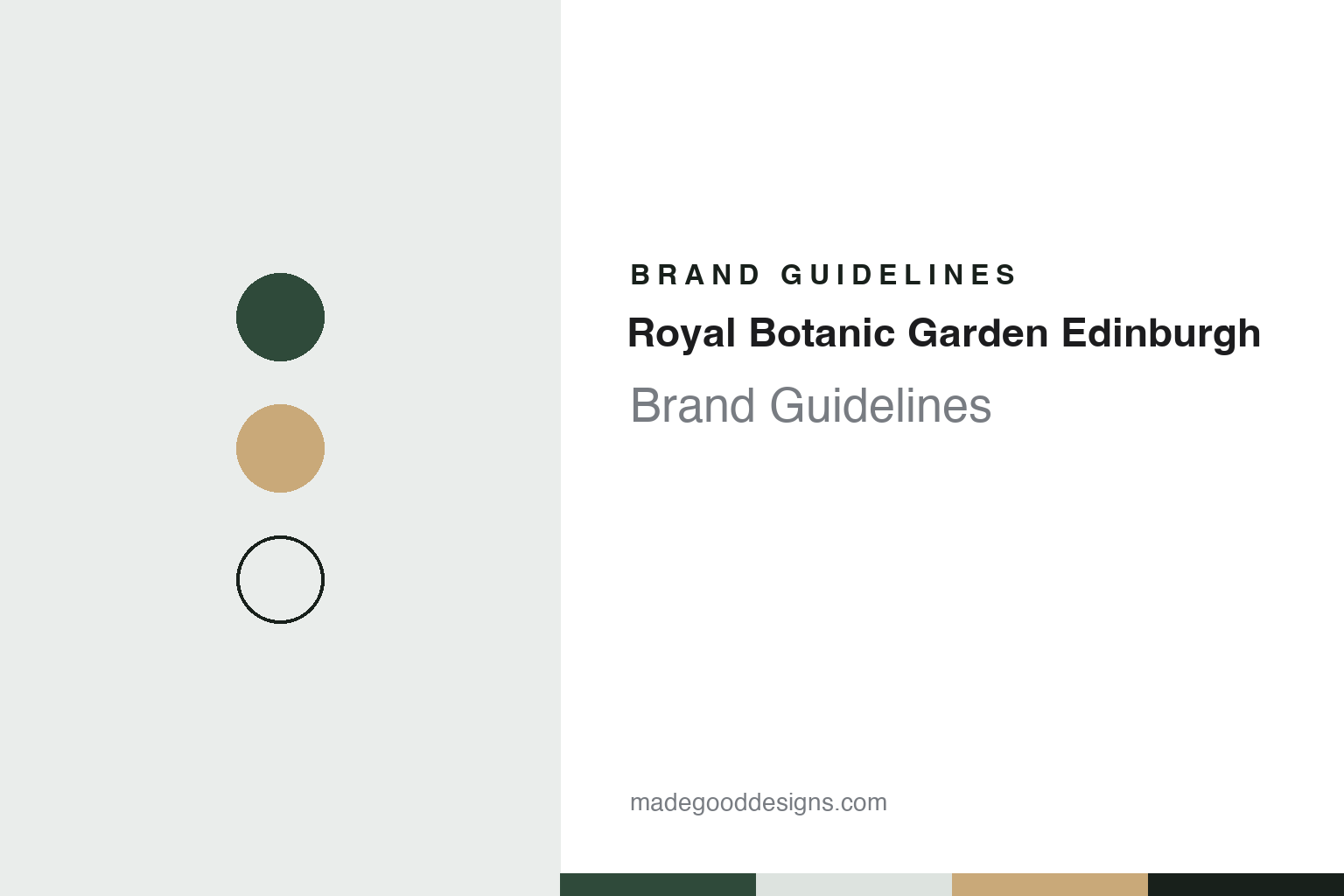
Royal Botanic Garden Edinburgh Brand Guidelines
A 1670 physic garden that became “the Botanics”.
Aa
Two constants: a fern green, glasshouse grey and sandstone palette and a botanical serif register. Abstract homage — not a Royal Botanic Garden Edinburgh asset; no logo, sign or building is reproduced.
A Physic Garden
Four sites in Edinburgh across 150 years.
The Royal Botanic Garden Edinburgh began in 1670 as a physic garden near the Palace of Holyroodhouse. The garden’s own history names its founders as two physicians, Andrew Balfour and Robert Sibbald, and gives its purpose as supplying fresh plants for medical prescriptions and teaching medical botany to students.
The first plot was soon too small. In the mid-1670s the garden moved to ground beside Trinity Hospital, leased from the town council; that land now lies under Waverley Station, where a plaque marks the site. The garden received a royal warrant in 1699, and its first glasshouse was built in 1713, the garden says. In 1763, under the Regius Keeper John Hope and with an endowment from the Crown, the collections moved to a larger site near Leith Walk, away from the Old Town; the garden credits Hope with securing permanent Crown funding.
The move to the present site at Inverleith began in 1820. Historic Environment Scotland’s Inventory of Gardens and Designed Landscapes, which added the garden on 1 July 1987, says the new ground covered about 14 acres and the transfer took three years. In 1864 the experimental garden of the Royal Caledonian Horticultural Society was transferred to it, and in 1876 the 28 acres around Inverleith House were acquired, completing most of the garden’s present extent. The garden came wholly under the Crown in 1889, the Inventory says; the garden’s own timeline adds that it began opening on Sundays that year.
Its governance has changed with the state. In April 1986, as a consequence of the National Heritage (Scotland) Act 1985, the garden became a grant-in-aid body with a board of trustees, according to the Inventory. English Wikipedia describes it today as an executive non-departmental public body of the Scottish Government, with its headquarters at the Edinburgh site and a Regius Keeper at its head.
Colour
Palm Houses, a gallery and three regional gardens.
The glasshouses are the garden’s landmarks. The Tropical Palm House opened in 1834 as an irregular octagon of stone pillars and glazed wooden sashes under a conical roof, the garden says; within two decades it was too small, and in 1855 Parliament agreed to fund a larger house. The Temperate Palm House was built from 1856 and planted by the spring of 1858. The Inventory describes it as thought to be the tallest glasshouse in Britain, and English Wikipedia calls it the tallest palm house in Scotland. A range of seven interconnected exhibition houses followed in 1967.
Both Palm Houses, listed at category A, closed for restoration under the Edinburgh Biomes programme, which the garden began in 2019. They reopened on 2 October 2026 after five years of work, the garden announced: more than five thousand panes of glass were made from bespoke templates, repairs were made to the original iron structure, and about 600 plant specimens were to return to the two houses.
Other buildings record later chapters. Inverleith House, a classical mansion of 1774 listed at category B, housed the Scottish National Gallery of Modern Art from 1960 until 1984, according to English Wikipedia and the Inventory, and has served as the garden’s exhibition space since 1986. The Herbarium and Library building opened in 1964. The Botanic Cottage, once the gardener’s home, classroom and entrance of the Leith Walk garden, was moved stone by stone to Inverleith and reopened in 2016. On the west side, the John Hope Gateway is a timber-and-glass visitor building designed by Edward Cullinan Architects with the engineers Buro Happold, whose planted sedum roof appears to float above the building, according to Buro Happold; the garden says it was opened in 2010.
Edinburgh is one of four gardens. Benmore, on Scotland’s west coast, became the first regional garden in 1929; Logan, on the south-western tip of the country, followed in 1969; and Dawyck, near Peebles in the Scottish Borders, joined in 1979 by the garden’s account, or 1978 by English Wikipedia’s. An avenue of giant redwoods marks the approach at Benmore. The garden gives its herbarium as about three million specimens, the oldest collected in 1697, and English Wikipedia puts the living collection at more than 13,300 species.
Typography
How botanic gardens present themselves.
Botanic gardens tend to carry their place in their names. Many take a city, a state or a country, some carry a royal title, and some are better known locally by a founder’s name or a short form. Edinburgh’s garden received a royal warrant in 1699 and is called “the Botanics” in the city; St. Louis has long called the Missouri Botanical Garden “Shaw’s Garden”, after Henry Shaw, who created it. Initials such as RBGE stand in for a long formal name on websites and publications.
Glasshouses often act as the visual signature. Edinburgh’s Tropical Palm House dates from 1834 and its Temperate Palm House from 1858, and the pair reopened in October 2026 after five years of restoration; in St. Louis the Climatron, a geodesic dome opened in 1960, has given the garden a shape that its anniversaries are built around. Newer visitor buildings, such as Edinburgh’s John Hope Gateway, add a contemporary entrance alongside the historic houses.
The institutions behind the names differ. Some gardens are public bodies, as the Edinburgh garden is in Scotland; some are run by trusts and boards of trustees, as Shaw’s will arranged for St. Louis in 1889; others belong to cities, national institutes, horticultural societies or families. Many manage more than one site, from regional gardens to nature reserves, and heritage registers list several of their grounds and buildings.
Named seasonal events extend the identity beyond the gates. Illuminated winter trails such as Christmas at the Botanics in Edinburgh and Garden Glow in St. Louis carry the garden’s name into the evening, alongside festivals and concert series. This guide sets out what can be checked about each garden — when it was founded, who runs it, what it built and when — and marks clearly what rests on the garden’s own account.
Aa
A botanical serif for a garden founded in 1670. (Specimen set in Cormorant Garamond, a serif STAND-IN; NOT the Royal Botanic Garden Edinburgh logo.)
The Botanics
A long name, a short one, and a set of initials.
Edinburgh calls the garden “the Botanics”, English Wikipedia notes, and the institution uses the short form itself, most visibly in Christmas at the Botanics, its illuminated winter trail, which runs from 19 November to 30 December in 2026. The full name is long, and the initials RBGE run through its website and publications. Its journals show the name at work: the Notes from the Royal Botanic Garden Edinburgh, started in 1900, became the Edinburgh Journal of Botany in May 1990, and a horticulture journal launched in 2003 took the name Sibbaldia, after the alpine plant named for Robert Sibbald, the garden says.
The grounds carry older markers too. John Hope raised a monument to Carl Linnaeus at the Leith Walk garden in 1778, English Wikipedia says; the Inventory records it at Inverleith and its move to its present position in 1967, and notes early eighteenth-century gatepiers with broken pediments and carved lions at the south-west entrance. The Rock Garden was rebuilt between 1908 and 1914 with conglomerate from Ben Ledi and sandstone from Dumfriesshire, the Inventory adds.
For a design guide, the Royal Botanic Garden Edinburgh shows how one institution can carry three and a half centuries of moves, glasshouses and regional sites under a formal name, a set of initials and a local nickname. Compare Kew Gardens in London and the Eden Project in Cornwall. For this guide we use a fern green, a glasshouse grey and a warm sandstone with a serif, an unofficial interpretation; no product or logo is reproduced.
Explore & save
Keep Royal Botanic Garden Edinburgh’s identity on hand — save it to a board in the Made Good inspiration library.
Royal Botanic Garden Edinburgh identity set
Pin the Royal Botanic Garden Edinburgh fern green, glasshouse grey and sandstone palette and the botanical serif register to your own board.
Source & notes
Frequently Asked Questions
What font can I use to match the Royal Botanic Garden Edinburgh look?
This guide describes Royal Botanic Garden Edinburgh’s type as “A botanical serif for a garden founded in 1670”. Its type specimen is set in Cormorant Garamond from Google Fonts as a stand-in; Cormorant Garamond is not Royal Botanic Garden Edinburgh’s own lettering.
What colours are in the Royal Botanic Garden Edinburgh palette?
This guide’s Royal Botanic Garden Edinburgh palette is Fern green #2F4A3A, Ink #18201B, Glasshouse grey #DDE3DF, Sandstone #C9A979 and Paper #F6F5F0. The tones are the guide’s own unofficial interpretation, not official Royal Botanic Garden Edinburgh hex codes.
When was Royal Botanic Garden Edinburgh founded?
Royal Botanic Garden Edinburgh was founded in 1670 (as a physic garden), in Edinburgh, Scotland.
Who founded Royal Botanic Garden Edinburgh?
Royal Botanic Garden Edinburgh was founded by Andrew Balfour and Robert Sibbald in 1670 (as a physic garden).