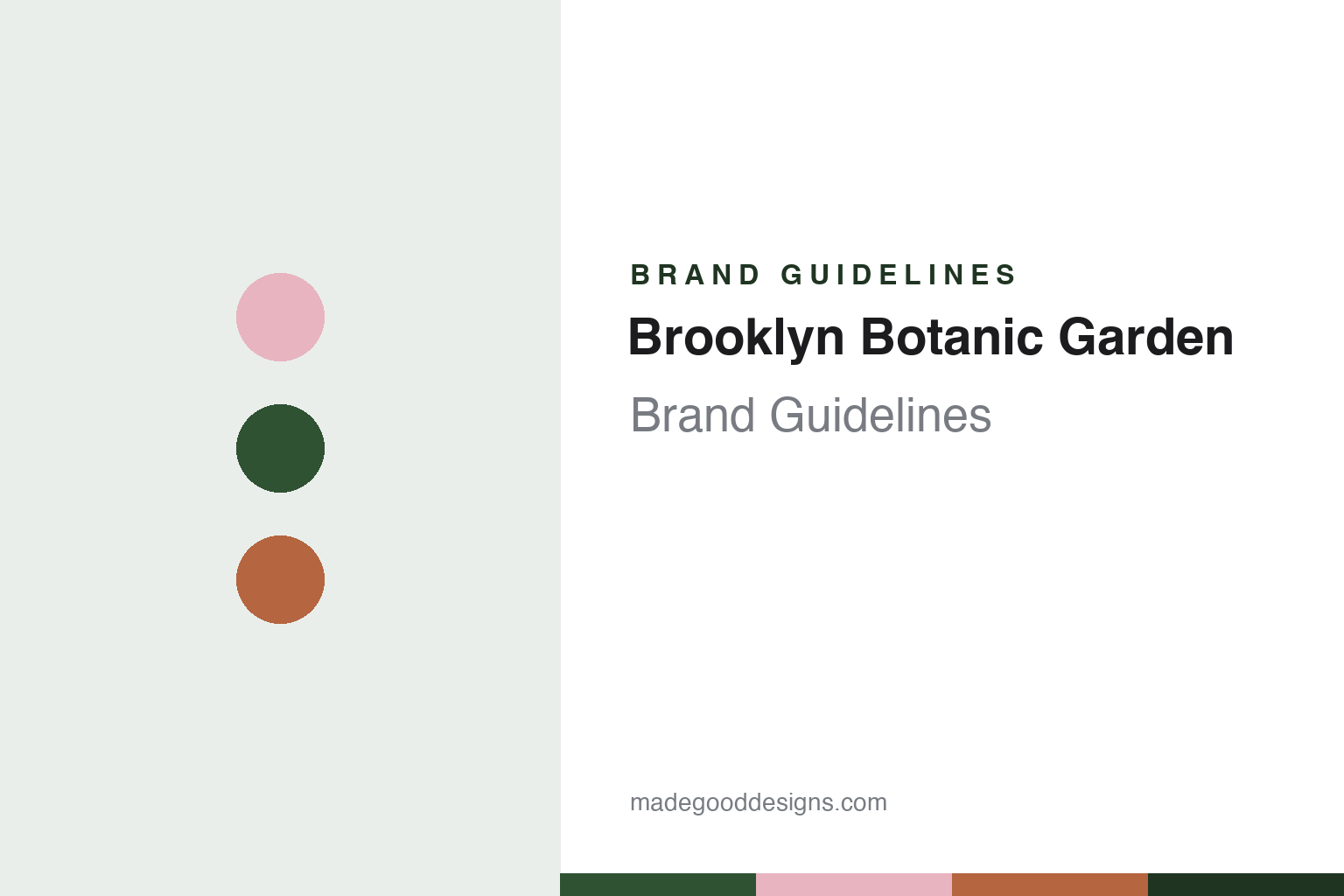
Brooklyn Botanic Garden Brand Guidelines
A garden on a former ash dump, beside a museum, in central Brooklyn.
Aa
Two constants: a green, blossom pink and brick palette and a garden serif register. Abstract homage — not a Brooklyn Botanic Garden mark; no logo, sign or photograph is reproduced.
An ash dump becomes a garden
Reserved in 1897, founded in 1910, opened in 1911.
Brooklyn Botanic Garden, usually shortened to BBG, sits in the middle of Brooklyn, on a block it shares with the Brooklyn Museum, the Central Library and Mount Prospect Park. Its land was set aside on 18 May 1897, when the New York State Legislature reserved 39 acres for a botanic garden, according to English Wikipedia; the garden’s own history gives the same year and acreage, and says the site now covers 52 acres. Part of the triangle east of Flatbush Avenue had been used as an ash dump until shortly before the garden was laid out, Wikipedia says.
The garden was to be run under the Brooklyn Institute of Arts and Sciences, the body that then also ran the Brooklyn Museum. The city and the institute signed a maintenance agreement in December 1909, and the garden dates its founding to 1910, when the botanist C. Stuart Gager became its first director. The Olmsted Brothers firm drew the original site plan, and McKim, Mead & White was hired as architect for its buildings.
The first section to open was the Native Flora Garden, then called the Local Flora Section, on 13 May 1911, which the garden counts as its official opening. The landscape architect Harold Caparn was appointed in 1912 and, according to both the garden and Wikipedia, designed much of the grounds over the next three decades, including the Osborne Garden and the Cranford Rose Garden. Wikipedia says the garden split from the Brooklyn Institute during the 1970s. In the 1950s it also took on a research site at Kitchawan in Westchester County, the first of several outlying sites it operated in the region, according to the same account.
Colour
Palm house, rose garden, cherry trees.
The garden filled out quickly in its first decades. A children’s garden program began in 1914. The Japanese Hill-and-Pond Garden, which the garden credits to the landscape designer Takeo Shiota, opened in 1915; a rock garden built from boulders found on the site followed in 1916. In April 1917 the Laboratory Building and Conservatory — today the Administration Building and the Palm House — were dedicated. The garden describes the building as Tuscan Revival and by McKim, Mead & White, and Wikipedia records that the Laboratory Building was designated a New York City landmark in 2007.
Named gardens arrived through the 1920s and 1930s. A Shakespeare Garden opened in 1925, the same year a gift of 32 bonsai started the bonsai collection. The Cranford Rose Garden was dedicated in 1928, the Osborne Garden, an Italian-style garden with pergolas and columns, in 1939, and in 1941 rows of ‘Kanzan’ cherry trees were planted to form the Cherry Esplanade. A Fragrance Garden designed by the landscape architect Alice R. Ireys opened in 1955. In 1945 the garden published the first title in a series of gardening handbooks that it still produces.
The second building era began in the 1980s. Work on a new conservatory designed by Davis, Brody & Associates started in May 1984, Wikipedia says, and the Steinhardt Conservatory opened on 19 May 1988, while the old Palm House was renovated as an education center and event space. A new Eastern Parkway entrance by Polshek Partnership Architects opened in 2005, and in May 2012 the garden opened the Steinberg Visitor Center by Weiss/Manfredi on Washington Avenue. New Atlas reported in May 2012 that the building is set into an existing hill, with curved glass walls, a planted roof of about 10,000 square feet and a geothermal heating and cooling system; inside are an orientation room, an information lobby, a shop, an exhibition gallery, a café and an elliptical events space, with fritted glass marked by vertical lines. An expansion of the Native Flora Garden followed in June 2013.
Typography
Gardens, glasshouses and names.
Botanic gardens tend to carry their place in their names. Many take a city, a state or a country, some carry a royal title, and some are better known locally by a founder’s name or a short form. Edinburgh’s garden received a royal warrant in 1699 and is called “the Botanics” in the city; St. Louis has long called the Missouri Botanical Garden “Shaw’s Garden”, after Henry Shaw, who created it. Initials such as RBGE stand in for a long formal name on websites and publications.
Glasshouses often act as the visual signature. Edinburgh’s Tropical Palm House dates from 1834 and its Temperate Palm House from 1858, and the pair reopened in October 2026 after five years of restoration; in St. Louis the Climatron, a geodesic dome opened in 1960, has given the garden a shape that its anniversaries are built around. Newer visitor buildings, such as Edinburgh’s John Hope Gateway, add a contemporary entrance alongside the historic houses.
The institutions behind the names differ. Some gardens are public bodies, as the Edinburgh garden is in Scotland; some are run by trusts and boards of trustees, as Shaw’s will arranged for St. Louis in 1889; others belong to cities, national institutes, horticultural societies or families. Many manage more than one site, from regional gardens to nature reserves, and heritage registers list several of their grounds and buildings.
Named seasonal events extend the identity beyond the gates. Illuminated winter trails such as Christmas at the Botanics in Edinburgh and Garden Glow in St. Louis carry the garden’s name into the evening, alongside festivals and concert series. This guide sets out what can be checked about each garden — when it was founded, who runs it, what it built and when — and marks clearly what rests on the garden’s own account.
Aa
A garden serif for a garden laid out by the Olmsted Brothers. (Specimen set in Fraunces, a serif STAND-IN; NOT the Brooklyn Botanic Garden logo.)
Brooklyn Botanic Garden
Three gates, a cherry festival and a short name.
Much of what visitors meet first at Brooklyn Botanic Garden is architecture. Wikipedia describes three entrances: a brick and limestone gate with three arches on Flatbush Avenue, designed by McKim, Mead & White and dedicated in 1930; the Eastern Parkway entrance, rebuilt in 2003 with a stainless-steel gate, curved steel walls and a tall cast-glass cone; and the visitor center on Washington Avenue, with its gabled copper roof and curving glass pavilion.
The garden’s calendar carries its name in the same way. It held its first Sakura Matsuri, a cherry blossom festival, in 1982, and Wikipedia says the garden began hosting it that year as an annual event. In 1996 it launched its website at bbg.org, and the short form BBG appears throughout its own history and in Wikipedia’s account. BBG is a separate institution from the New York Botanical Garden in the Bronx, which Wikipedia says covers 250 acres.
The garden’s own history also lists a plant bred on site: in 1977 it received a patent for Magnolia × ‘Elizabeth’, a yellow magnolia developed at BBG, and the plaza of magnolias near the Administration Building was renamed in 2005 for a former president. In 2010 the garden marked its centennial with events and exhibits and opened a new Herb Garden at the south end of the grounds.
For a design guide, Brooklyn Botanic Garden shows how a compact city garden can build its identity from named gardens, gates and a yearly blossom festival rather than from size. Compare the New York Botanical Garden in the Bronx and the Chicago Botanic Garden. For this guide we use a deep green, a blossom pink and a brick red with a serif, an unofficial interpretation; no product or logo is reproduced.
Explore & save
Keep Brooklyn Botanic Garden’s identity on hand — save it to a board in the Made Good inspiration library.
Brooklyn Botanic Garden identity set
Pin the Brooklyn Botanic Garden green, blossom pink and brick palette and the garden serif register to your own board.
Source & notes
Frequently Asked Questions
What font can I use to match the Brooklyn Botanic Garden look?
This guide describes Brooklyn Botanic Garden’s type as “A garden serif for a garden laid out by the Olmsted Brothers”. Its type specimen is set in Fraunces from Google Fonts as a stand-in; Fraunces is not Brooklyn Botanic Garden’s own lettering.
What colours are in the Brooklyn Botanic Garden palette?
This guide’s Brooklyn Botanic Garden palette is Esplanade green #2F5233, Deep hedge #1F3522, Kanzan pink #E8B4C0, Palm house brick #B5653F and Limestone #F3EFE6. The tones are the guide’s own unofficial interpretation, not official Brooklyn Botanic Garden hex codes.
When was Brooklyn Botanic Garden founded?
Brooklyn Botanic Garden was founded in 1910 (opened May 1911), in Brooklyn, New York.