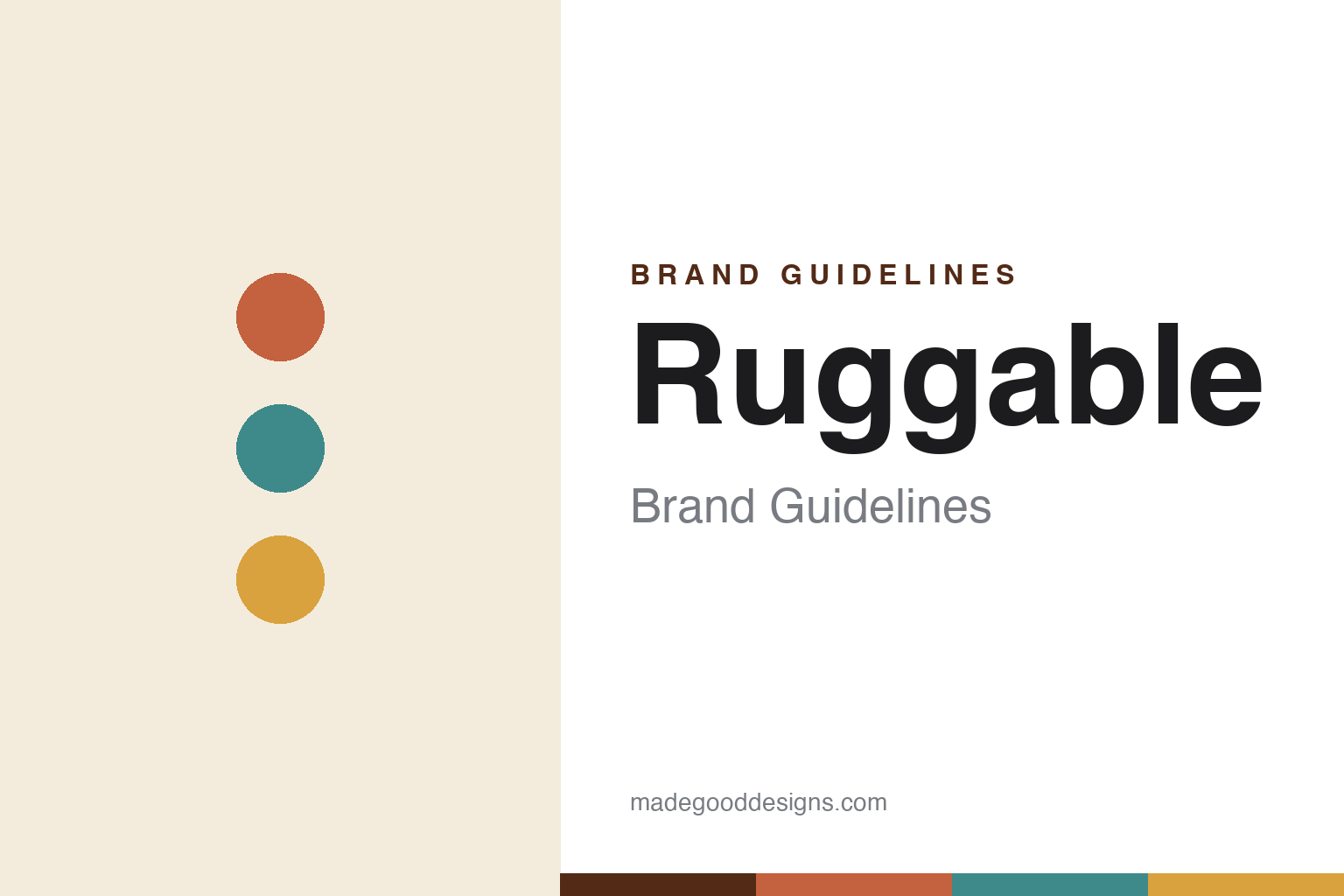
Ruggable Brand Guidelines
The Original Washable Rug.
Aa
Two constants: a friendly home palette and a rounded, friendly wordmark. Abstract homage — not the Ruggable wordmark or rug patterns.
The rug you can wash
Ruggable invented a category from a spill.
Ruggable is a lesson in a product invention becoming a brand. Conceived by Jeneva Bell — after a puppy ruined a new area rug — it solved a real problem with a two-piece, machine-washable rug system: a thin rug top that grips onto a separate non-slip pad. Invented around 2008–2010 and relaunched as a direct-to-consumer business in 2017, it created and named a category: “The Original Washable Rug.”
The design lets the product carry the colour — huge ranges of patterns and licensed collaborations (Disney, Jonathan Adler, Iris Apfel, Morris & Co., Bridgerton) — over a clean, friendly, home-lifestyle brand frame. The voice is warm and practical: spend less time cleaning up, more time living.
(Honest notes: Ruggable is private and PE-backed (a 2021 growth investment from Trilantic North America). Founder Jeneva Bell is now Founder & President, not CEO — Nicole Otto, a Nike veteran, became CEO in 2025. It grew explosively then matured (a 2023 restructuring), and revenue isn’t publicly disclosed, so we won’t cite one. No official brand hex is published.)
Colour
Ruggable lives in a friendly home palette. Click a swatch to copy the hex.
Ruggable’s identity is friendly, warm and home-like — a rust, a teal, an ochre, a cream, and an ink. Because the rug patterns supply the colour, the brand frame stays clean and neutral; these warm, homey accents represent the lived-in world Ruggable sells into. It signals practical, family-friendly, real-home comfort rather than precious design-object minimalism. The honest caveat: with no published brand hex, these tones are an original, unofficial interpretation, not first-party values.
The lesson is let the product be the colour. Ruggable’s world is a real, lived-in home. For designers, it is a reminder that when the product line is endlessly patterned, the brand frame should stay calm and neutral so the rugs pop — the identity organises, the product performs. The takeaways: keep the brand frame clean so a varied product can lead; use warm, homey accents for the brand’s own world; and treat any single hex as unofficial — using a rust-brown for small text so the home tones stay warm.
Typography
The wordmark spirit is a rounded, friendly sans — warm and practical.
Ruggable’s identity carries a friendly, warm, practical spirit — a clean, rounded wordmark over bright, real-home photography (pets, kids, the occasional implied spill). A rounded, friendly sans captures the mood: it is approachable and unpretentious, the register of a brand solving an everyday mess with a smile. Set against warm home tones, the rounded type feels welcoming and practical — exactly the livable personality Ruggable carries. It is friendly rather than precious, mirroring a rug built for real life. (Ruggable’s real wordmark and rug patterns are trademarks and trade dress we describe but do not reproduce, and the exact typeface is not published, so we don’t assert it.) Because the specific mark is not ours to use, the honest description is “a rounded sans spirit,” not the Ruggable logo. The type behaves like the brand: friendly, warm and practical.
Aa
A rounded sans spirit — warm and practical. (Specimen set in Nunito, a rounded sans; NOT the Ruggable logo, which is a trademark.)
Owning a category you invent
Ruggable stands for the washable rug.
Ruggable is a lesson in naming the category you create. It didn’t just sell rugs; it invented the washable rug and claimed the definitional line — “The Original Washable Rug” — while keeping the brand frame clean so an ever-growing, endlessly patterned product line could lead. The identity organises; the invention differentiates. The differentiator is a genuine product innovation, clearly owned.
For designers and brand-builders, Ruggable offers a clear takeaway: when you invent a category, own its plain-language name. The lessons: let a varied product carry the colour while the brand frame stays neutral; use warm, real-home photography to make an innovation feel livable; and claim the category with a simple, ownable line. It is also a reminder to stay accurate: Ruggable’s founding is a range (invented ~2008–2010, relaunched DTC 2017), it is PE-backed, and its founder is now President while a new CEO leads it — with the palette here an unofficial interpretation. Ruggable owned the washable rug — proof that inventing a category can be the difference.
Explore & save
Keep Ruggable’s identity on hand — save it to a board in the Made Good inspiration library.
Ruggable identity set
Pin the friendly-home palette and the rounded-sans spirit to your own board.