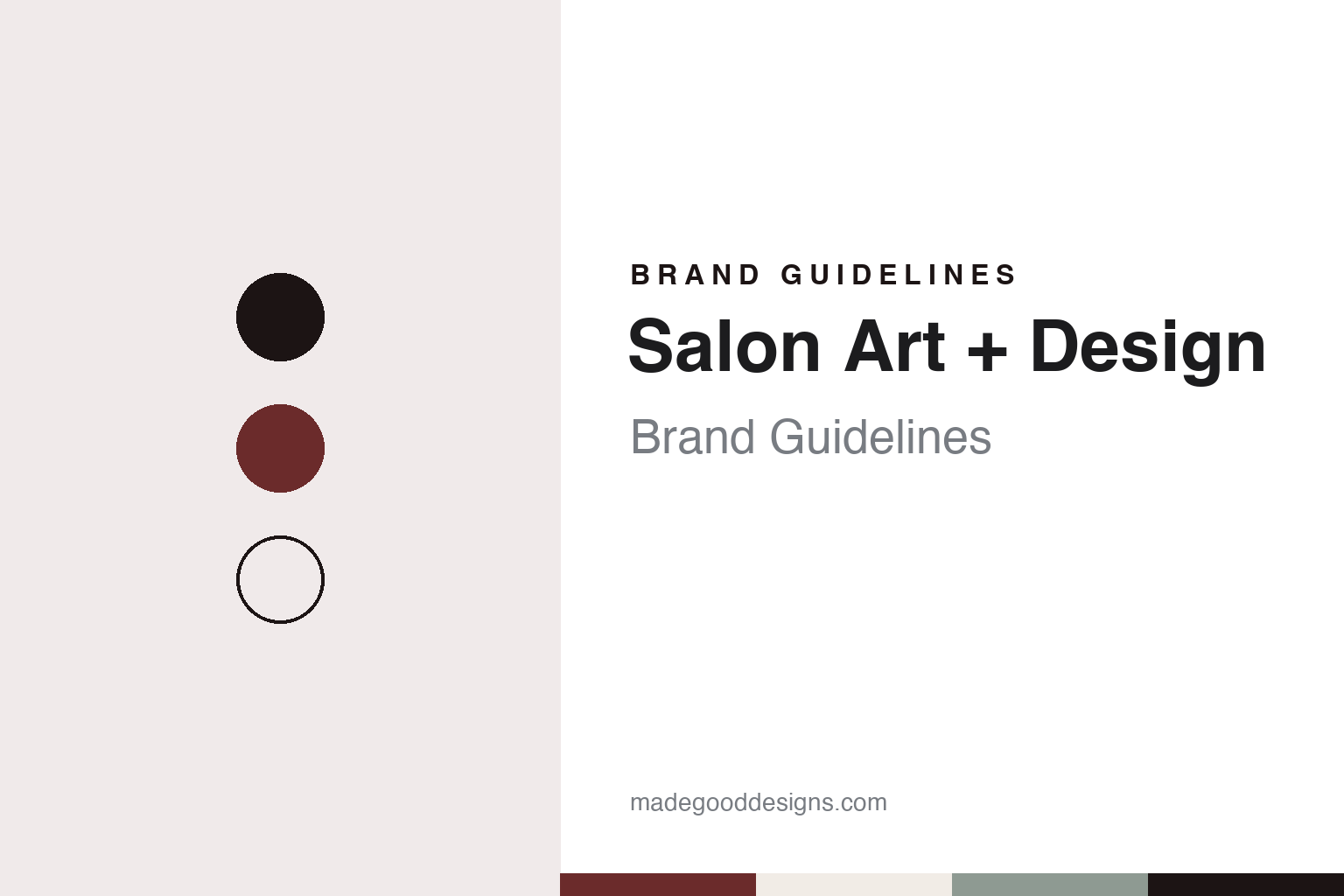
Salon Art + Design Brand Guidelines
New York’s November design fair at the Park Avenue Armory.
Aa
Two constants: a brick, plaster and sage palette and a geometric sans register. Abstract homage — not a Salon Art + Design asset; no logo, poster or exhibited work is reproduced.
A producer of niche fairs
A November fair from a New York show producer.
Salon Art + Design is a fair of collectible design, decorative arts and art held each November at the Park Avenue Armory in New York. It made its debut in 2012, Galerie magazine wrote in August 2026; the design site InCollect described the November 2015 fair as being in its fourth year, which agrees with that date. The fair is often shortened to “Salon,” and Antiques and The Arts Weekly wrote of it in December 2015 as “the Salon of Art + Design.”
The fair is produced by Sanford L. Smith + Associates (SLSA), a New York company that organises art, antiques and book fairs. Its founder, Sanford L. Smith, built a career on fairs for particular collecting fields. The company says he created the All American Antiques Show at the Pier in 1980, followed by Modernism, a show of design from 1860 to 1960, and Works on Paper, a fair of watercolours, photographs, prints and drawings. SLSA presents Salon Art + Design as continuing the line that Modernism began. Antiques and The Arts Weekly gave the Fall Antiques Show, Modernism and the Outsider Art Fair as examples of his shows.
Today SLSA’s list of events, according to its websites, also includes the ABAA New York International Antiquarian Book Fair, the ADAA Fair and the ESA Ephemera Fair. In 2024 leadership of the company passed to two partners, and Nicky Dessources became executive director of Salon Art + Design that year, Interior Design magazine reported in November 2025. The magazine said she had been involved with the fair for about a decade in various roles before taking over.
The armory stands on Park Avenue in Manhattan. Interior Design described the 2025 fair as filling the armory’s Drill Hall, with further exhibitors placed at the building’s entryway and along its hallways outside the hall.
Colour
Old and new, art and design.
The fair’s pitch is a mix of periods and fields. InCollect described it in 2015 as a mix of art, design and decorative art objects, with a focus on twentieth- and twenty-first-century design. Antiques and The Arts Weekly wrote the same year that the 55-gallery show included a substantial number of European exhibitors, many of them from France, and named the PAD fairs in Paris and London and Design Miami as its nearest equivalents, while noting that Salon differed from all of them in combining art and design, old and new.
The organiser puts it in similar terms. Its website says the fair presents vintage, modern and contemporary design alongside twentieth-century art, and that it is built on the idea that designers and collectors now “create environments rather than collect objects.” That phrase explains how stands are often dressed: as rooms, with furniture, lighting and a painting or sculpture together, rather than as rows of single pieces.
The range is wide. Galerie listed furniture, lighting, ceramics, glass, textiles, sculpture, painting and decorative arts for the 2026 fair, with jewellery as a further section. Interior Design called Salon a single destination for art, design, antiques and jewellery, which it said was rare in New York’s fair calendar.
The 2025 fair was the 14th edition and ran until 10 November 2025, with around 50 exhibitors, 11 of them showing at Salon for the first time, according to Interior Design. The Thursday preview that opened the fair benefited the Dia Art Foundation. Among the exhibitors the magazine described were Atelier Courbet and Todd Merrill Studio, which InCollect had also listed at the 2015 fair. The preview is followed by public days; Galerie spoke in 2026 of the “five days of the fair.”
Typography
Fairs and their wordmarks.
Art, antiques and collectible-design fairs tend to present themselves through a short name: an acronym built from a longer title, such as FIAC or BRAFA, or a city-based name that ties the event to the place where it is held. These names are usually set in capitals and kept from one year to the next, while each edition adds its own dates, poster or key visual.
The organisers behind them vary. Some fairs are run by dealer associations or non-profit bodies set up by dealers; others by exhibition companies that also stage trade shows; others by charities, chambers of commerce or cultural bodies acting in an institutional role. A committee of dealers or a selection panel usually decides which galleries take part.
Most fairs last only a few days a year, in a landmark hall, a pavilion in a park, an armory or a modern exhibition centre, and many open with a preview or vernissage for invited guests before the public days. Stands are arranged by gallery and often grouped by period or field, from antiquities and Old Masters to modern and contemporary art and twentieth-century design, with talks, guided tours and a curated or younger-galleries section alongside the main aisles. Some fairs add outdoor works or partner venues elsewhere in the city.
For a design guide, these fairs show how an identity can rest on a few constants — a wordmark, a month and a building — while venues, organisers and sections change around them. The guides in this series describe those constants as dated sources record them, with our own colours and type as an unofficial interpretation, and with no rankings, no prices and no claims about the quality or importance of any fair, gallery or work.
Aa
A geometric sans for a name joined by a plus sign. (Specimen set in Jost, a sans STAND-IN; NOT the Salon Art + Design logo.)
Salon
A plus sign and a fixed November date.
Galerie reported in August 2026 that the 15th edition had been announced for the Park Avenue Armory from 4 to 8 November 2026, fifteen editions after the 2012 debut. Earlier in 2026, the magazine reported, Salon had returned to the New York department store Bergdorf Goodman for a second annual installation, turning the seventh-floor home department into a residential setting with works from the fair’s galleries. The fair has also widened its Honorary Committee and its Design & Art Advisory Council of collectors, editors, museum figures and interior designers, Galerie wrote.
The name carries much of the identity. The two fields the fair covers are joined by a plus sign rather than a word, so that “Art + Design” reads almost as a sum. Antiques and The Arts Weekly wrote “the Salon of Art + Design” in 2015, while the organiser and the magazines that covered the 2025 and 2026 fairs use Salon Art + Design; in shorter references, including the organiser’s own, it is simply Salon.
The other constants are a single venue and a single month. Since 2012 the fair has returned to the same armory each November, which gives it a fixed place in New York’s autumn calendar and a consistent backdrop of a vast drill hall and panelled rooms for its photographs. Within that frame, each edition is presented through gallery stands dressed as interiors rather than through a change of location or format.
For a design guide, Salon Art + Design shows how a fair can make a mixed offer legible through its name: two fields, one plus sign, one building. Compare PAD Paris, which Antiques and The Arts Weekly named as one of Salon’s nearest equivalents, and The Winter Show, the January fair held in the same armory. For this guide we use a brick red, a pale plaster and a muted sage with a sans, an unofficial interpretation; no product or logo is reproduced.
Explore & save
Keep Salon Art + Design’s identity on hand — save it to a board in the Made Good inspiration library.
Salon Art + Design identity set
Pin the Salon Art + Design brick, plaster and sage palette and the geometric sans register to your own board.
Source & notes
Frequently Asked Questions
What font can I use to match the Salon Art + Design look?
This guide describes Salon Art + Design’s type as “A geometric sans for a name joined by a plus sign”. Its type specimen is set in Jost from Google Fonts as a stand-in; Jost is not Salon Art + Design’s own lettering.
What colours are in the Salon Art + Design palette?
This guide’s Salon Art + Design palette is Armory brick #6B2B2B, Drill-hall dark #1C1414, Plaster #F1ECE6, Sage #8E9A92 and Paper #FAF8F5. The tones are the guide’s own unofficial interpretation, not official Salon Art + Design hex codes.
When was Salon Art + Design founded?
Salon Art + Design was founded in 2012, in New York, USA.