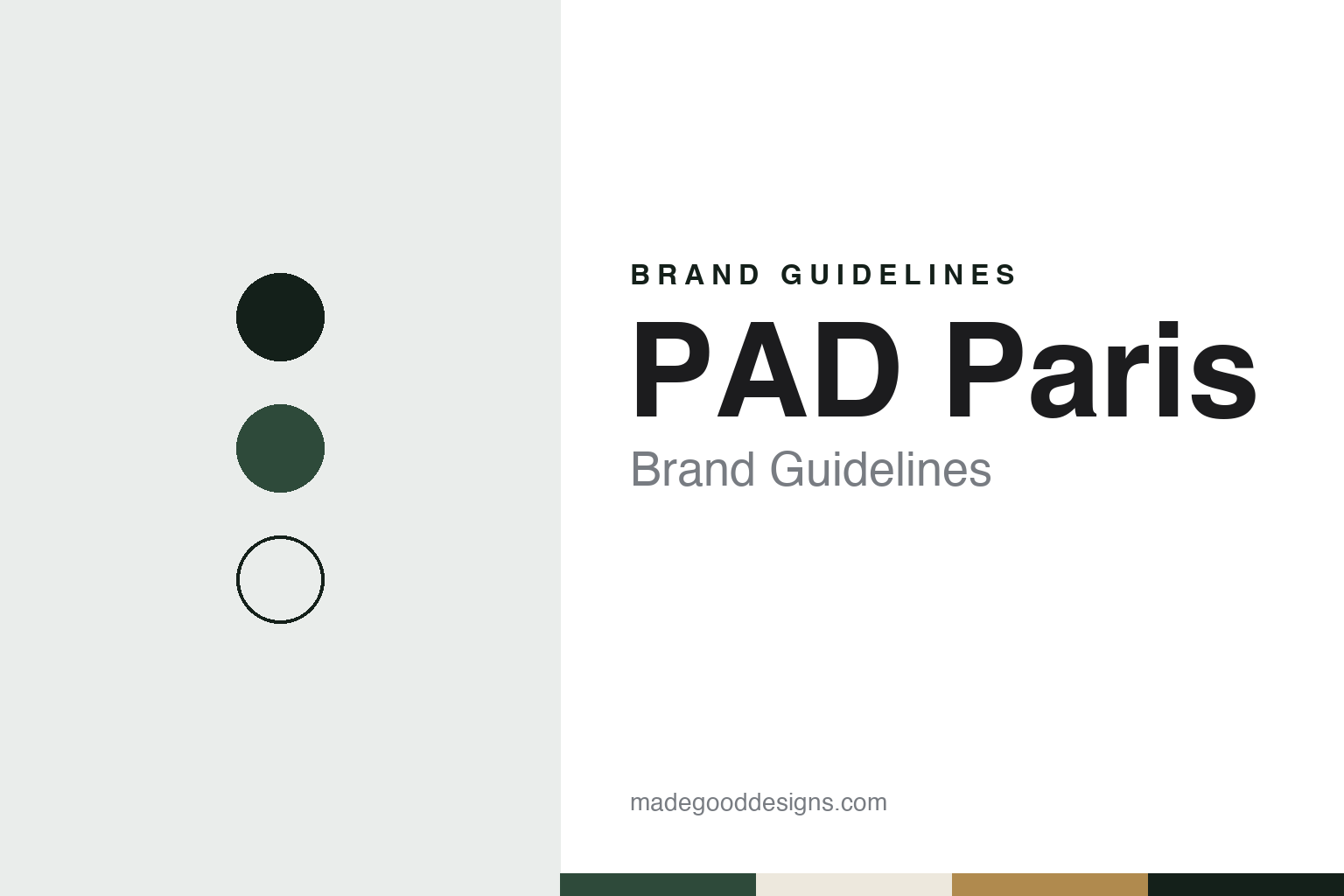
PAD Paris Brand Guidelines
The collectible-design fair in the Jardin des Tuileries since 1998.
Aa
Two constants: a garden green, linen and patina gold palette and a Didone serif register. Abstract homage — not a PAD Paris asset; no logo, poster or exhibited work is reproduced.
A pavilion in the garden
A design fair set up in the Tuileries each spring.
PAD Paris is a fair for collectible design held each spring in central Paris. PAD stands for Pavilion of Art & Design, as Time Out Paris spelled it out in March 2026, and the fair was founded in 1998 by Patrick Perrin, the date given by Time Out Paris, the collectible-design magazine TLmag in April 2026 and the Paris listings site Sortiraparis in January 2026. The organiser’s own website also says the fair was created in 1998. In a 2018 interview with The Art Newspaper, Perrin put the start of the fair in the Tuileries gardens at “21 years” earlier, a round figure that sits close to the 1998 date the other sources give.
Perrin launched the fair in the Jardin des Tuileries, the public garden in the centre of Paris, he told The Art Newspaper in 2018, and it has stayed there: TLmag called the garden the fair’s location again in 2026, and Time Out Paris described the 2026 edition as returning to the Tuileries. The setting is reflected in the name, which speaks of a pavilion rather than a hall.
The fair takes place in early April. The Art Newspaper’s French edition reported in April 2025 that PAD was settling into the Tuileries for its 27th year, at the same time as Art Paris, the modern and contemporary art fair. The 2026 edition was the 28th: it ran from 8 to 12 April 2026 with 77 galleries, according to both Time Out Paris and TLmag.
The organiser describes the fair as bringing together French and international galleries of historical and contemporary design, with each edition setting up a dialogue between the two. TLmag listed the range in 2026 as decorative arts, historic and contemporary design, jewellery, tapestries and contemporary art, shown in what it called an intimate setting.
Colour
Twentieth-century dealers and contemporary studios.
The fair’s exhibitor list mixes two groups. The Art Newspaper’s French edition described in 2025 a core of loyal dealers in twentieth-century decorative arts, once nicknamed the “antiquaires du XXe siècle,” the antique dealers of the twentieth century, alongside Paris galleries that commission and show new design. One dealer told the paper that the fair let exhibitors build themed stands around a historical moment, such as the modernism of the 1930s or Art Nouveau, presented as a kind of historical capsule.
The paper also reported that fifteen galleries were taking part for the first time in 2025, some from as far away as Mexico City, and that the fair had built links with modern and contemporary art galleries that also show design. In 2026 Time Out Paris named Galerie kreo and Carpenters Workshop Gallery among the exhibitors, galleries that it described as equally at home with twentieth-century classics and contemporary design.
Stands are arranged gallery by gallery rather than by period. TLmag noted in 2026 that each gallery presents its own scenography and curatorial point of view, so that a visitor moves from a room of mid-century furniture to a room of new studio pieces, then on to tapestry, ceramics or jewellery. Some exhibitors build complete interiors; TLmag described a 2026 group installation made of two symmetrical rooms, one read as an office and the other as a living room, joined by a narrow corridor.
The audience, as The Art Newspaper’s French edition described it in 2025, is made up of collectors, interior decorators and design professionals, and one exhibitor credited the fair’s team with bringing those visitors back each year. TLmag framed the fair in 2026 around the links between art, design and the decorative arts in the context of collecting, with each gallery bringing a selection of its own pieces, and noted a programme that shows young artists and makers next to established names from design and the decorative arts.
Typography
Fairs and their wordmarks.
Art, antiques and collectible-design fairs tend to present themselves through a short name: an acronym built from a longer title, such as FIAC or BRAFA, or a city-based name that ties the event to the place where it is held. These names are usually set in capitals and kept from one year to the next, while each edition adds its own dates, poster or key visual.
The organisers behind them vary. Some fairs are run by dealer associations or non-profit bodies set up by dealers; others by exhibition companies that also stage trade shows; others by charities, chambers of commerce or cultural bodies acting in an institutional role. A committee of dealers or a selection panel usually decides which galleries take part.
Most fairs last only a few days a year, in a landmark hall, a pavilion in a park, an armory or a modern exhibition centre, and many open with a preview or vernissage for invited guests before the public days. Stands are arranged by gallery and often grouped by period or field, from antiquities and Old Masters to modern and contemporary art and twentieth-century design, with talks, guided tours and a curated or younger-galleries section alongside the main aisles. Some fairs add outdoor works or partner venues elsewhere in the city.
For a design guide, these fairs show how an identity can rest on a few constants — a wordmark, a month and a building — while venues, organisers and sections change around them. The guides in this series describe those constants as dated sources record them, with our own colours and type as an unofficial interpretation, and with no rankings, no prices and no claims about the quality or importance of any fair, gallery or work.
Aa
A high-contrast Didone serif for an acronym set in capitals. (Specimen set in Bodoni Moda, a serif STAND-IN; NOT the PAD Paris logo.)
PAD
One acronym, more than one city.
The PAD name has travelled. Perrin told The Art Newspaper in January 2018 that he had launched PAD at Berkeley Square in London “11 years” before, which places the start of PAD London at around 2007. TLmag wrote in April 2026 that the London edition is held every October, so the two fairs sit at opposite ends of the year: Paris in the spring, London in the autumn.
In February 2018 Perrin also brought the format to Switzerland. The Art Newspaper reported that PAD Genève was launched with artgenève, the Geneva art fair, for its seventh edition from 1 to 4 February 2018, with 27 galleries of design, decorative arts, antiquities and jewellery in a separate hall linked to the art fair at the Palexpo exhibition centre. Perrin told the paper that he saw collectors in the region around Geneva with an interest in the decorative arts and design.
Across these editions the identity rests on the acronym. The name is short, written in capitals and followed by the city — PAD Paris, PAD London — so that a single three-letter mark can carry several fairs. The full English name, Pavilion of Art & Design, describes the format plainly: a pavilion, not a convention hall, and art alongside design. The Tuileries setting gives the Paris fair its own imagery of a garden and a temporary building, and a spring date fixed in the calendar.
For a design guide, PAD Paris shows how a fair can build an identity from a short acronym, a fixed season and a single setting. Compare Design Miami, another fair built around collectible design, and Art Paris, the art fair held in Paris in the same April week. For this guide we use a garden green, a soft linen and a patina gold with a serif, an unofficial interpretation; no product or logo is reproduced.
Explore & save
Keep PAD Paris’s identity on hand — save it to a board in the Made Good inspiration library.
PAD Paris identity set
Pin the PAD Paris garden green, linen and patina gold palette and the Didone serif register to your own board.
Source & notes
Frequently Asked Questions
What font can I use to match the PAD Paris look?
This guide describes PAD Paris’ type as “A high-contrast Didone serif for an acronym set in capitals”. Its type specimen is set in Bodoni Moda from Google Fonts as a stand-in; Bodoni Moda is not PAD Paris’ own lettering.
What colours are in the PAD Paris palette?
This guide’s PAD Paris palette is Garden green #2E4A3A, Pavilion night #14201A, Linen #EDE8DD, Patina gold #B08A4E and Paper #F8F6F1. The tones are the guide’s own unofficial interpretation, not official PAD Paris hex codes.
When was PAD Paris founded?
PAD Paris was founded in 1998, in Paris, France.
Who founded PAD Paris?
PAD Paris was founded by Patrick Perrin in 1998.