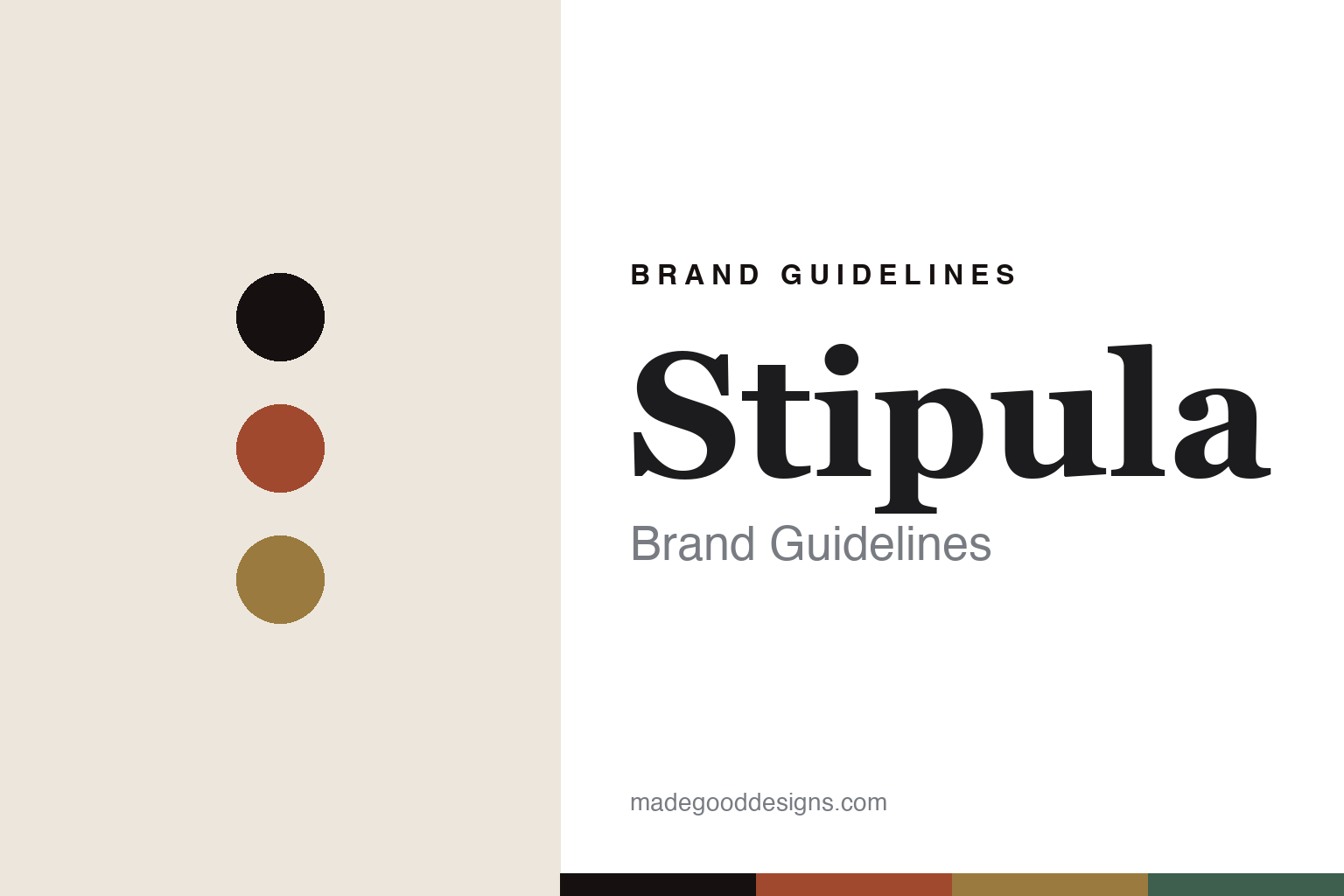
Stipula Brand Guidelines
The Florentine workshop.
Aa
Two constants: a terracotta-and-gold palette and a Florentine serif register. Abstract homage — not the Stipula pen or packaging.
The Florentine workshop
Stipula hand-makes pens from artisanal materials in Florence.
Stipula is a lesson in artisanal craft as identity. A Florentine house that works from a studio at Vallina on the Arno, it traces its craft lineage to 1945, when a teenage Renzo Salvadori found his talent for pen-making in post-war Florence.
Its identity is artisanal materials, hand-made: Stipula works in celluloid, ebonite (hard rubber) and its own exclusive in-house resins, shaped by a workshop of nib masters, modellers, miniature painters and goldsmiths — and it still uses historic Globus (Bologna) nib tooling from the 1930s. The flagship is the Etruria line, an Etruscan nod to its Tuscan home.
(Honest notes: the founding date is best given carefully — the brand traces its craft to 1945, while the commonly-cited “1973” brand-founding year we could not verify, so we avoid asserting it. The “T-Flex” flexible nib, the “Suprema” resin and the Latin name-meaning (“stipula,” a stalk used to seal old contracts) are widely repeated but reported rather than confirmed. There’s no official brand hex, so these tones are an unofficial interpretation. This is design commentary and does not promote any product.)
Colour
Stipula lives in a terracotta-and-gold palette. Click a swatch to copy the hex.
Stipula’s identity is artisanal, Florentine and warm — an Etruscan terracotta, an ink, a Florence gold, an Arno green, and a cream. The palette pairs an Etruscan terracotta with a Florence gold — the register of Tuscan earth and Renaissance metal. It signals craft and place rather than gloss. The honest caveat: with no published brand hex, these tones are an original, unofficial interpretation, not first-party values.
The lesson is a terracotta with a gold signals an artisanal, Florentine brand. Stipula’s world is a hand-turned pen from a Tuscan workshop. For designers, it is a reminder that an earthy, place-derived palette reads as artisanal and warm — right for a Florentine maker. The takeaways: work expressive materials (celluloid, ebonite, in-house resin); root it in a place (Florence, Etruria); keep it hand-made; and treat any single hex as unofficial.
Typography
The register is a Florentine serif — classical, warm, artisanal.
Stipula’s identity carries a classical, warm, artisanal spirit — a Tuscan workshop and a hand-turned pen. A classical Roman serif captures the mood: it is timeless and warm, the register of Florence. Set in a terracotta-and-gold palette, the Florentine serif feels classical and warm — exactly the personality Stipula carries. It is artisanal rather than slick, mirroring a hand-made object. (Stipula’s real pens and wordmark are works we describe but do not reproduce, and the exact typeface is not ours to use.) Because it is not ours to use, the honest description is “a Florentine serif spirit,” shown here in a stand-in. The type behaves like the brand: classical, warm and artisanal.
Aa
A Florentine serif spirit — classical and warm. (Specimen set in Marcellus, a classical Roman serif STAND-IN; NOT the Stipula packaging.)
Artisanal craft as identity
Stipula stands for the Florentine hand-made pen.
Stipula is a lesson in making artisanal craft the identity. A terracotta-and-gold palette, a Florentine serif and hand-made materials make craft the whole brand — classical, warm, artisanal. The craft is the differentiator. The differentiator is a Florentine, hand-made identity.
For designers and brand-builders, Stipula offers a clear takeaway: let the workshop and the materials lead. The lessons: work expressive materials (celluloid, ebonite, in-house resin); keep it hand-made; root it in a place (Florence); and be honest about the dates. It is also a reminder to stay accurate: the craft traces to 1945, the “1973” brand year is unverified, and the palette here is an unofficial interpretation. Stipula made artisanal craft the brand — proof that a workshop can be the difference.
Explore & save
Keep Stipula’s identity on hand — save it to a board in the Made Good inspiration library.
Stipula identity set
Pin the terracotta-and-gold palette and the Florentine-serif register to your own board.