Tallinn Architecture Biennale Brand Guidelines
A Baltic architecture festival built around competitions and pavilions.
Aa
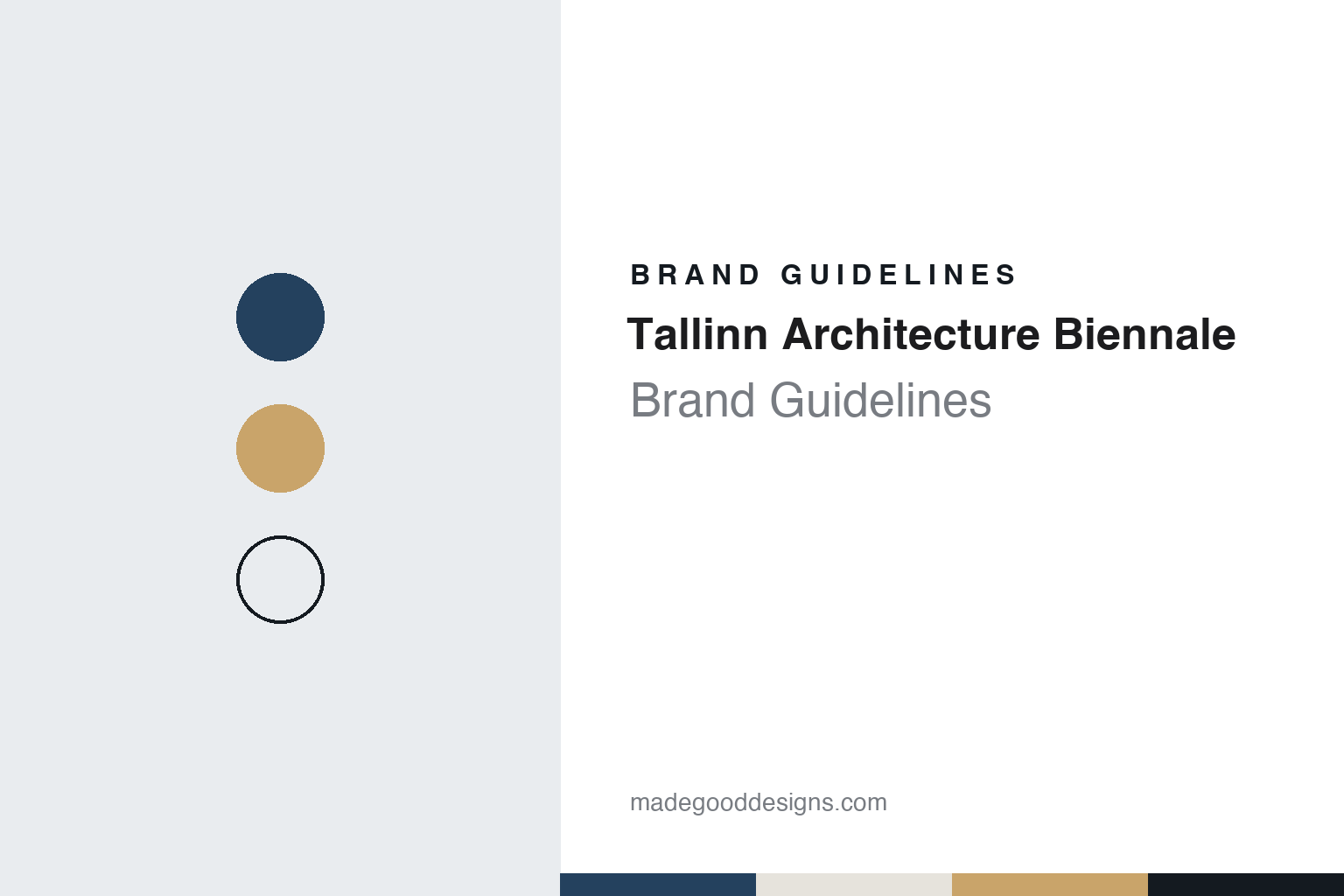
Two constants: a Tallinn Architecture Biennale blue, limestone and plywood palette and a Plain grotesque register. Abstract homage — not a Tallinn Architecture Biennale asset or mark; no logo, poster or pavilion is reproduced.
Landscape Urbanism
A festival held since 2011.
The Tallinn Architecture Biennale, shortened to TAB, is an international architecture festival held in the Estonian capital. It is organised by the Estonian Centre for Architecture, which said in February 2023, announcing a curatorial competition, that the festival had been held since 2011. Dezeen described it on 15 October 2026 as an international architecture and urban planning festival that has taken place in Tallinn every two years since 2011.
The first edition, in 2011, was titled Landscape Urbanism and curated by Villem Tomiste, according to the biennale’s own history. Later editions followed in 2013, with Recycling Socialism, which the biennale says looked again at the Soviet-era urban environment of Tallinn; in 2015, with Self-Driven City, about future cities with self-driving cars; and in 2017, with bioTallinn, about the boundary between the natural and the artificial. The 2019 edition, Beauty Matters, was curated by Yael Reisner and, the biennale says, argued that beauty matters again in architecture.
The sixth edition came in 2022. Titled Edible; Or, The Architecture of Metabolism, it approached food both literally and metaphorically, according to the biennale. The seventh edition followed in 2024 and the eighth in 2026.
Each edition has its own curator or curatorial team, chosen through a curatorial competition. In February 2023 the Estonian Centre for Architecture opened the competition for the seventh edition, TAB 2024, describing a programme aimed at practitioners at the top of the field, young professionals just starting out and a broader audience of architecture enthusiasts.
Colour
Exhibitions, a symposium and pavilions.
A TAB edition is built from several parts rather than one show. The biennale lists a curatorial exhibition, a symposium, an installation competition, a vision competition and a satellite programme, and for 2026 a special TAB issue of the Estonian architecture magazine MAJA.
The 2024 edition shows the format. ArchDaily reported on 14 October 2024 that TAB 2024 had opened at the Museum of Estonian Architecture and at other venues in the city centre, under the theme Resources for a Future, with a head curator and two co-curators. The event ran through October and November 2024 with free participation, the magazine wrote. Its curatorial exhibition was organised in three sections — Social Intelligence, Building Concept and Material Formation — and a symposium took place on 11 October at the Estonian Academy of Arts. The edition’s installation competition, titled For-This-Situation, asked entrants to design public infrastructure from materials repurposed from local suppliers, with an emphasis on reused and bio-based materials, ArchDaily reported.
The installation programme gives each edition a built object in the street. For 2019, Dezeen reported on 16 October 2019, a team of London-based designers built a twisting timber and steel pavilion from steam-bent boards, using digital models projected in augmented reality as construction guides in place of line drawings. Dezeen also recalled in 2026 that earlier central pavilions had included a puzzle-like structure partly designed by the public and a bus shelter built from reclaimed materials.
Typography
Design and documentation.
Architecture biennials, triennials, festivals and open-house events usually take their names from the city that holds them. Most combine the place with words such as architecture, urbanism, biennale, triennial, festival or open house, and many are shortened to an acronym or a few initials, so that the name works as a date in the calendar as much as a title.
The bodies behind them vary. Some are hosted by city governments or public agencies acting in an institutional role; others are run by architecture centres, professional institutes, foundations, non-profit organisations or media and events companies. Several share an organiser with a permanent architecture centre or exhibition hall in the same city, and some work in partnership with a neighbouring city or a network of sister events abroad.
What they share is a programme spread across a city rather than gathered in one hall. Exhibition halls, reused industrial buildings, stations, plazas and parks hold curated exhibitions and installations, while talks, tours, workshops and, in open-house events, buildings opened to the public for a weekend or a week, often with volunteer guides, carry the programme into the streets. Biennials and triennials tend to work with a director or curatorial team and a yearly theme; festivals and open-house events often depend on many independent hosts.
Visual identity follows the same pattern. A steady name or wordmark carries from edition to edition, while each director or curator brings a new title, key visual and set of venues. This guide describes each event from its own first edition, using dated sources for organisers, venues, dates and themes, and sets an unofficial palette and type stand-in beside it; no logo or key visual is reproduced.
Aa
A plain grotesque — three letters, TAB, and a year. (Specimen set in Archivo, a sans STAND-IN; NOT the Tallinn Architecture Biennale logo.)
How Much?
The eighth edition, 2026.
The eighth Tallinn Architecture Biennale, TAB 2026, runs from 9 September to 30 November 2026, with an opening week from 9 to 13 September, the biennale says. Titled How Much?, it asks what the built environment really costs and who pays for it, and it is co-curated by a five-person team: three architects from a Tallinn studio, with two further co-curators, one of them from Austria. The programme was launched on 2 June 2026 with a landscape planting on the roof of Tallinn Linnahall, which the biennale describes as a monumental building that has stood empty for decades; Linnahall also hosts the curatorial exhibition, opened on 9 September.
A two-day symposium took place on 10 and 11 September at the Estonian Academy of Arts. The installation competition, titled Budget Bougie, was won by a pavilion called Resonance, designed by a studio based in Shanghai and Tokyo and unveiled in front of the Museum of Estonian Architecture on 10 September. Dezeen reported on 15 October 2026 that the pavilion is a square, inward-facing courtyard on a traffic island, built from rebar, rope, limestone and plywood, and designed so that it can be taken down at the end of the festival. A vision competition exhibition about a site on the southern edge of the Old Town opened on 16 October in the outdoor gallery at Tammsaare Park, and a satellite programme of film, music, performing arts, education and public-space events extends to Tartu and Kuressaare, the biennale says. It names the Ministry of Culture, the Cultural Endowment of Estonia and the City of Tallinn as the 2026 edition’s funders.
The biennale presents itself mostly through its three letters: TAB, followed by the year, as in TAB 2024 or TAB’26. The sources used here describe themes, curators and pavilions rather than a logo or a house typeface, so the colours and type on this page are our own. Our palette takes its cue from the 2026 pavilion’s materials as Dezeen lists them: a pale limestone and a warm plywood, set against a deep Baltic blue and a near-black ink.
For a design guide, the Tallinn Architecture Biennale shows how a short acronym and a year can carry an event whose theme, curators and pavilion change every edition. Compare Oslo Architecture Triennale, another architecture event in northern Europe, and Chicago Architecture Biennial, another architecture biennial. For this guide we use a Baltic blue, a limestone grey and a plywood tan with a sans, an unofficial interpretation; no product or logo is reproduced.
Explore & save
Keep Tallinn Architecture Biennale’s identity on hand — save it to a board in the Made Good inspiration library.
Tallinn Architecture Biennale identity set
Pin the Tallinn Architecture Biennale blue, limestone and plywood palette and the Plain grotesque register to your own board.
Source & notes
Frequently Asked Questions
What font can I use to match the Tallinn Architecture Biennale look?
This guide describes Tallinn Architecture Biennale’s type as “A plain grotesque — three letters, TAB, and a year”. Its type specimen is set in Archivo from Google Fonts as a stand-in; Archivo is not Tallinn Architecture Biennale’s own lettering.
What colours are in the Tallinn Architecture Biennale palette?
This guide’s Tallinn Architecture Biennale palette is Baltic blue #24415E, Ink #141A20, Limestone #E6E3DC, Plywood #C9A46A and Paper #F7F6F3. The tones are the guide’s own unofficial interpretation, not official Tallinn Architecture Biennale hex codes.