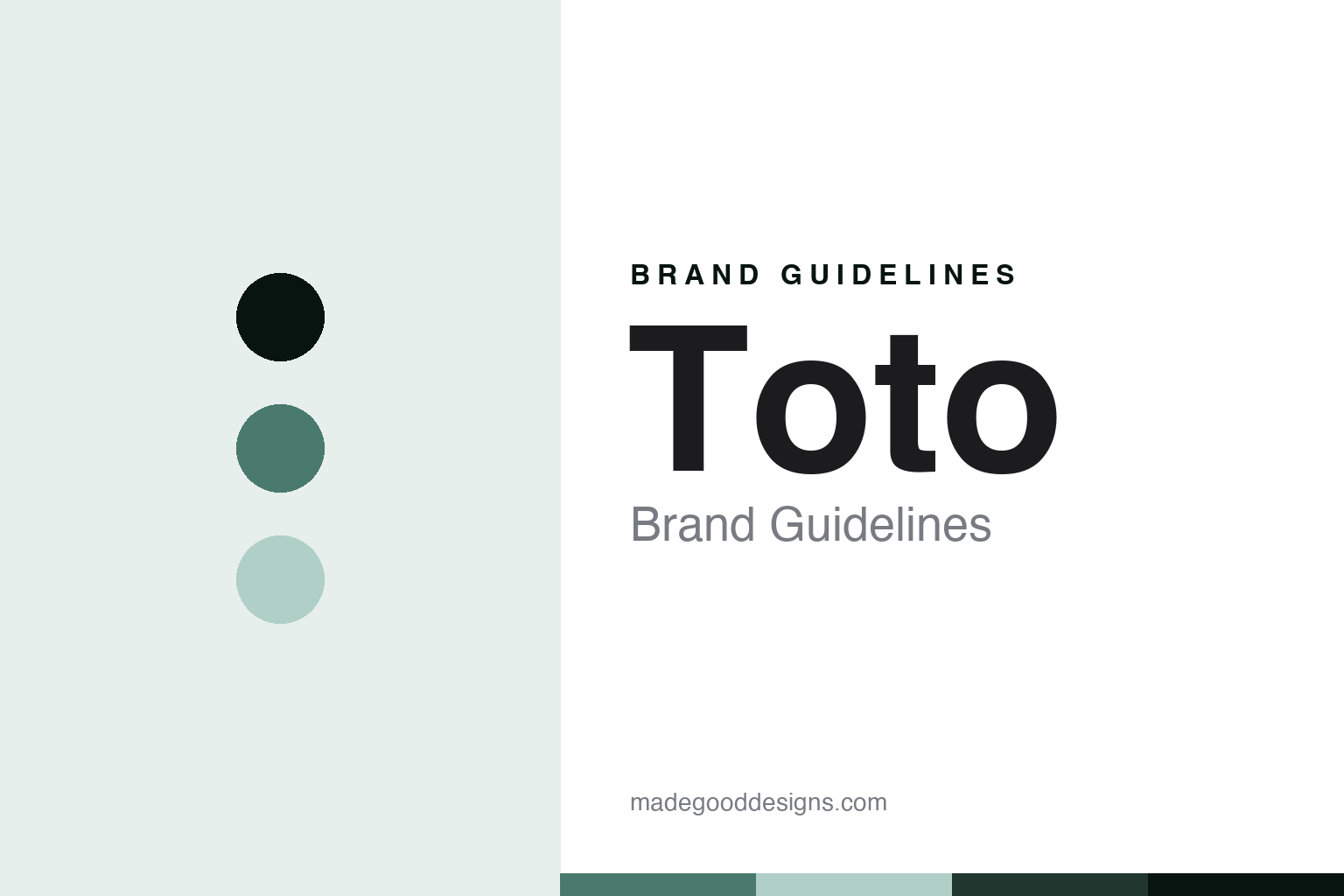
Toto Brand Guidelines
The Washlet house.
Aa
Two constants: a celadon palette and a ceramic-sans register. Abstract homage — not a Toto product or mark.
The Washlet house
Toto is the Japanese fixtures house of 1917, maker of the Washlet, listed in Tokyo and made across a global network.
Toto is the vein’s Japanese ceramics giant — a Kitakyushu house that grew from sanitary pottery into the maker of a fixture the world now copies. Toto makes bathroom fixtures: toilets and the Washlet bidet seat, faucets and taps, basins, baths and showers. Its answer to how a maker becomes a name is a category-defining product: refine sanitary ceramics for a century, then add the Washlet and make cleanliness itself the brand. A fixture, engineered clean.
Its identity is the Washlet house. Toto’s Washlet, its ceramics heritage and its Japanese engineering are the work it is known for, including its taps and faucets. A fixture, from Japan. The Washlet house.
(Honest notes, so the story stays precise. Toto — TOTO Ltd., at toto.com — makes toilets and the Washlet bidet seat, faucets and taps, basins, baths and showers, plus the Neorest line. It was founded on 15 May 1917 as Toyo Toki, meaning Oriental Ceramics, in Kitakyushu, Fukuoka, Japan, credited to founder Kazuchika Okura; the name evolved from Toyo Toki to Toto Kiki in 1970 and to TOTO Ltd. in 2007. The Washlet, its signature, launched in 1980 and Neorest in 1993. On where it is made — a theme of this vein — Toto is a Japanese house with a global manufacturing footprint, across roughly nine countries, including Japan and a long-standing US plant at Morrow, Georgia, so we say Japanese heritage with global making rather than all-Japanese. On ownership, it is an independent, publicly listed Japanese company, on the Tokyo Stock Exchange, with no foreign parent. Washlet and Neorest are registered marks, capitalised and described but never reproduced; the Japanese origin is treated respectfully, and there is no official brand hex, so these tones are an unofficial interpretation. This is design commentary and does not promote any product.)
Colour
Toto lives in a celadon palette. Click a swatch to copy the hex.
Toto’s identity is clean, made and engineered — a celadon, an ink, a pale jade, a deep celadon, and a paper. The palette leans celadon and pale jade: a glazed-ceramic register that nods to a century of sanitary pottery. It signals a fixtures and ceramics house. The honest caveat: with no published brand hex, these values are an original, unofficial interpretation, not first-party colours, and the celadon is a respectful nod, not a Toto asset.
The lesson is a celadon palette signals a clean, ceramics-heritage identity. Toto’s world is a clean, engineered object. For designers, it is a reminder that a soft celadon and a pale jade can carry a fixtures maker — the glaze of fired sanitary ceramic. Because these tones can fail as small text, keep type dark and let the colour live in the accents, palette and band. The takeaways: perfect the ceramic; add one category-defining product; be honest about a global make; and treat any single hex as unofficial.
Typography
The register is a ceramic sans — clean, precise, made.
Toto’s identity carries a clean, precise, made spirit — an engineering-and-ceramics house, not a fashion brand. A ceramic sans captures the mood: hygienic, exact and Japanese, the register of a fixture engineered for cleanliness. Set in a celadon palette, the ceramic sans feels clean and precise — exactly the personality Toto carries. It is a category-defining product rather than a logo, mirroring glazed ceramic and clean water. (Toto’s real wordmark, and the Washlet and Neorest marks and forms, are things we describe but do not reproduce, and the exact typeface is not ours to use.) Because it is not ours to use, the honest description is “a ceramic-sans spirit,” shown here in a stand-in. The type behaves like the fixture: clean, precise and made.
Aa
A ceramic-sans spirit — clean and made. (Specimen set in Mulish, a ceramic-sans STAND-IN; NOT the Toto logo.)
The tap makers
Toto stands for the Washlet house, made in Japan and beyond.
Toto is a lesson in how a category-defining product can be an identity. A celadon palette, a ceramic sans and a Washlet make one thing — the Washlet house — the whole identity: clean, made and engineered. The Washlet is the differentiator, and the century of ceramics is the meaning. The point is a Japanese house that refined sanitary ceramics from 1917, then defined a category with the Washlet, and makes fixtures worldwide.
Put to work, the identity is a category-defining product, told straight, as design. A maker in this spirit would perfect the ceramic and add one great product — the Washlet, from Kitakyushu. A reader in this spirit would keep the make honest: Toto is a Japanese house, but it manufactures across roughly nine countries, including a US plant in Georgia, so it is Japanese-and-global, not all-Japanese. Toto holds the vein’s around-the-world thread as the Japanese fixtures giant, its who-owns-it thread as the listed independent among consolidated peers, and its where-made thread at the global end with Grohe and Kohler. The honest editorial moves are to date the founding to 1917, to capitalise Washlet and Neorest as marks, and to state the global making. The lesson Toto teaches is that a category-defining product can hold an identity: the ceramics heritage gives it substance, and the Washlet keeps it credible.
For designers and brand-builders, Toto holds a Japan pole in the tap makers: define a category — and be honest about a global make. The lessons: perfect the material; invent the product others copy; make it globally but say so; respect the origin; and never reproduce a logo. It is also a reminder to stay precise: Toto is the Japanese fixtures house of 1917, maker of the Washlet, listed in Tokyo and made across a global network — with the palette here an unofficial interpretation. Read that way, Toto is less a tap maker than a cleanliness engineer: a ceramics house that decided the bathroom could be quietly, precisely better, and made that idea a global standard. Toto made the-Washlet-house the identity — proof that a fixture, honestly told, can be the difference.
Explore & save
Keep Toto’s identity on hand — save it to a board in the Made Good inspiration library.
Toto identity set
Pin the celadon palette and the ceramic-sans register to your own board.