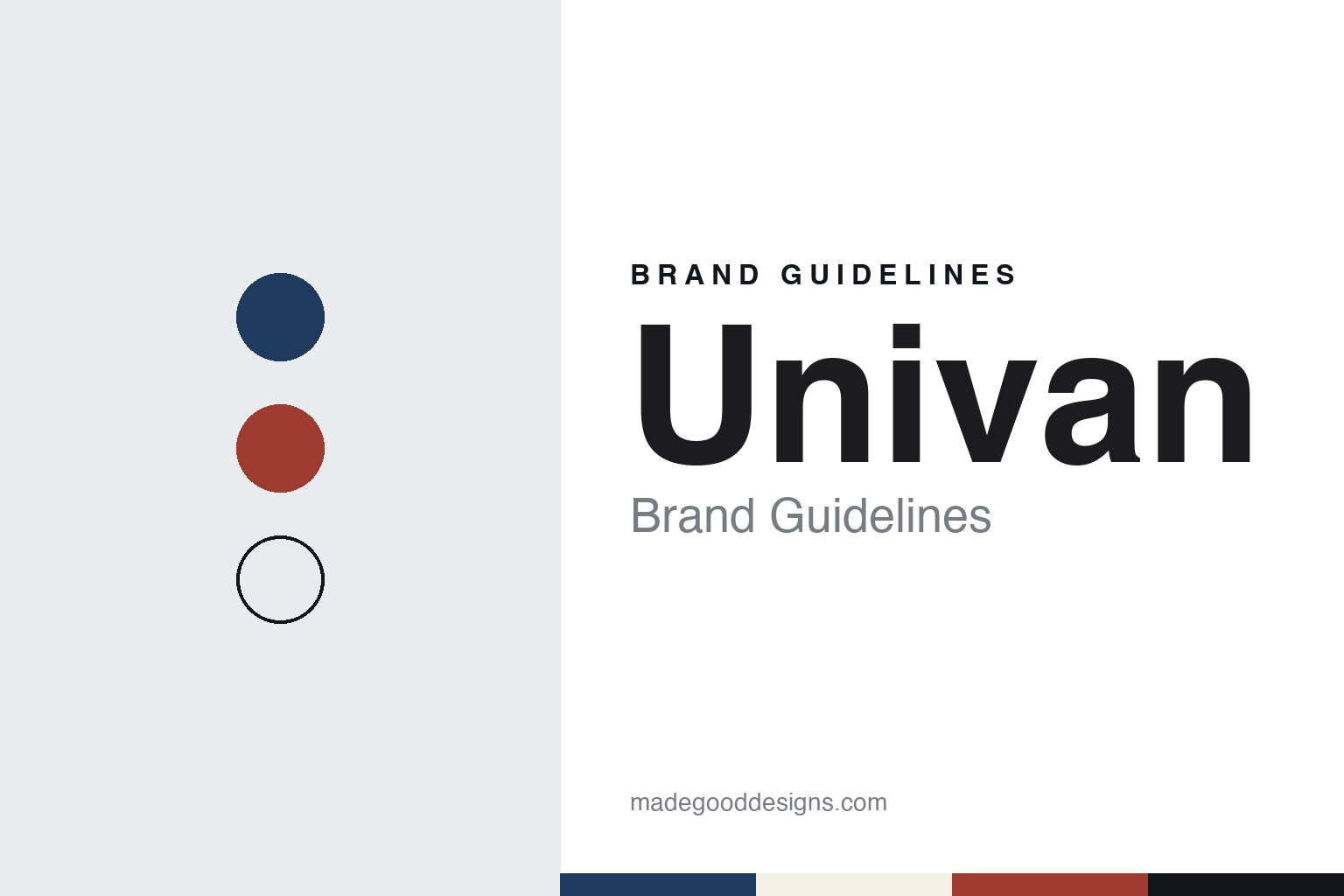
Univan Brand Guidelines
A Hong Kong ship manager of 1973 that merged with Anglo-Eastern in 2015.
Aa
Two constants: a harbour navy, hull red and chart paper palette and a plain maritime sans register. Abstract homage — not a Univan or Anglo-Eastern asset; no flag, logo or livery is reproduced.
United Vanderperre
A captain’s ship manager in Hong Kong.
Univan began in Hong Kong in 1973. English Wikipedia, citing the company’s own page about its founder, names Captain C. A. J. Vanderperre as the man who set it up, and explains the name as a contraction of “United Vanderperre”. The same article repeats the company’s description of him as the father of third-party ship management; that phrase comes from Univan itself rather than from an outside history, and it is the company’s view of its own place in the trade.
Third-party ship management was the business Univan was built around: looking after vessels that belong to other owners. English Wikipedia lists the services as ship management, ship chartering, inspection, conversion supervision, newbuilding supervision and crew management, and gives the head office as North Point, on Hong Kong Island.
The early milestones are modest and specific. According to English Wikipedia, Univan took its first ship under technical management in 1975, a tanker named “Sun Clipper”. In 1976 it opened its own manning office in Mumbai, the first of several offices it would run in India. Between 1989 and 1991 it added manning offices in Manila, Yangon and New Delhi. Chennai followed in 1994 and Kochi in 1995, then Kolkata in 2006, Dalian in 2008 and Tokyo in 2010. By 2010, then, a Hong Kong head office sat at the centre of offices in India, the Philippines, Myanmar, China and Japan, and English Wikipedia also lists offices in Dubai. The company had grown from one managed tanker in the mid-1970s to a manager with crewing and training bases across Asia.
Colour
Academies, simulators and partners.
Training was a large part of how Univan described itself. English Wikipedia says the company opened its first training academy in Kochi in 1996 and a much larger centre in Mumbai in 2005, run as the Univan Maritime Training Academy, or UMTA. In 2006 the Mumbai site added a ship-manoeuvring simulator and a full-mission liquid cargo handling simulator, covering five oil, chemical and gas cargo handling set-ups, and a further academy followed in Manila. The article also mentions cadet courses and courses under STCW, the international convention on seafarer training, certification and watchkeeping.
The company also worked through partnerships. English Wikipedia lists joint ventures over the years with partners that include Torben Karlshoej, who went on to found Teekay, the Mediterranean Shipping Company, the shipbroker Clarksons and the Vlasov family behind V-Ships. In the early 2000s, the same article says, Captain Vanderperre set up a ship-owning joint venture, Vanship Holdings, with a fleet of very large crude carriers and some bulk carriers that Univan managed; those ships were sold in 2010.
Industry awards followed in the 2010s. English Wikipedia records Univan as Ship Manager of the Year at the Lloyd’s List Asia Awards in 2012 and again in 2014, and lists further shortlistings and commendations at Lloyd’s List and Seatrade events in 2012 and 2013. These were trade awards for ship management rather than design prizes.
The people Univan trained and employed also spread through the industry. One example comes from Singapore: Executive Ship Management says its founder, the marine engineer B. S. Teeka, sailed with Hong Kong-based Univan Ship Management before he moved ashore and later set up his own company there in 1998.
Typography
The ship manager as a brand.
Third-party ship managers sell a service rather than a product. They run vessels that belong to someone else, so their identities have no hull, funnel or cargo of their own to show. Instead they present themselves through the work: technical management, crewing, newbuilding supervision and the training of seafarers. V.Group, for example, describes itself as “an independent service provider, not a ship owner or a manufacturer,” and Anglo-Eastern says it manages vessels on behalf of shipowners, charterers and operators.
Their marks tend to be simple and sit on corporate websites. Blue and teal wordmarks are a familiar sight in the trade, but not a rule: V.Group’s logo files come in green and black versions, and Anglo-Eastern’s header pairs a white wordmark with a golden emblem. Around those marks sit photographs of ships and crews as the companies publish them — a managed vessel at sea, a simulator room, cadets with their teachers or on graduation day.
The websites follow a common plan. There are service pages for technical management and crewing, often split by vessel type, from tankers and bulk carriers to LNG carriers and cruise ships. Training-centre pages show simulators and classrooms; Anglo-Eastern, for instance, runs its own academy and training centres in India and the Philippines. Office maps and location lists stretch across Asia and Europe, and careers-at-sea pages set out cadet programmes and routes to promotion.
This guide looks at how each manager tells that story: who founded it, who owns it, which mergers shaped it, and how it describes its services and its seafarers. Figures for fleets, staff and offices are given as the companies or dated reports state them, and each palette here is an unofficial interpretation, not a brand standard.
Aa
A plain maritime sans for a founder’s name. (Specimen set in Archivo, a sans STAND-IN; NOT the Univan logo.)
Univan
Into the Anglo-Eastern Univan Group, 2015.
Univan did not stay independent. On 17 August 2015, World Maritime News, now published as Offshore Energy, reported that Univan and Anglo-Eastern, another third-party ship manager, had decided to merge their activities and form a new company, the Anglo-Eastern Univan Group. The merger had been announced late on the previous Friday. The new company, the report said, would take on more than 600 vessels, 100 of them under crew management, with a pool of more than 24,000 seafarers and more than 1,700 shoreside staff. Anglo-Eastern’s Peter Cremers was to be chairman and Univan’s Bjørn Højgaard chief executive, and for the time being the two would keep operating as separate entities from their existing offices in Singapore and Hong Kong.
Anglo-Eastern’s own timeline records the same step: in August 2015 it merged with Hong Kong-based Univan Ship Management, giving a combined fleet of more than 600 ships under management. English Wikipedia says that after the merger the business was renamed the Anglo-Eastern Univan Group. Anglo-Eastern’s next listed milestone, in October 2017, was its first rebranding exercise in more than 40 years, which introduced newly articulated values and a refreshed visual identity. Its website now presents the group simply as Anglo-Eastern, with its head office in Hong Kong, more than 700 vessels under full technical management, another 500 under crew management, more than 39,000 seafarers and over 2,200 shore employees, figures the company gives for itself in 2026.
Since that 2015 merger Univan has been part of Anglo-Eastern rather than a stand-alone ship manager, and its name lives on mainly in the group’s history and in the 2015 combined title.
For a design guide, Univan shows how a ship manager’s name can come straight from its founder and then fold into a merged group’s identity. Compare Anglo-Eastern and V-Ships. For this guide we use a harbour navy, a hull red and a pale chart-paper tone with a sans, an unofficial interpretation; no product or logo is reproduced.
Explore & save
Keep Univan’s identity on hand — save it to a board in the Made Good inspiration library.
Univan identity set
Pin the Univan harbour navy, hull red and chart paper palette and the plain maritime sans register to your own board.