Sanborns Brand Guidelines
A 1903 drugstore, a tiled palace and three owls on a branch.
Aa
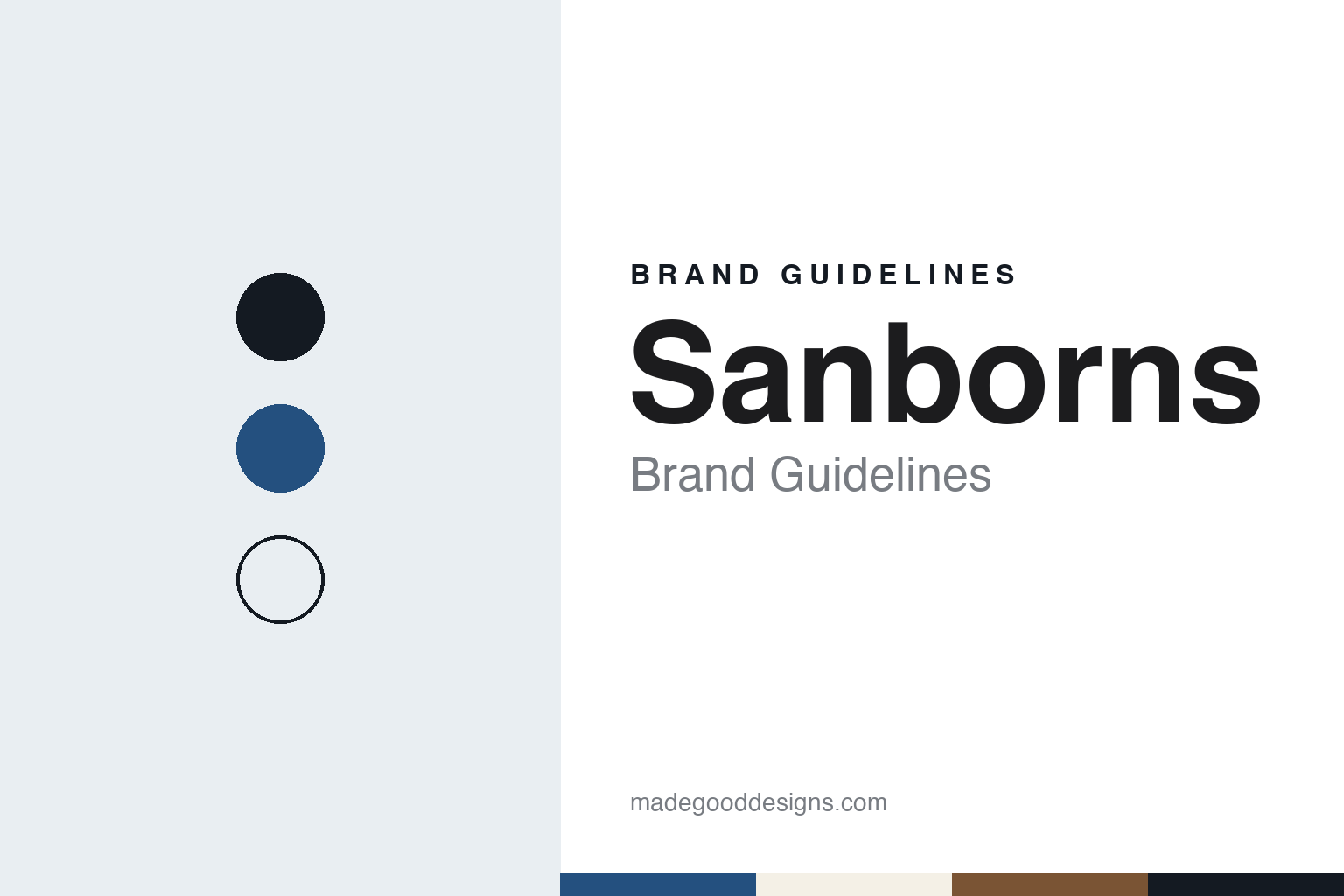
Two constants: a Sanborns tile blue, glaze white and owl brown palette and a Classic serif register. Abstract homage — not a Sanborns product or mark; no logo, sign or shopfront is reproduced.
Two brothers and a drugstore
Madero Street, 1903.
Sanborns began as a pharmacy. Walter Sanborn, a newly licensed American pharmacist, went to Mexico in 1898 and worked in a Mexico City apothecary shop, and his brother Frank followed; in 1903 the brothers opened their own drugstore in the city, the International Directory of Company Histories says. English Wikipedia, citing a 2018 York University doctoral thesis on the chain by Kevin Chrisman, places that shop on San Francisco Street, today’s Madero Street, near the Alameda, and says the company dates its founding to 19 June 1903. The two sources name the first shop differently: the Directory calls it Farmacia América and English Wikipedia the Sanborns American Pharmacy. Both agree that the business took the name Sanborn Hermanos, Spanish for Sanborn Brothers, in 1907.
The brothers built the trade on service. According to the Directory, they dropped the commission that doctors then took for sending prescriptions to a pharmacist, and sent medicines out with bicycle messengers. They also began serving lunch to staff and then sandwiches to customers, and in 1910 they brought a soda fountain from the United States; the soda fountain grew into a restaurant. That mix of counter, kitchen and shop is still the core of the brand.
In 1919 the business moved into the Casa de los Azulejos, the House of Tiles, in the historic centre. English Wikipedia describes the building as an eighteenth-century Baroque palace of the Counts of the Valle de Orizaba, whose façade a countess of the family had covered on three sides in 1737 with blue and white Talavera tiles from Puebla; from 1881 its top floor had been rented to the Jockey Club. Sources differ on the opening: English Wikipedia, citing Chrisman, says the Sanborns rented the house in January 1919 and opened the new store there on 11 October 1919, while the Directory dates the opening to 1921. The old central courtyard became the main dining room, and in 1925 José Clemente Orozco painted the mural Omnisciencia on the main staircase. Sanborns bought the building from the Iturbe family in 1978, English Wikipedia says, and it remains the chain’s flagship.
Colour
Silver, a soda fountain and a junior department store.
From the start Sanborns sold more than medicine. In the early 1920s Frank Sanborn set craftsmen to work making silver to the company’s own designs, the Directory says, and by the middle of the century the shop also sold the work of some 1,300 craftspeople in wood, wool, glass, pottery, leather and other materials. Waitresses in the tiled courtyard wore costumes from the Isthmus of Tehuantepec, it adds. In his 1946 chronicle Nueva grandeza mexicana, the writer Salvador Novo described the Madero Street store as a place to eat or to buy toothpaste, a suit, silver, trinkets, paintings or sweets, English Wikipedia notes.
That range became the format. In 1953 the company opened a four-storey store on the Paseo de la Reforma, which the Directory calls a virtual department store, with a restaurant, a soda fountain, a drug department, cosmetics, clothing, household goods, crafts, photographic supplies and a bakery under one roof. Today English Wikipedia describes Sanborns as a chain that combines a sit-down restaurant, usually with a bar, and a junior department store selling books and magazines, electronics, music, toys, cosmetics, sweets and gifts, with a pharmacy counter. The restaurant’s signature dish, it says, citing the company, is enchiladas suizas, chicken enchiladas with cheese and green sauce. Sanborns Café is a restaurant-only format.
The mark is a picture rather than a monogram. Spanish Wikipedia describes the logo and mascots as three owls standing on a branch with a crescent moon behind them, and the sign with the three owls hangs at the Casa de los Azulejos. English Wikipedia says the owls are said to stand for Frank Sanborn and his two sons. For a designer the useful lesson is how much of the identity lives in a building: the blue and white tiles, the courtyard dining room and the Orozco staircase carry much of what the chain looks like.
Typography
Design and documentation.
The department stores of Mexico and Chile are big, city-centre and shopping-mall businesses, and their identities are carried as much by buildings as by logos. Two of the oldest, Liverpool and El Palacio de Hierro, began as nineteenth-century clothing and fabric shops in the historic centre of Mexico City, and Liverpool’s corporate history page still traces the chain back to that first shop of 1847 and lists, year by year, its moves into shopping centres and other cities.
Store naming is often plain description or a borrowed place. El Palacio de Hierro, according to English Wikipedia, took its name from the iron-and-steel building that rose in the 1880s; Liverpool, Spanish Wikipedia says, was named after the English port its imported goods were shipped from. Branches then take the name of the district or mall they anchor, so a shopper meets the brand as “Liverpool Insurgentes” or “Liverpool Polanco,” and Spanish Wikipedia writes of “Palacio Polanco.”
The flagship façade does a great deal of the work. Downtown stores keep their early buildings, and newer flagships are built as architecture in their own right — El Palacio de Hierro’s Polanco store, reopened in 2015, has floors themed on districts of the city. Seasonal campaigns are just as visible: El Financiero has described Liverpool’s recurring Venta Nocturna sales, held over two or three days several times a year, and the Christmas tree that El Palacio de Hierro raises in front of its Polanco store with a luxury partner: Dior in 2025 and Swarovski in 2026.
Store cards carrying the chain’s name are part of the picture too: El Financiero notes that Liverpool pitches some sale offers to its own cardholders, though this guide does not describe the credit products themselves. Corporate pages also set out owners and listings: both Mexican groups have long been listed on the Mexican Stock Exchange, and Liverpool’s investor site carries its annual and quarterly reports beside a year-by-year history.
Aa
A classic serif — “Meet me at the fountain.” (Specimen set in Fraunces, a serif STAND-IN; NOT the Sanborns logo.)
Sanborns
From Walgreen to Grupo Carso.
In 1946 the Sanborn family sold the business to the Walgreen Co., the Chicago drugstore chain, the Directory says. Mexican law required majority Mexican ownership, so Walgreen held a minority stake and ran the company under a long-term management contract; The Directory adds that it was the chain’s only venture outside the United States, and English Wikipedia that the deal included the Sanborns name. Shares traded on the Mexican stock exchange from 1956. Under Walgreen the chain spread beyond the old centre: a store in Acapulco in 1966 and one in Puebla in 1969, when it had 12 outlets, then 17 by 1971. In 1976 it bought the 18 units of the Denny’s restaurant chain in five Mexican cities, later turned into Sanborns Café coffee shops, and in 1980 it ran 44 outlets, the Directory says.
In 1984 Walgreen sold its stake of 46.9 per cent to a group of Mexican investors. By the early 1990s Grupo Carso, the holding company of Carlos Slim, owned two-thirds of Sanborns, according to the Directory, which counts 86 Sanborns and 35 Sanborns Café units at the end of 1995, plus majority stakes in the Mix-Up and Discolandia music chains. Sanborns is now one of the formats of Grupo Sanborns, Carso’s retail arm, beside Sears in Mexico, Dax, Mixup and iShop, English Wikipedia says.
The chain has also shrunk. Abroad, it closed both of its branches in El Salvador, at Metrocentro and Multiplaza, in August 2020, Forbes Centroamérica reported. At home some long-standing branches have gone: Infobae reported in August 2024 that the La Fragua branch, opened in 1954, closed in 2018, and that the Casa Boker branch, opened in 1976, stopped trading in 2020 and stayed shut. Grupo Sanborns had 164 Sanborns stores at the end of 2019, El CEO reported in August 2025, and had since closed units including the store at Centro Insurgentes. At the end of 2025 there were 141 Sanborns stores, one more than a year earlier, while Sanborns Café fell from 17 to 14, Xataka México reported in February 2026, citing El Economista.
For a design guide, Sanborns shows how a flagship building and a simple pictorial mark can carry a chain for more than a century. Compare El Palacio de Hierro, another Mexico City department store, and Sears. For this guide we use a tile blue, a glaze white and an owl brown with a serif, an unofficial interpretation; no product or logo is reproduced.
Explore & save
Keep Sanborns’s identity on hand — save it to a board in the Made Good inspiration library.
Sanborns identity set
Pin the Sanborns tile blue, glaze white and owl brown palette and the Classic serif register to your own board.