Rofu Kinderland Brand Guidelines
A 1962 toy wholesaler that became a superstore chain in Germany’s south-west.
Aa
Two constants: an orange, sky and deep-blue palette and a rounded sans register. Abstract homage — not a Rofu Kinderland product or mark; no logo, sign or packaging is reproduced.
Robert Fuchs Spielwaren
A wholesaler before a shop.
Rofu Kinderland began as a wholesale business. The company’s history page and German Wikipedia both say that Eberhard Fuchs founded Robert Fuchs Spielwaren in 1962, at the age of 18. He named the firm after his father, Robert, because he was under 21 and not yet of legal age at the time, the company explains. The chain writes its name ROFU, in capitals, and the operating company today is ROFU Kinderland Spielwarenhandelsgesellschaft mbH.
In its first years the firm supplied small shops and fairground showmen, and Fuchs travelled to the Far East early on to import goods himself, the company says. When self-service supermarkets spread across West Germany at the end of the 1960s, it stocked the toy shelves of chains including Rewe, Toom and Tengelmann across the country with goods bought in Europe and the Far East. The company says it still runs its own office in Hong Kong.
The retail chain came two decades later. In 1984 Fuchs opened the first ROFU Kinderland shop in Birkenfeld, in Rhineland-Palatinate, in a warehouse building that sold the firm’s own imports alongside branded toys. The company’s account says the shop was not in a typical shopping district but drew customers through the size of its range and its low prices, and further branches followed in Rhineland-Palatinate and the neighbouring Saarland. German Wikipedia gives 1984 as the founding date of the present company and files it under businesses founded in 1962. In October 2024 the chain marked its 40th anniversary, the company says.
Colour
From Birkenfeld to Hoppstädten-Weiersbach.
Growth needed space. Because Birkenfeld had no more commercial land, the company says, the neighbouring municipality of Hoppstädten offered a site, which was built on in 1991; German Wikipedia says the head office moved to Hoppstädten-Weiersbach in the early 1990s, and it remains the company’s headquarters and central warehouse. By the end of 2004, the company says, the site held 25,000 square metres of storage and work space and about 2,000 square metres of offices, and that year a further 27,000-square-metre warehouse opened at Ramstein, on the motorway between Kaiserslautern and Saarbrücken. From September 2011 the central warehouse was enlarged in stages to 36,000 square metres.
The format is the toy and baby superstore. German Wikipedia describes branches of around 800 square metres each and a range of about 13,000 articles, from toys, children’s vehicles and baby goods to craft and school supplies, children’s books, board games and puzzles, gifts and party goods. On its own pages the company names brands including Lego, Playmobil, Barbie and Hasbro, and a stationery and craft department. In December 2025 the media trade title MEEDIA described Rofu as family-run and reported that, by its own account, it carried some 20,000 articles, including a low-price own label. Rofu has sold online at rofu.de since 2010, German Wikipedia says; in November 2026 its home page said the online shop was temporarily closed while a new one was prepared.
The network kept spreading south and west. The 100th branch opened in Schwandorf, in Bavaria, in March 2023, the company says, and German Wikipedia puts the peak at 104 branches. In January 2026 Focus reported that Rofu ran 104 branches in seven German states with around 1,970 staff, and that it had opened a new branch in Brühl, in Baden, as recently as November 2025.
Typography
Toy shops and their signs.
Toy-shop chains in Europe, Latin America and Australia usually introduce themselves through a shop sign and a seasonal catalogue. Some of their names began as something else entirely: the Belgian chain DreamLand started as a neighbourhood supermarket called LIMA in Liedekerke in 1956 and turned to toys in 1978, according to Dutch Wikipedia. Logos, colour schemes and shop signs change over time, and each guide in this series describes the current sign only as the company itself shows it.
Store networks take several forms: high-street shops, large stores on retail parks, franchise branches and online shops. Branch, staff and country counts in these guides are given only with their source and date, because toy-shop networks grow and shrink through takeovers, rebrands, bankruptcies and closures, and a chain that has closed is described as closed.
A number of chains began as buying groups or associations of independent toy shops. Intertoys in the Netherlands grew out of a purchasing organisation that started buying toys in 1976, and NRC reported in October 2024 that about half of its shops were still run by franchisees. Where a name covers a network of independently owned shops rather than branches of one company, these guides say so plainly, and they describe owners, from retail groups and investors to founding families, as dated facts.
Chains also name their own ranges, catalogues and seasonal campaigns, such as the Intertoys Speelboek, published each September since 1987, and these guides name them only as the companies do. Corporate pages and company histories describe founders and owners; each guide sets out what can be checked against dated, independent sources, with any gap in the record stated plainly.
Aa
A friendly rounded sans for a superstore fascia. (Specimen set in Fredoka, a rounded sans STAND-IN; NOT the Rofu Kinderland logo.)
Rofu Kinderland
A rescue in self-administration, 2026.
The chain went through insolvency proceedings in 2026. In December 2025 MEEDIA reported that Rofu was reorganising its management and looking for a “supporting strategic partnership,” citing consumer restraint, higher costs and intense competition. On 19 January 2026 the company applied for restructuring in self-administration (Eigenverwaltung), a German insolvency procedure in which the existing management stays in office under the supervision of a court-appointed administrator. Focus reported that Rofu gave a weak Christmas season, consumer restraint, higher costs and competition as its reasons, and that the shops and the online store stayed open. The local court in Idar-Oberstein opened the proceedings on 1 April 2026, according to the company’s timeline.
On 23 April 2026 Rofu signed an investor agreement with Kids & School Holding GmbH. The food-retail trade magazine Lebensmittel Praxis reported that day that the plan kept 77 branches and closed 27 after clearance sales, with job cuts at the head office and the closure of the outer warehouse at Ramstein. Its report of 27 July 2026 said all creditor groups had approved the insolvency plan unanimously at the end of June, that the court in Idar-Oberstein had lifted the proceedings, and that from 1 August 2026 the company would trade independently again, with Kids & School Holding taking over the business and key assets and the head office staying at Hoppstädten-Weiersbach. The company puts the jobs kept at around 1,150. Among the 27 closed branches were Birkenfeld, home of the first shop, and Schwandorf, the 100th, according to the company’s list. As of October 2026, German Wikipedia describes 77 branches in six states, with Kids & School Holding as majority shareholder since 2026.
For a design guide, Rofu Kinderland shows how a regional superstore name built over four decades carries on through a change of owner and a smaller network. Compare Smyths Toys, another toy superstore chain, and Intertoys, a Dutch toy chain. For this guide we use a warm orange, a sky blue and a deep blue with a rounded sans, an unofficial interpretation; no product or logo is reproduced.
Explore & save
Keep Rofu Kinderland’s identity on hand — save it to a board in the Made Good inspiration library.
Rofu Kinderland identity set
Pin the Rofu Kinderland orange, sky and deep-blue palette and the rounded sans register to your own board.
Source & notes
Frequently Asked Questions
What font can I use to match the Rofu Kinderland look?
This guide describes Rofu Kinderland’s type as “A friendly rounded sans for a superstore fascia”. Its type specimen is set in Fredoka from Google Fonts as a stand-in; Fredoka is not Rofu Kinderland’s own lettering.
What colours are in the Rofu Kinderland palette?
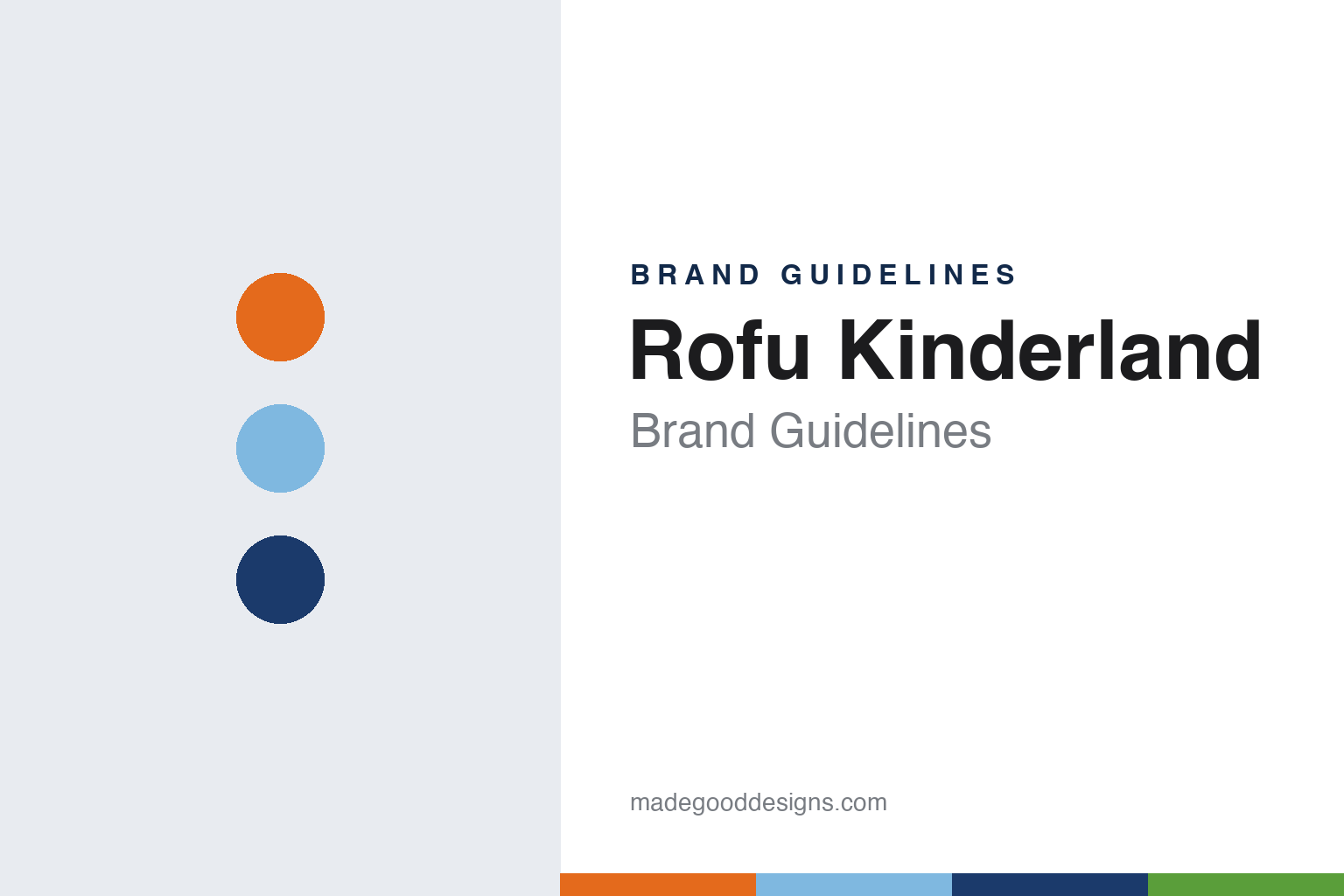
This guide’s Rofu Kinderland palette is Warm orange #E46A1C, Deep blue #1B3A6B, Sky #7FB8E0, Leaf green #5A9E3A and Paper #FAF8F3. The tones are the guide’s own unofficial interpretation, not official Rofu Kinderland hex codes.
When was Rofu Kinderland founded?
Rofu Kinderland was founded in 1962 (as Robert Fuchs Spielwaren), in Germany.
Who owns Rofu Kinderland?
Rofu Kinderland is owned by Kids & School Holding GmbH (since 2026).