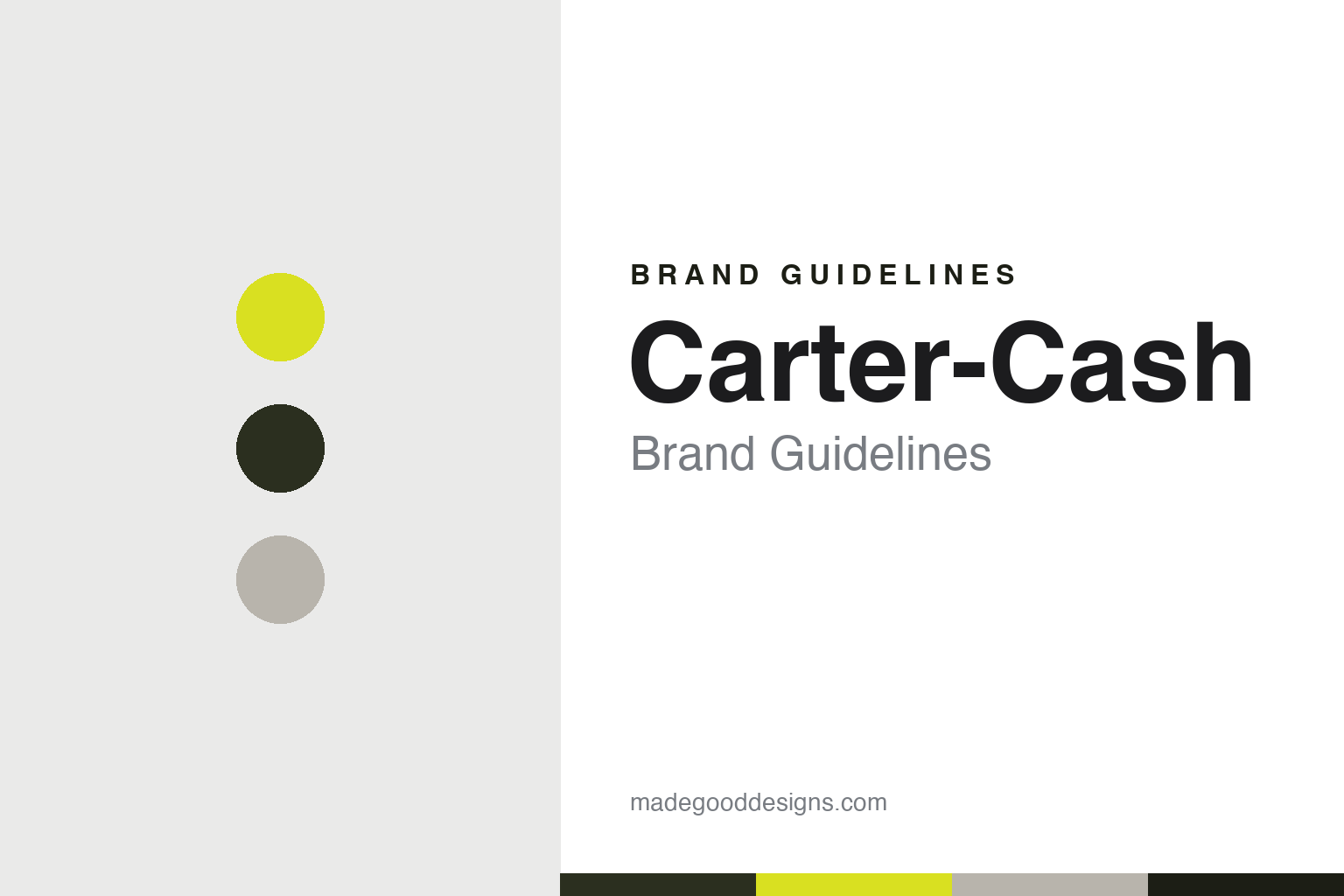
Carter-Cash Brand Guidelines
Low-cost car parts in bare industrial stores, since 2002.
Aa
Two constants: a yellow, olive and concrete palette of our own and a condensed sans register. Abstract homage — not a Carter-Cash sign or mark; no logo, shopfront or product is reproduced.
A low-cost idea
A discount store inside a car-service group.
Carter-Cash was created in 2002 inside the northern French car-services group now called Mobivia. L’argus, in a profile published on 3 May 2022, described it as a “house product” of Mobivia, shaped by what the magazine called its cousins Norauto and Midas but built around what they did not do: low-cost distribution of car parts.
The magazine credits the idea to Patrick Lefebvre, a close colleague of the group’s head, Éric Derville, who backed him. At a time when the group was building its business around car maintenance and repair, the two men wanted a different approach: a store selling spare parts, tyres, oil, batteries and accessories at low prices, which L’argus said was meant to compete with everyone and no one at the same time.
A letter they sent to staff, quoted by the magazine, set out the concept: different products and keener prices, a much smaller workshop offer, very limited sales service, and plain, practical, low-cost merchandising. The intended customers were home mechanics, professional mechanics and young drivers looking for price, choice and convenience. L’argus compared the formula to hard-discount retail.
The first store opened in 2002 at Sainte-Geneviève-des-Bois, in the Essonne department south of Paris, on a former Norauto site, according to the same profile. The founder had a free hand, the magazine said, on one condition: not to copy the codes of Norauto or Midas, but to keep costs down in property, communication and store presentation so that products and services could stay cheap.
Colour
Concrete floors and yellow posters.
The store format follows from that idea. L’argus reported in 2022 that Carter-Cash stores are still set up in former industrial sites in business zones, to be visible and easy to reach; decoration is close to absent, down to bare concrete floors, with goods shown on wooden pallets, in cartons and in plastic bins, and posters in fluorescent yellow pasted up throughout the store to catch the eye.
Every store has its own workshop, kept to a minimum, for fitting tyres and changing oil. Staff work as seller-fitters, moving between the sales floor and the workshop. The chain’s then international managing director, Thierry Deuzé, told the magazine that the early work was to validate the concept, find the right economic and organisational balance, and get the low-cost message across to staff and customers, which he said did not come naturally to either; with a single battery offer, he said, there was no sales pitch to make between an entry-level product, an own brand and a major brand.
Growth came in phases. L’argus said the chain reached 35 stores in France in 2014, and that three years later it opened its first store in Spain and a site in Italy. At the end of March 2022 it counted 84 stores: 73 in France, 6 in Spain, 4 in Italy and 1 in Morocco. The chain grew only through company-owned stores, the magazine said, and did not plan to franchise.
Online selling followed the stores. According to L’argus, Carter-Cash launched its first web shop in 2012, added home delivery in 2019, and then bought an online parts retailer. The Journal de l’Automobile reported on 3 June 2021 that from 1 June 2021 Carter-Cash had taken over the assets of Discount Auto Center, known as Yakarouler, after the commercial court of Créteil accepted its offer, keeping almost all of the team of about thirty people. In September 2023 Mobivia announced that Carter-Cash had merged with Yakarouler, AftermarketInsight reported.
Typography
Signs, menus and networks.
Car-service, tyre and auto-parts chains sell things that are hard to picture: a tyre change, an oil service, a set of wiper blades. So their identities lean on the shop front. A sign has to be read from a moving car, across a forecourt or a retail park, and most of these chains rely on one strong colour, a short wordmark and a fascia that looks the same from town to town. Some explain the choice: Autobacs links its orange to its founder’s visit to the United States, according to a 2014 profile in Hiragana Times.
The formats vary more than the signs. Some chains run drive-in service centres with a row of bays and a small counter; others run large stores where accessories, tyres and car-care goods fill the floor and a workshop sits alongside. In Japan, Autobacs lists a large-format Super Autobacs, a format combined with a fuel station and car-wash shops next to its standard store, and Yellow Hat counts motorcycle and bicycle chains among its group companies.
Ownership shapes the brand as well. Many networks are franchises, with local owners trading under a shared name; Autobacs says it began franchising in 1975, and Yellow Hat signed its first group store in 1982. Other chains belong to tyre makers or parts groups. The guides in this series name those owners and give the dates of each change, from company pages and dated reports, without ranking one chain against another.
Service menus are where the design work becomes practical. Chains name their services the way a driver would ask for them, and Yellow Hat’s service pages, for instance, cover tyres, air-conditioning maintenance and bodywork repair. Most also publish corporate pages on founders, owners and store counts. Read together, those pages show how a sign, a colour and a list of services turn into a brand.
Aa
A condensed sans for a poster-led store. (Specimen set in Barlow Condensed, a sans STAND-IN; NOT the Carter-Cash logo.)
Carter-Cash
A new logo and a new slogan in 2025.
The chain stays part of Mobivia. Le Journal des Entreprises reported on 3 October 2025 that Carter-Cash, which it described as a discounter of car parts, tyres, accessories and maintenance services based in Villeneuve-d’Ascq in the Nord department, had about 110 stores in France, Italy and Spain and some 1,500 employees. It had appointed Hélène Dewynter, its France network director since 2024, as managing director, succeeding Thierry Deuzé, who had led the company for about ten years and moved to run the Norauto group, another Mobivia subsidiary.
The same report said the chain’s ambitions rested on a new brand platform, with a new logo, a new slogan, “Rouler moins cher” (roughly, “drive for less”), and a new in-store experience. The company described its aim, in a statement quoted by the paper, as being a discounter that extends the life of its customers’ vehicles with advice, products and essential services at low prices all year round. The paper also noted a range of reconditioned products, and said the plan included more stores in France, Spain and Italy and more work on awareness of the name.
The low-cost idea remains the thread. L’argus quoted a notice pinned up in the staff room of a store at Wattignies, near Lille, reminding employees that the chain is low cost and should go to the essentials, be smart and get things right the first time at lower cost; Thierry Deuzé told the magazine in 2022 that the chain’s culture was not to do as the others do.
For a design guide, Carter-Cash shows how a deliberately bare store and loud yellow posters can become an identity in themselves. Compare Norauto, the group chain it was created alongside, and Midas, which L’argus named as one of its cousins in 2022. For this guide we use a bright yellow, an olive black and a concrete grey with a sans, an unofficial interpretation; no product or logo is reproduced.
Explore & save
Keep Carter-Cash’s identity on hand — save it to a board in the Made Good inspiration library.
Carter-Cash identity set
Pin the Carter-Cash yellow, olive and concrete palette and the condensed sans register to your own board.
Source & notes
Frequently Asked Questions
What font can I use to match the Carter-Cash look?
This guide describes Carter-Cash’s type as “A condensed sans for a poster-led store”. Its type specimen is set in Barlow Condensed from Google Fonts as a stand-in; Barlow Condensed is not Carter-Cash’s own lettering.
What colours are in the Carter-Cash palette?
This guide’s Carter-Cash palette is Shop-floor olive #2B2F1F, Pallet black #1C1E15, Poster yellow #D9E021, Concrete #B8B4AC and Paper #F4F3EE. The tones are the guide’s own unofficial interpretation, not official Carter-Cash hex codes.
When was Carter-Cash founded?
Carter-Cash was founded in 2002, in Sainte-Geneviève-des-Bois, France. Carter-Cash is known for Low-cost parts, tyres and quick service.