Botanic Brand Guidelines
The Haute-Savoie garden-centre chain founded by three families of growers.
Aa
Two constants: a moss, larch and pale-glass palette and a rounded lower-case sans register. Abstract homage — not a Botanic product or mark; no sign, logo or packaging is reproduced.
Les Serres du Salève
Three families of growers in Haute-Savoie.
Botanic began in Haute-Savoie in 1977, when three families of horticulturists — Albert and Jacques Verdonnet, François Bouchet and Claude Blanchet — set up a company called Les Serres du Salève to run the first garden centre in Annemasse, on the car park of a hypermarket, according to French Wikipedia, which cites the local weekly Le Messager in 2022. The garden centres then traded as Jardinery, and by 1995 there were twelve of them in the Savoie and around Lyon, French Wikipedia says.
For a few years the company traded under another chain’s sign. In 1992 it joined the Jardiland franchise, itself a grouping of horticultural families, to develop a national network, French Wikipedia says, citing a 2014 article in the trade magazine LSA; Toute la Franchise, a French franchise trade site, also wrote in April 2016 that Botanic had been a Jardiland franchisee from 1992 to 1995. In 1995, after internal disagreements, the company left Jardiland and created its own sign, Botanic.
Claude Blanchet, who ran the business, steered it toward “ecological gardening” and sustainable development, French Wikipedia says: the first Botanic stores were built in wood and glass, and the chain’s communication was printed on recycled paper. In 1996 the head office moved to the international business park at Archamps, in Haute-Savoie, where it remains. In 2002 his son Luc Blanchet took over the management of the company, according to French Wikipedia.
Colour
An organic sign, a pet chain and a mission.
The organic positioning became the chain’s defining trait. From 2008, French Wikipedia says, citing Le Messager, Botanic sold only garden treatments carrying the organic-farming label; Toute la Franchise headed its 2016 profile of the company “the organic sign.” The chain also widened its range: French Wikipedia lists pet departments, organic food markets and natural hygiene products in some stores. In February 2017 its president Luc Blanchet announced plans to install an organic food market in each of the group’s 66 garden centres, Le Figaro reported, citing the news agency AFP.
Pets became a second business. Toute la Franchise wrote that Botanic had grown only through its own stores until 2013, when it adopted franchising, notably to develop its pet-shop concept Médor et Compagnie. In February 2017 Botanic agreed to take over Rapid Croq’, a pet-food and accessories chain created in 2001 and based at Saint-Romain-le-Puy, in the Loire, which the company said would double the Médor et Compagnie network to about fifty shops, Le Figaro reported. Luc Blanchet said the network would gradually be unified in the Médor et Compagnie colours, “predominantly red.” In September 2022, French Wikipedia says, Botanic bought the online aquarium retailer Aqua-store.fr.
The company has also turned its positioning into a legal status. Botanic says it launched, in 2020, the first French scheme for collecting and recycling customers’ plastic plant pots; French Wikipedia dates a recycling partnership with Veolia to 2021, with the recycled material used for pots the chain sells. In 2021 the group became a société à mission, a French company status that writes a stated purpose into its articles — in February 2021 according to the company, in March 2021 according to French Wikipedia. Its stated purpose is “Ensemble, retrouver le chemin de la nature” (together, finding the way back to nature), and the company says an independent body audits it every two years.
Typography
How garden-centre chains present themselves.
Garden-centre chains are retailers whose identity is read first from the road: a sign over a large site, repeated on carrier bags, catalogues, loyalty cards and websites. The chains in this series come from France, England, California, Ontario and New Zealand, and most of them publish their logos and colours on their own websites rather than in public brand manuals, so the palettes in these guides are our own interpretations.
Formats vary widely. At one end is the large out-of-town garden centre with plant halls, outdoor nursery areas and, where the company says it offers them, a café, a pet department and a Christmas shop. At the other are smaller town-centre plant shops: Truffaut, which French Wikipedia says opened a garden centre at Le Chesnay in 1964, opened an urban format at Boulogne-Billancourt in 2017.
Ownership is just as varied, and each guide states it as a dated fact. Some chains are family companies, such as Botanic, which Le Figaro described in 2017 as owned by its three founding families. Others belong to farmers’ cooperatives: Toute la Franchise wrote in 2016 that Gamm vert was the sign of the cooperative group InVivo. Others again have been owned by investment funds or listed groups, or have been sold, merged or closed, and their guides say plainly what happened and when.
The chains also present themselves through the calendar and through their own ranges: spring planting, summer outdoor living and Christmas each bring their own events, and many chains sell own-label products under names the companies choose themselves. Corporate pages on founders, owners and history complete the picture, and each guide marks clearly what rests only on the company’s own word.
Aa
A rounded lower-case sans for a name the company writes in lower case. (Specimen set in Quicksand, a sans STAND-IN; NOT the Botanic logo.)
Botanic
A family company in lower case.
Accounts of the company’s capital differ. Le Figaro reported in February 2017 that Botanic was owned by the three founding families — Blanchet, Bouchet and Verdonnet — and that the group had 2,200 staff. Toute la Franchise wrote in 2016 that Botanic was backed by a development-capital fund and had opened its capital to its employees, with 80 percent of its 2,300 staff shareholders in 2014, and that it had 70 stores in 2013; the same profile placed it fourth among French garden-centre chains by sales and third by number of stores. The company describes itself today as family-run since its creation and names Luc Blanchet as president and Eric Bouchet as managing director.
On its own website in November 2026 Botanic says it has more than 75 stores across France, organised around nine areas from plants and flowers, vegetable gardening and pets to home decoration, organic food and natural hygiene; French Wikipedia’s company entry gives 79. French Wikipedia also records the chain’s slogans: “Le jardin, une seconde nature” from 1995 to 2007, “Un nouveau mode de vie” from 2007 to 2012, and “Votre jardin vous le rendra” as the current one.
The company writes its name in lower case, as botanic®, across its website, and it groups its own-label ranges as “signature” brands, among them Grain de Vie, Vivacroc and Nature & Vous.
For a design guide, Botanic shows how a regional family business can build a national identity around a single idea — gardening with nature — carried from store buildings to a legal statement of purpose. Compare Jardiland, whose franchise Botanic belonged to from 1992 to 1995, and Truffaut, another French garden-centre chain. For this guide we use an alpine moss green, larch wood, pale glass and seed cream with a sans, an unofficial interpretation; no product or logo is reproduced.
Explore & save
Keep Botanic’s identity on hand — save it to a board in the Made Good inspiration library.
Botanic identity set
Pin the Botanic moss, larch and pale-glass palette and the rounded lower-case sans register to your own board.
Source & notes
Frequently Asked Questions
What font can I use to match the Botanic look?
This guide describes Botanic’s type as “A rounded lower-case sans for a name the company writes in lower case”. Its type specimen is set in Quicksand from Google Fonts as a stand-in; Quicksand is not Botanic’s own lettering.
What colours are in the Botanic palette?
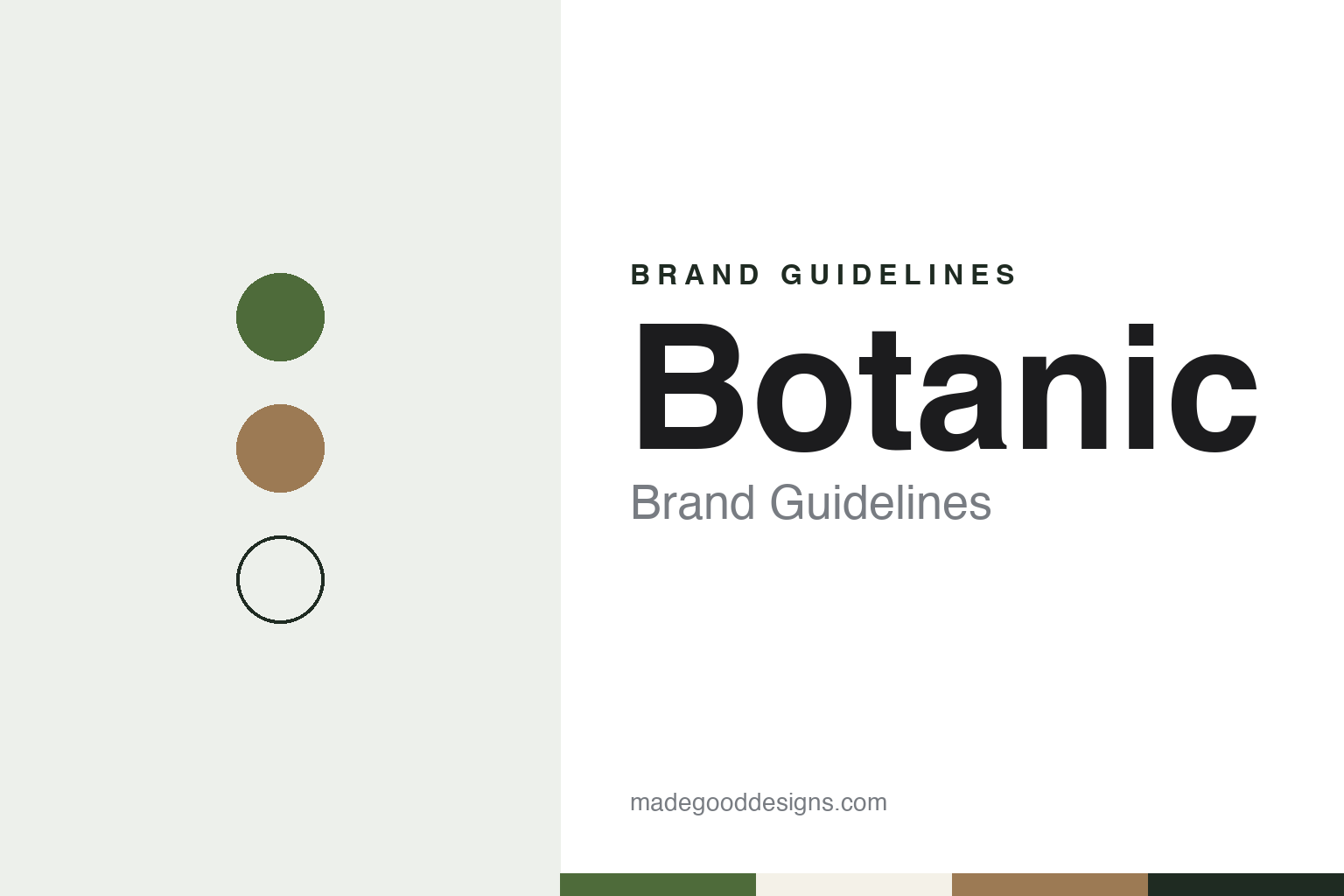
This guide’s Botanic palette is Alpine moss #4E6B3A, Larch wood #9C7A54, Pale glass #E6EEE8, Seed cream #F4F1E8 and Forest ink #1F2B22. The tones are the guide’s own unofficial interpretation, not official Botanic hex codes.
When was Botanic founded?
Botanic was founded in 1977 (Les Serres du Salève), in Annemasse, Haute-Savoie.
Who founded Botanic?
Botanic was founded by Verdonnet, Bouchet and Blanchet families in 1977 (Les Serres du Salève).