Limelight Brand Guidelines
The Pakistani fashion label started in 2010 by Amna and Wahaaj.
Aa
Two constants: a Limelight green, lime and rose palette and a Geometric sans register. Abstract homage — not a Limelight product or mark; no garment, print, logo or label is reproduced.
A small start
Two co-founders and a label for everyday clothes.
Limelight is a Pakistani fashion label for women, children and men that began in 2010. Its creative director and co-founder, Amna Wahaaj, told the Lahore fashion magazine Sunday in April 2021 that she and Wahaaj started the brand together that year “from a very small scale,” with the aim of “providing good, affordable clothes.” She said she had studied textiles at the National College of Arts, the art school in Lahore.
The founding year is consistent across the sources. A Daily Pakistan report of April 2016 called Limelight a prêt and ready-to-wear brand “launched back in 2010,” and Diva magazine wrote in September 2019 that “it all started in 2010 with womenswear.” The company’s own “Our Story” page opens with the same year, describing a start with “debonair textures and swanky fabrics.”
Its history is told through its founders. In 2021, eleven years after the launch, Amna Wahaaj was still the label’s creative director, and she told Sunday that the brand had kept its online retail going while holding to reasonable prices and variety, which she described as what customers look for.
Lahore has been central to the brand’s public life. In April 2016 Daily Pakistan reported that Limelight held the launch of its spring and summer lawn collection at its flagship store on MM Alam Road, one of the city’s main shopping streets, at an event organised by the agency Savvy PR. The label sells its collections through its own shops and its online store.
Colour
From stitched prêt to unstitched lawn.
Limelight started with ready-made clothes. Daily Pakistan wrote in 2016 that it had previously sold only stitched, ready-to-wear and prêt clothing, and that it launched its first lawn collection in 2015, seeing the lawn trend in the market; the 2016 range was its second year of unstitched lawn fabric. The same report said the label also sold its own bags, shoes and other accessories, as well as separate tops and trousers.
The range then widened by customer. Diva reported in 2019 that the brand had started with womenswear and “eventually forayed into kids and menswear,” selling both stitched and unstitched fabric together with accessories. The company’s own page tells the same story: its range “started with women’s formal & casual wear, moving to kids and men’s wear,” and it says it introduced unstitched fabric so that customers could adopt a style of their own.
The product list has kept growing. The company says its portfolio now extends to bottoms, bags, wraps and jewellery, among other lines, and its online store groups them under women, girls, men and accessories, with sub-sections for scarves, sunglasses and hair accessories.
Amna Wahaaj gave Sunday a short account of her own approach. Asked to define her aesthetic in three words, she answered “colour, composition and breathing space.” For the spring and summer season of 2021 she named bold colours, monochrome, tie and dye and tiered dresses among the trends to watch, along with longer lengths, prints, slouchy bottoms and varied sleeves.
The company’s own journal fills in the seasons. In October 2020 it described its fabrics as including lawn, slub khaddar and cambric, and said it offered eastern and, more recently, western clothes, from embellished suits to jumpsuits, midi dresses and crop tops, with new styles launched “every week or so.” A year later, in October 2021, it presented an Unstitched Cambric Collection for autumn, which it said used mosaic prints with motifs running from floral to geometric, sold in its shops and online. Those are the company’s own descriptions of its ranges.
Typography
Design and documentation.
Pakistani and Bangladeshi fashion and retail brands present themselves through a few recurring touchpoints: the shop sign over a mall unit, the logo on a carrier bag, the seasonal look-book and the corporate page that names a founder or a parent company. Some marks point back to craft — Khaadi, for example, says the hands in its logo symbolise its heritage in handloom craft — while others set a short name in plain capitals, as Sapphire does.
The formats vary widely. Some of the brands in this group began as a single shop and grew into mall flagships at home and abroad; others are the retail arms of textile mills, and can draw on a parent’s own spinning, weaving and printing before cloth reaches a store, as Sapphire describes. Alongside them sit supermarket chains, craft-led lifestyle stores and online marketplaces, each with its own way of showing a name on a shopfront, a shelf or a screen.
Collections are named in the companies’ own terms. Lawn, prêt and unstitched fabric appear again and again in their catalogues, and the balance between them has shifted: Profit by Pakistan Today reported in 2017, from Pakistan Bureau of Statistics data, that ready-made clothes took 13 percent of household clothing spending in 2002 and 33 percent in 2016, while unstitched cloth and accessories fell from more than 68 percent to 50 percent.
Ownership is set out plainly in each guide: family-owned, founder-owned, mill-owned or group-owned, with dates where a dated source gives them. Each guide separates what independent press and official filings record from what the company says about itself, and the palettes and type pairings shown are an unofficial interpretation rather than a reproduction of any brand’s colours or marks.
Aa
A geometric sans — “colour, composition and breathing space.” (Specimen set in Jost, a sans STAND-IN; NOT the Limelight logo.)
Limelight
From one flagship to shops across Pakistan.
The chain has grown through its own shops. Diva counted more than 55 stores nationwide in September 2019. In 2026 the company’s “Our Story” page says Limelight has more than 80 stores across the country; that figure is the company’s own.
Its store locator lists shops in Lahore, Karachi, Islamabad and Rawalpindi, and in cities across Punjab and beyond, among them Multan, Faisalabad, Sialkot, Gujranwala, Bahawalpur and Sargodha in Punjab, Hyderabad in Sindh, Peshawar and Abbottabad in Khyber Pakhtunkhwa, and Quetta in Balochistan. In Lahore alone the list runs from DHA and Gulberg to Johar Town, Model Town and malls such as Emporium Mall, Mall of Lahore and Dolmen Mall in DHA; in Islamabad it includes the Centaurus, F-10 Emporium and WTC Mall, and in Karachi a shop at Saima Jinnah Icon Mall.
The chain has stayed close to the formula it described from the start. In 2016 Daily Pakistan listed prêt, ready-to-wear, unstitched lawn and accessories; in 2019 Diva listed stitched and unstitched fabric, accessories and lines for children and men; and the company’s own page in 2026 names the same mix, with bottoms, wraps, sleepwear and jewellery added. Each source places women’s clothing at the start of the story.
For a design guide, Limelight shows how a founder-led label can grow from a small first range of stitched prêt into a national chain that covers lawn, menswear, childrenswear and accessories, while its creative director sums up its look in three plain words. Compare Khaadi, another Pakistani fashion chain that grew from its own shops, and Outfitters, a Pakistani fashion chain built around ready-to-wear. For this guide we use a leaf green, a pale lime and a dusty rose with a sans, an unofficial interpretation; no product or logo is reproduced.
Explore & save
Keep Limelight’s identity on hand — save it to a board in the Made Good inspiration library.
Limelight identity set
Pin the Limelight green, lime and rose palette and the Geometric sans register to your own board.
Source & notes
Frequently Asked Questions
What font can I use to match the Limelight look?
This guide describes Limelight’s type as “A geometric sans — “colour, composition and breathing space.””. Its type specimen is set in Jost from Google Fonts as a stand-in; Jost is not Limelight’s own lettering.
What colours are in the Limelight palette?
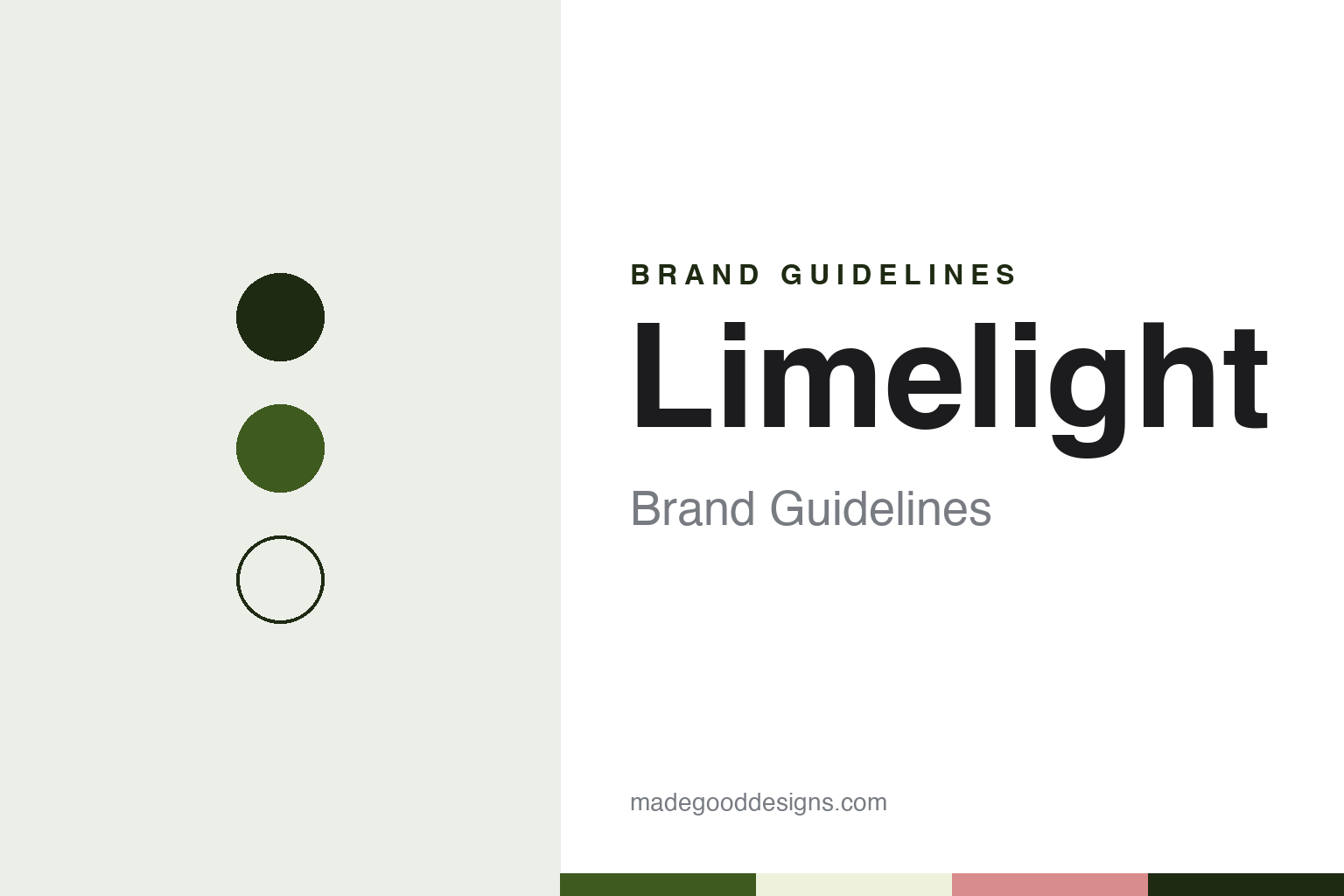
This guide’s Limelight palette is Leaf green #3E5A1E, Deep moss #1E2A12, Pale lime #EEF2DC, Dusty rose #D98C8C and Paper #FAFAF5. The tones are the guide’s own unofficial interpretation, not official Limelight hex codes.
When was Limelight founded?
Limelight was founded in 2010, in Pakistan. Limelight is known for Prêt, stitched and unstitched fashion.