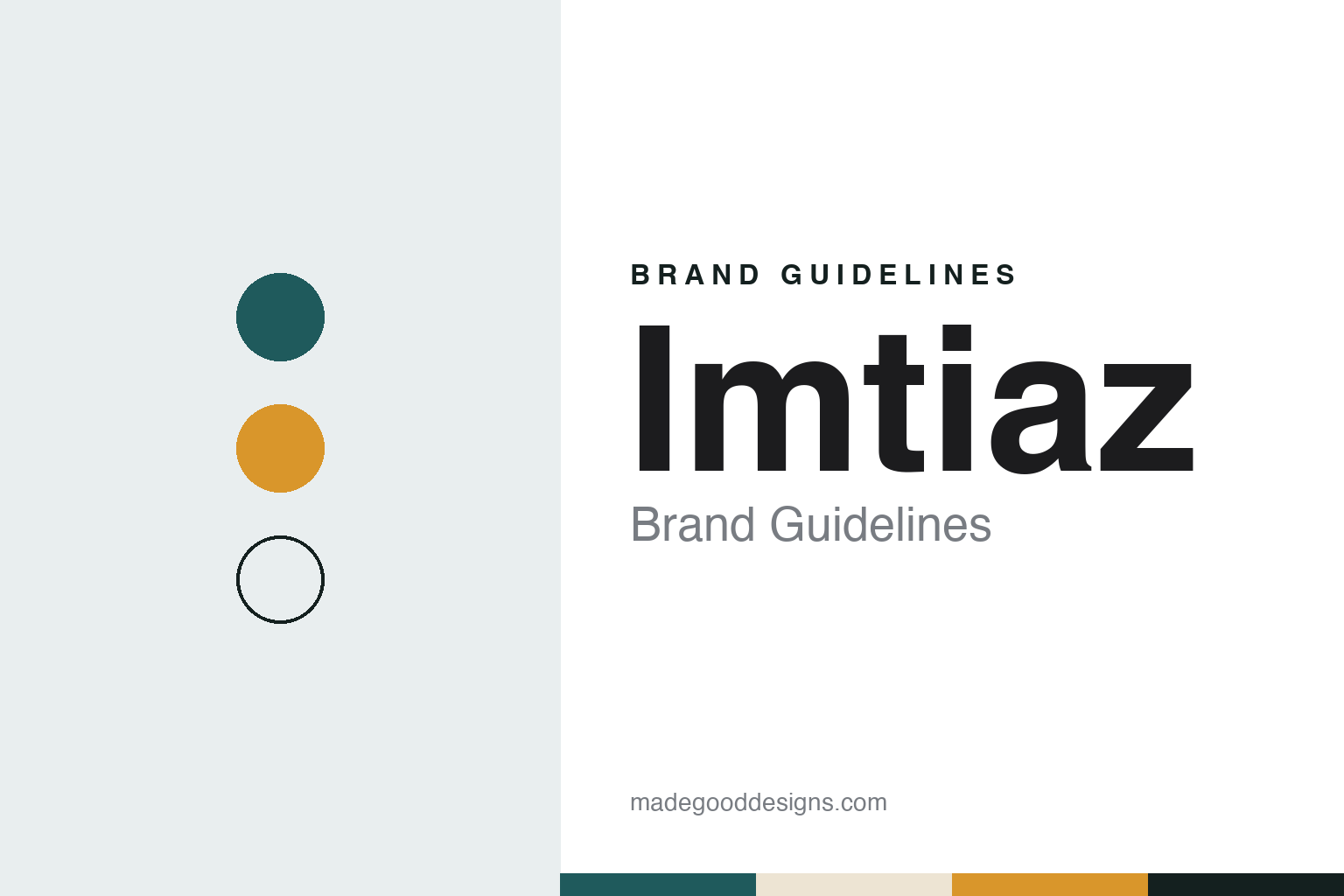
Imtiaz Brand Guidelines
The Bahadurabad grocery shop that grew into a supermarket chain.
Aa
Two constants: a teal, saffron and sand palette and a rounded grocery sans register. Abstract homage — not an Imtiaz mark; no logo, sign or packaging is reproduced.
A kiryana in Bahadurabad
A neighbourhood grocery and a delivery rickshaw.
Imtiaz began as a neighbourhood grocery in Karachi. In an interview with Aurora, the marketing magazine of the Dawn group, published in its May–June 2017 issue, the company’s managing director Imtiaz Abbasi said the story began in 1955, when his father opened a kiryana store, a general grocery, in a narrow lane in Bahadurabad. Other reports give his full name as Imtiaz Hussain Abbasi: Profit by Pakistan Today called him the company’s owner in 2016, and Daily Pakistan described him in 2020 as the man who turned the corner shop into a chain.
Home delivery is the oldest part of the business. Abbasi told Aurora that delivery began in the 1950s as a cycle rickshaw round, and that his own earliest job was riding one to take groceries to customers. Households kept a monthly list with the shop, he said, and the order was packed, delivered and paid for on the doorstep, the way neighbourhood kiryana shops worked. By 2017 customers ordered by phone, by email or in person, and the delivery department collected payment on arrival.
The model changed after a trip abroad. In 1978, Abbasi said, he visited Singapore and saw the Al-Mustafa Store, and on his return the family began adding product categories to the grocery range; a few years later it bought the neighbouring shops to enlarge the Bahadurabad store. Customers still complained that the store was crowded at weekends and in the first ten days of each month, when monthly provisions were bought, so new branches were given larger floor areas and a department-store layout aimed at one-stop shopping.
Abbasi also told Aurora that the company runs its own rice and flour mills and an in-house facility for grinding, cleaning and packing spices, and that most of its custom comes from middle-income households; those are the company’s own descriptions.
Colour
From Karachi branches to Punjab.
The chain grew inside Karachi first. English Wikipedia dates the Karachi expansion from 2003, with branches in areas including Awami Markaz, Nazimabad, Defence, Gulshan-e-Iqbal, Sharafabad and Malir, and Abbasi listed Awami Markaz, DHA, Nazimabad and Gulshan-e-Iqbal among the newer stores in his 2017 interview.
The move out of Sindh came in September 2016. Profit by Pakistan Today reported on 24 September 2016 that the chain was opening its outlet at King’s Mall in Gujranwala the following day, its debut in Punjab. The same report described Imtiaz as a private company that does not publish financial details, with more than 3,000 staff, five branches in Karachi and about 700,000 home-delivery customers at the time. The paper quoted the owner describing the approach as “wholesale within retail,” and summed up the strategy as “piling high and selling low.” It also noted that international operators, among them Metro Cash and Carry and the Carrefour franchise Hyperstar, had entered Pakistan during the previous decade.
A store in Faisalabad followed in 2017, according to both Aurora and English Wikipedia, and by then Abbasi put the workforce at about 8,300 people. English Wikipedia lists later openings in Clifton in 2019, Lahore in 2020, Sialkot and Bahawalpur in 2021, Sargodha, Vehari and Peshawar in 2022 and Quetta in 2023, and gives branches in fourteen cities as of 2024, including Islamabad, Multan, Gujrat and Sahiwal.
The company’s own pages give its scale in two slightly different ways: the About page lists 33 stores in 14 cities and more than 14,000 employees, while the home page shows 38 stores in 15 cities. On either count, the business that started in one Bahadurabad lane reaches well beyond Karachi, from Peshawar in the north to Quetta in the west.
Typography
Signs, formats and owners.
Pakistani and Bangladeshi fashion and retail brands present themselves through a few recurring touchpoints: the shop sign over a mall unit, the logo on a carrier bag, the seasonal look-book and the corporate page that names a founder or a parent company. Some marks point back to craft — Khaadi, for example, says the hands in its logo symbolise its heritage in handloom craft — while others set a short name in plain capitals, as Sapphire does.
The formats vary widely. Some of the brands in this group began as a single shop and grew into mall flagships at home and abroad; others are the retail arms of textile mills, and can draw on a parent’s own spinning, weaving and printing before cloth reaches a store, as Sapphire describes. Alongside them sit supermarket chains, craft-led lifestyle stores and online marketplaces, each with its own way of showing a name on a shopfront, a shelf or a screen.
Collections are named in the companies’ own terms. Lawn, prêt and unstitched fabric appear again and again in their catalogues, and the balance between them has shifted: Profit by Pakistan Today reported in 2017, from Pakistan Bureau of Statistics data, that ready-made clothes took 13 percent of household clothing spending in 2002 and 33 percent in 2016, while unstitched cloth and accessories fell from more than 68 percent to 50 percent.
Ownership is set out plainly in each guide: family-owned, founder-owned, mill-owned or group-owned, with dates where a dated source gives them. Each guide separates what independent press and official filings record from what the company says about itself, and the palettes and type pairings shown are an unofficial interpretation rather than a reproduction of any brand’s colours or marks.
Aa
A rounded, sturdy sans for a grocery chain. (Specimen set in Rubik, a sans STAND-IN; NOT the Imtiaz logo.)
Imtiaz
From a shopping trolley to a star.
For most of its history the chain traded as Imtiaz Super Market, with a logo built around a shopping trolley. In August 2020 it replaced that mark. Daily Pakistan reported on 15 August 2020 that the new logo was a star made from four symbols, which the company explains as a star for change, a joyful figure for the customer, a tick for straight dealing and an arch for strength. The wordmark was shortened at the same time from “Imtiaz Super Market” to plain “Imtiaz,” and the change was presented under the campaign tag #NEWONE. The company’s About page gives the same reading of the four symbols today.
The rebrand also split the chain into three named formats, Daily Pakistan reported: Imtiaz Mega, for the widest range of categories; Imtiaz Super Market, for everyday shopping; and Imtiaz Xpress, a round-the-clock store. The same report said the Islamabad Mega store would open to customers from 21 August 2020, and put the chain at eleven branches at that point. The company says its stores carry more than 52,000 products from over 10,000 brands, a figure that rests on its own word.
Ownership has stayed with the family that opened the Bahadurabad shop: the founder’s son built the chain, and Profit by Pakistan Today described it in 2016 as a private company that does not disclose its financial details, and noted that the owner did not say how its expansion was financed. Abbasi told Aurora in 2017 that the company screens and then trains its own staff for weeks or months before they work on the shop floor, with product knowledge, shelf display and customer handling as the core subjects.
For a design guide, Imtiaz shows how a neighbourhood grocer can keep its own name through every stage of growth and let the format word, Mega, Super Market or Xpress, carry the change in scale. Compare foodpanda, the delivery platform that operates in Pakistan, and Outfitters, a Pakistani fashion chain. For this guide we use a deep teal, a saffron and a warm sand with a rounded sans, an unofficial interpretation; no product or logo is reproduced.
Explore & save
Keep Imtiaz’s identity on hand — save it to a board in the Made Good inspiration library.
Imtiaz identity set
Pin the Imtiaz teal, saffron and sand palette and the rounded grocery sans register to your own board.
Source & notes
Frequently Asked Questions
What font can I use to match the Imtiaz look?
This guide describes Imtiaz’s type as “A rounded, sturdy sans for a grocery chain”. Its type specimen is set in Rubik from Google Fonts as a stand-in; Rubik is not Imtiaz’s own lettering.
What colours are in the Imtiaz palette?
This guide’s Imtiaz palette is Market teal #1F5A5C, Ink #14201F, Saffron #D9962B, Bahadurabad sand #EDE4D3 and Paper #F8F6F1. The tones are the guide’s own unofficial interpretation, not official Imtiaz hex codes.
When was Imtiaz founded?
Imtiaz was founded in 1955 (as a grocery shop), in Bahadurabad, Karachi, Pakistan.