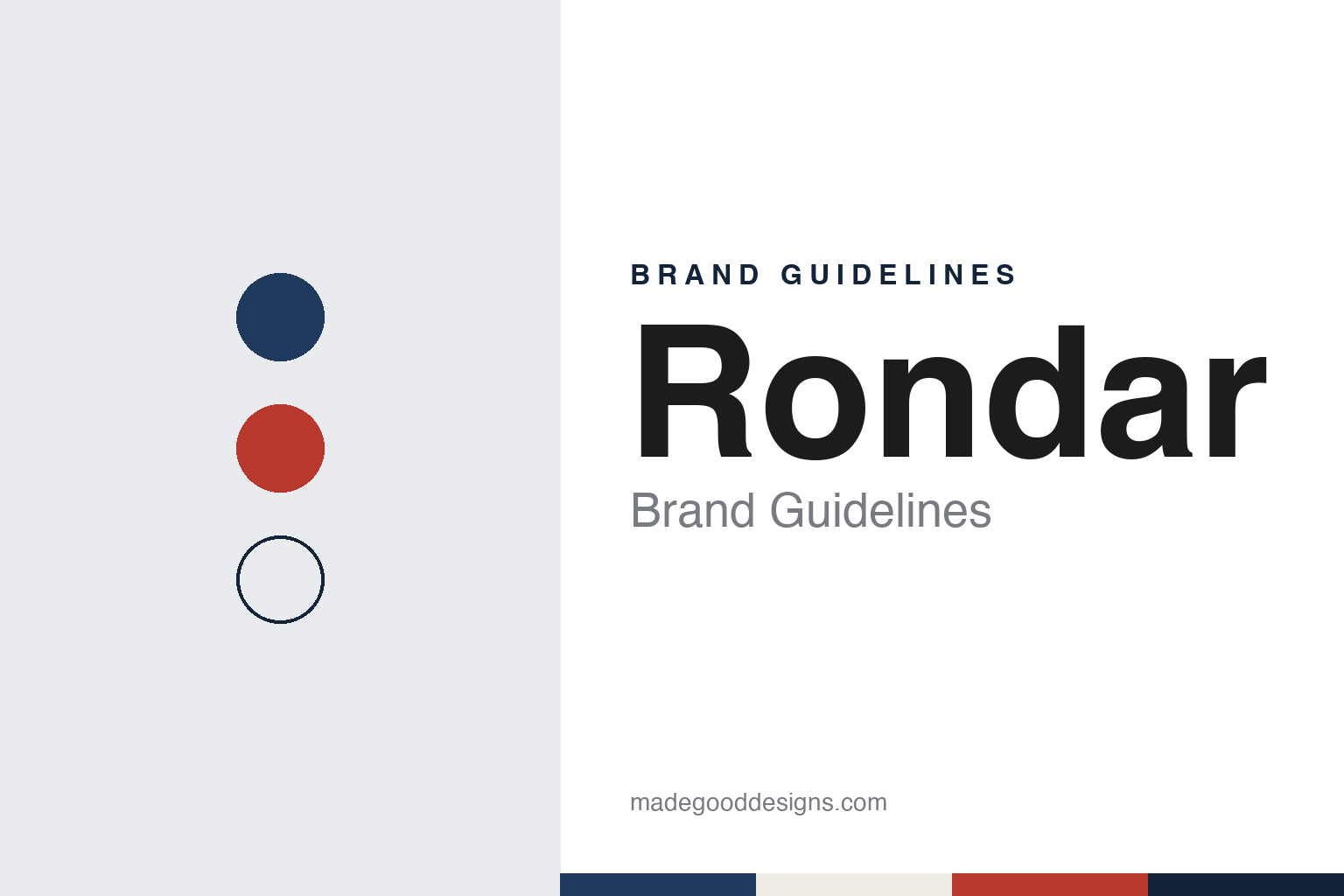
Rondar Brand Guidelines
A British builder of other people’s classes, closed in 2023.
Aa
Two constants: a class navy, gelcoat white and number red palette and a condensed sans register. Abstract homage — not a Rondar product or mark; no boat, logo or hull graphic is reproduced.
Rondar Raceboats
A builder for the classes, and a company that has closed.
Rondar was a British builder of racing dinghies and small keelboats, and it no longer trades. The company behind the name, Rondar Raceboats Limited, was incorporated in England on 8 May 1991, according to Companies House. The register shows that it began as a shelf company called Inhoco 110 Limited, was renamed Rondar Boats Limited in September 1991, and took the name Rondar Raceboats Limited in May 1997. Its recorded line of business was “other manufacturing.” The 1997 change replaced “Boats” with “Raceboats” in the company’s legal name.
The end of the company is on the same register. A creditors’ voluntary liquidation began on 30 October 2023, and the company was dissolved on 8 March 2026, Companies House records. The last accounts it filed covered the year to June 2022. The Rondar name now survives on boats already built, but the company that built them has closed.
Rondar’s place in British sailing came from building boats for established one-design classes rather than from designs of its own. In a one-design class the hull shape and the main dimensions are fixed by the class rules, and a licensed builder works from shared moulds, plugs or templates. A builder of this kind is chosen by a class association or a design-rights holder, and its work is judged on construction and supply rather than on new shapes. That is why the Rondar name appears most often in class histories and in lists of approved builders, rather than as the name of a boat.
Colour
The 505, the Firefly, the Viper 640 and the Sonar.
Four classes give a clear outline of the business. On the 505, the two-person racing dinghy, English Wikipedia describes Rondar Raceboats as the class’s most prolific builder, producing wet-layup hulls on a semi-production basis. The same article says that Ovington Boats, the dinghy builder in north-east England, at one time built hulls for Rondar under contract before going on to build its own.
The Firefly, a two-person dinghy that Ovington calls the backbone of UK team racing, was produced by Rondar in the UK from 1997 to 2023, according to English Wikipedia. Ovington now builds the Firefly, and it says its version is made from existing moulds owned by the class’s national association and was developed together with that association and the RYA, the national sailing body.
The Viper 640, a sportsboat originally built by Viper Boats in the United States, gained Rondar as its official class manufacturer in 2005, English Wikipedia says. In February 2015 Scuttlebutt Sailing News reported that the International Sonar Class had announced that the Sonar, the 23-foot keelboat designed by Bruce Kirby, would from then on be built by Rondar in the UK. Shumway Marine of Rochester, which had owned the builder’s rights for 18 years, made the arrangement with Kirby’s cooperation, the report said. It quoted Paul Young as managing director of Rondar Boats Ltd and printed the company’s web address as rondarboats.com.
The same report described the Sonar as a 23-foot sloop raced by a crew of three or four, with more than 800 boats in commission and fleets used for both fleet and team racing. In the UK, it said, the class raced at Cowes on the Isle of Wight and on the Clyde in Scotland, while North American fleets stretched from Newport, Rhode Island, to Vancouver. The arrangement took Rondar into building a keelboat for an international class, alongside its dinghy work.
Those arrangements describe a particular kind of company. Rondar did not own the 505, the Firefly, the Viper 640 or the Sonar; it held the right to build them for a period, under rules written by the classes. In the Firefly’s case, the moulds now in use belong to the class’s national association, Ovington says.
Typography
How dinghy builders and sailmakers present themselves.
Dinghy builders and sailmakers present themselves mostly through names and numbers. A builder’s name usually sits on the hull and on its website, while the sail carries the marks that racing needs: a class emblem and a sail number, placed as each class’s rules describe. When a class changes its name, the sail changes with it; in 2019 the International Laser Class Association said new class sails would carry its updated ILCA logo.
Much of this branding lives at the water’s edge rather than in shops. Builders and lofts show their boats and sails at boat shows and on regatta stands, and many of their news pages read like club noticeboards, carrying class championship calendars, results and event reports alongside new models. Class associations, which are often run separately from the builders, organise much of that racing and publish their own rules and websites.
Ownership in the trade takes several forms, and the companies describe it in different ways. Some are family businesses that name their founders and later generations on their own pages; some sailmakers work through franchised or licensed lofts that share one name across many countries; and some builders have passed to investors or merged with former rivals, or have sold individual boat designs and their production rights to other firms. Building is often shared: a brand may design its boats and buy hulls, sails and spars from specialist suppliers.
This guide sets out what can be checked about each company: who founded it, who owns it now, where its boats or sails are made according to dated sources, and how it presents its name. It marks clearly what rests only on the company’s own word, and it makes no claims about speed or safety.
Aa
A condensed sans, close to the lettering of sail numbers. (Specimen set in Barlow Condensed, a sans STAND-IN; NOT the Rondar logo.)
Rondar
A name on the hull, a number on the sail.
On a one-design dinghy, much of what a sailor sees is set by the class rather than by the builder. Class rules decide the emblem on the mainsail and how the sail number is shown, and the class association keeps the register of numbers. The builder’s own name usually takes a smaller place on the hull, the transom or a plate, and in the class lists of builders and dealers. Rondar’s identity worked within those limits, and this guide does not reproduce its logo or any hull graphic.
Two points help anyone looking for the company today. Several unrelated British companies use the Rondar name, so the register entry that matters is Rondar Raceboats Limited, formerly Rondar Boats Limited. The web address rondar.com is not connected with the boatbuilder; the company’s address in 2015 was rondarboats.com, as Scuttlebutt Sailing News printed it.
The same builders recur across these class histories. Ovington appears in Rondar’s 505 history, as a contract builder of hulls, and again in its Firefly history, as the builder that now makes the boat. Other British dinghy makers, such as Topper, built their names on boats of their own design, which gives a useful contrast with Rondar’s class-builder model.
For a design guide, Rondar shows how a builder of other people’s designs can still leave a recognisable name, carried by class records, builders’ plates and sail-number typography rather than by a boat of its own; compare Ovington and Topper. For this guide we use a class navy, a deep hull blue, a gelcoat white, a number red and a spar grey with a condensed sans, an unofficial interpretation; no product or logo is reproduced.
Explore & save
Keep Rondar’s identity on hand — save it to a board in the Made Good inspiration library.
Rondar identity set
Pin the Rondar class navy, gelcoat white and number red palette and the condensed sans register to your own board.
Source & notes
Frequently Asked Questions
What font can I use to match the Rondar look?
This guide describes Rondar’s type as “A condensed sans, close to the lettering of sail numbers”. Its type specimen is set in Barlow Condensed from Google Fonts as a stand-in; Barlow Condensed is not Rondar’s own lettering.
What colours are in the Rondar palette?
This guide’s Rondar palette is Class navy #1F3A5C, Deep hull #12233A, Gelcoat white #EFEDE6, Number red #B8382E and Spar grey #8A9096. The tones are the guide’s own unofficial interpretation, not official Rondar hex codes.
When was Rondar founded?
Rondar was founded in 1991 (as Inhoco 110 Limited), in England.