Ferrandi Paris Brand Guidelines
The Paris chamber of commerce’s culinary school since 1920.
Aa
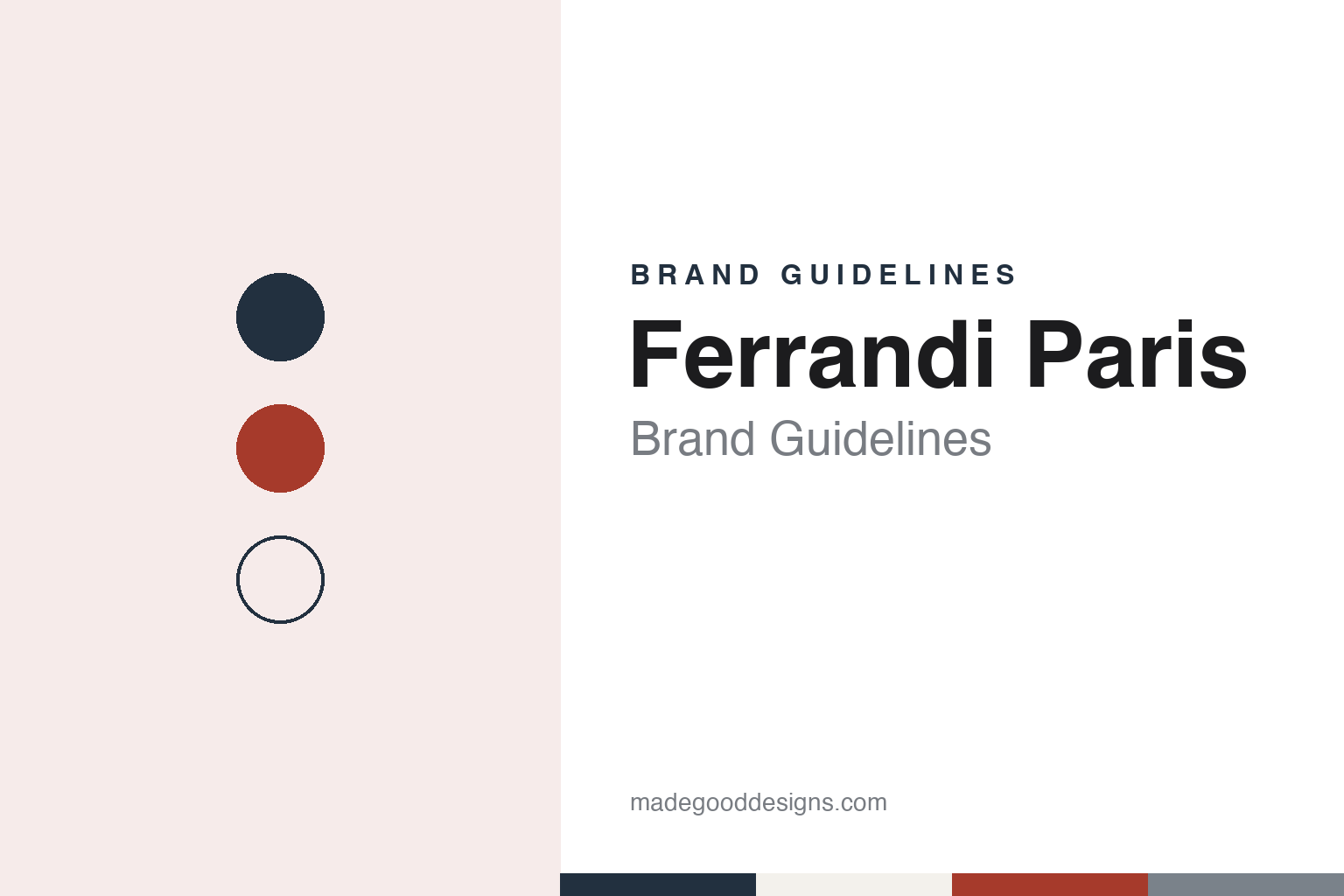
Two constants: a slate navy, brick red and chalk palette and a civic sans register. Abstract homage — not a Ferrandi Paris logo or mark; no wordmark, building or uniform is reproduced.
Workshop schools
A chamber of commerce opens a school for the trades.
Ferrandi Paris was founded in 1920 on the initiative of the Paris Chamber of Commerce and Industry, which wanted to set up ateliers-écoles, workshop schools for the trades, Gault&Millau reported in February 2024. French Wikipedia gives the same founding year and describes the school as a private grande école of the consular kind: it belongs to the CCI Paris Île-de-France, the regional chamber of commerce and industry, which is a public body.
The sources used for this guide do not say how the school operated during the occupation of 1940–1944.
Its name comes from a street. French Wikipedia, citing the school’s own 2014 cookery book Le grand cours de cuisine Ferrandi, links the name to the workshop school installed on the rue Jean-Ferrandi, in Paris’s 6th arrondissement, in 1958; Gault&Millau says the school has stood on the rue de l’Abbé-Grégoire, in the same arrondissement, since that year. On its own pages the school writes its name in capitals, FERRANDI Paris, and French Wikipedia records its tagline as “L’école française de gastronomie et de management hôtelier,” the French school of gastronomy and hotel management.
Colour
Kitchens, laboratories and two restaurants.
The Paris campus is large. Gault&Millau described a 25,000-square-metre site filling a whole city block, behind a discreet façade, with buildings of several storeys set around a long rectangular courtyard. It counted 40 professional laboratories for bread, pastry and cooking, and two training restaurants: Le Premier, a bistro-style room of up to 70 covers where apprentices on CAP, Bac Pro and BTS courses train, and Le 28, the more formal room where students on the hotel and restaurant management bachelor work.
Uniform carries the hierarchy. In April 2014 Le Figaro watched a lunch service at Le 28: the student chefs wore whites with their names embroidered on the chest, and in the dining room second-year students in blue scarves or ties directed first-years dressed in beige, while a teaching chef checked each plate at the pass. Student roles followed the brigade system, the paper said: one student called the orders, others ran plates, and the teachers tasted the dishes in a ritual meal before service.
The same building mixes very different courses. On its visit Gault&Millau found students from an AgroParisTech master’s programme on cooking and the food industry working in one kitchen laboratory, next to post-baccalaureate CAP students practising sauces, an example of the range of learners, from apprentices to graduates and adults retraining, that the school teaches.
Teaching runs from vocational certificates to master’s level. French Wikipedia lists CAP to BTS courses in cooking and catering, pastry, bakery, table service and hotel work; bachelor programmes in culinary arts and entrepreneurship and in hotel and restaurant management; MSc programmes in hospitality management and in culinary arts and responsible entrepreneurship; and courses for adults. Gault&Millau said the school launched a higher programme for chefs in the 1980s, that the culinary arts bachelor was officially created in 2011, and that Ferrandi joined the Conférence des Grandes Écoles in 2023.
The school says its two bachelor programmes have carried the state visa at Bac+3 level since 2017, awarded by the higher-education ministry after review by the CEFDG, the commission that evaluates management degrees, and that the visa has been renewed for five years. International students follow intensive programmes taught in English; on its visit Gault&Millau found a group from China, South Korea, Taiwan and Latin America making classic French pastries in one of the laboratories.
Typography
Schools, owners and the way they present themselves.
Culinary and pastry schools present themselves through a small set of public signs: a school name, a crest or logo, a colour scheme and a short descriptive line. Some names carry a symbol. Le Cordon Bleu takes its name from the blue ribbon of a French royal order, English Wikipedia says, and guests cut a blue ribbon when its new Paris campus opened in 2016, So Good magazine reported. Others come from a place: Ferrandi Paris is linked to the Paris street where its workshop school was installed in 1958, French Wikipedia says.
Ownership shapes how a school describes itself. Ferrandi belongs to the Paris Île-de-France chamber of commerce and industry, a public body, while Le Cordon Bleu was bought by Élisabeth Brassart in 1945, English Wikipedia says, and by André J. Cointreau in 1984, the Los Angeles Times reported, before growing into an international group. Other schools are run by education groups, families or universities; this guide reads their own pages on founders and history alongside dated press sources.
The buildings are part of the image. Schools publish their campuses, teaching kitchens, laboratories and training restaurants, where students cook and serve real guests. Press visits describe the same spaces from outside: in 2014 Le Figaro watched student chefs in whites with their names embroidered on the chest, and in 2016 So Good described a glass Paris building with a vegetable garden on its roof.
Programmes and diplomas appear under the names the schools give them, from vocational certificates to bachelor and master’s degrees, and official recognition is cited as the schools or dated sources state it. This guide sets out what can be checked about each school — who founded it, who owns it and where it teaches — and marks clearly what rests only on the school’s own word.
Aa
A civic sans — a register suited to a school written in capitals. (Specimen set in Libre Franklin, a sans STAND-IN; NOT the Ferrandi Paris logo.)
Ferrandi Paris
One school, several cities.
Ferrandi has spread beyond Paris. In February 2024 Gault&Millau counted five campuses, in Paris, Saint-Gratien, Dijon, Bordeaux and Rennes, with about 2,500 students, some 300 international students of around 40 nationalities and nearly 2,000 adults in further training. The school’s own campus pages, read in November 2026, add Strasbourg, an 8,000-square-metre site with laboratories, two restaurants and a training hotel, set up in partnership with the CEFPPA Adrien Zeller training centre for the 2026 academic year.
The other sites differ in character, the school says. Saint-Gratien has 5,000 square metres of teaching space; in Bordeaux students use the Campus du Lac of the CCI Bordeaux Gironde and a site on the Place de la Bourse; and the Dijon campus is part of the Cité Internationale de la Gastronomie et du Vin. The school’s pages describe the Paris campus as close to the landmarks of Saint-Germain-des-Prés.
Leadership sits with the school and its chamber. In 2026 the school names Thomas Allanic as its director general; in 2024 Gault&Millau quoted Richard Ginioux as director. Ferrandi also publishes under its own name: French Wikipedia lists books including Le grand cours de cuisine Ferrandi (Hachette, 2014), Pâtisserie (Flammarion, 2017) and Chocolat (Flammarion, 2019), and in 2026 the school announced Biscuits et confiseries, also with Flammarion. Its school restaurants, as Le Figaro described them in 2014, are open to the public at lunch.
For a design guide, Ferrandi Paris shows a school identity built on a street name set in capitals and a plain descriptive tagline, presented through its kitchens, laboratories and training restaurants. Compare Le Cordon Bleu, the privately owned Paris school founded in 1895, and Institut Paul Bocuse, the school near Lyon that Gault&Millau noted is also in the Conférence des Grandes Écoles. For this guide we use a slate navy, a brick red and chalk white with a sans, an unofficial interpretation; no product or logo is reproduced.
Explore & save
Keep Ferrandi Paris’s identity on hand — save it to a board in the Made Good inspiration library.
Ferrandi Paris identity set
Pin the slate navy, brick red and chalk palette and the civic sans register to your own board.
Source & notes
Frequently Asked Questions
What font can I use to match the Ferrandi Paris look?
This guide describes Ferrandi Paris’ type as “A civic sans — a register suited to a school written in capitals”. Its type specimen is set in Libre Franklin from Google Fonts as a stand-in; Libre Franklin is not Ferrandi Paris’ own lettering.
What colours are in the Ferrandi Paris palette?
This guide’s Ferrandi Paris palette is Slate navy #22303F, Brick red #A63A2B, Chalk #F3F1EC, Steel grey #7A828A and Paper #F9F8F5. The tones are the guide’s own unofficial interpretation, not official Ferrandi Paris hex codes.
When was Ferrandi Paris founded?
Ferrandi Paris was founded in 1920, in Paris, France. Ferrandi Paris is known for Le 28 and Le Premier training restaurants.
Who founded Ferrandi Paris?
Ferrandi Paris was founded by Paris Chamber of Commerce and Industry in 1920.