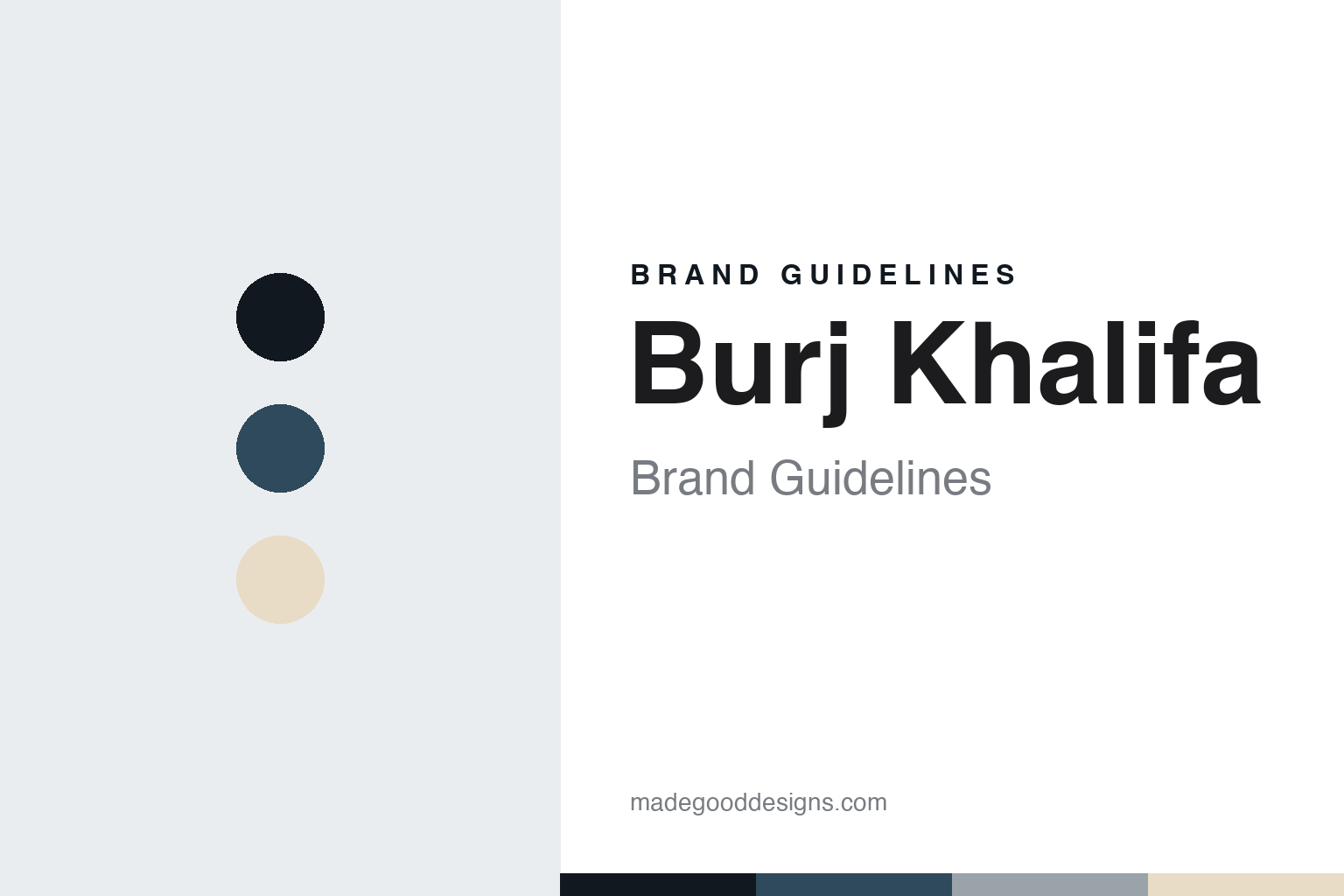
Burj Khalifa Brand Guidelines
Emaar’s spiralling tower of glass and steel above Downtown Dubai.
Aa
Two constants: a glass blue, brushed steel and dune sand palette and a refined serif register. Abstract homage — not a Burj Khalifa asset; no logo, photograph or signage is reproduced.
From Burj Dubai to Burj Khalifa
A tower unveiled under a new name.
Burj Khalifa is the skyscraper at the centre of Downtown Dubai, the district built by its developer, Emaar Properties, along Sheikh Zayed Road. English Wikipedia dates the start of construction to 12 January 2004 and the completion of the exterior to 1 October 2009; Dezeen wrote in 2025 that the tower topped out in January 2009 and that construction took place over six years. It officially opened on 4 January 2010. Throughout construction it was called Burj Dubai, “Dubai Tower”; it was unveiled at the opening as Burj Khalifa, named after Sheikh Khalifa bin Zayed Al Nahyan, then president of the United Arab Emirates, English Wikipedia says.
The design came from the Chicago office of Skidmore, Owings & Merrill. Dezeen, in a 2025 essay by Jane Englefield, credits the architect Adrian Smith, who designed it while at SOM, and the lead structural engineer Bill Baker, whose buttressed-core system had first been applied to Tower Palace III in Seoul. SOM’s project page names Emaar as client, gives 2006 as the year the design was finished and 2010 as completion, and lists 160 storeys and a height of 828 metres. That figure is the official height Emaar announced at the opening, which Dezeen reported in January 2010.
Many firms took part. English Wikipedia names Hyder Consulting as supervising engineer and NORR Group Consultants as supervising architect, and says the main contractor was Samsung C&T of South Korea, working with the Belgian group BESIX and the local company Arabtec, with Turner as project manager. In Dezeen’s 2025 assessment the tower was still the world’s tallest skyscraper fifteen years after its opening.
Colour
A desert flower and a spiral of setbacks.
The building’s look is set by its plan. Three wings fan out from a central core in a Y-shaped tripartite floor plan, a three-pronged design that Dezeen says was chosen to echo the hymenocallis, or spider lily, a desert flower of the region. SOM adds that the plan opens the apartments and offices to views of the Arabian Gulf, and that at ground level the tower is surrounded by green space, water features and pedestrian boulevards. It describes the tower as inspired by the geometries of that flower and by the patterning systems of Islamic architecture; Dezeen names the ninth-century Great Mosque of Samarra, with its spiralling minaret ramp, as one of Smith’s references.
As it rises, the tower steps back in 27 setbacks arranged in an upward spiral, reducing its mass and creating outdoor terraces, until the central core emerges and is shaped into the spire, which also houses communications equipment, English Wikipedia says. SOM says each wing has its own concrete core and perimeter columns and buttresses the others through a six-sided central hub, and that the changing shape at each tier is meant, in essence, to “confuse the wind.” Smith used the same phrase to the Wall Street Journal in 2011, Dezeen reports. The critic Blair Kamin, writing in Architectural Record in 2010, put it more simply: “This skyscraper looks like a skyscraper.”
The surface is reinforced concrete clad in glass. English Wikipedia describes more than 26,000 reflective glass panels with aluminium and textured stainless-steel spandrel panels and vertical tubular fins. Inside, SOM says, the upper floors draw on celestial themes, “inspired by the notion of a stationary spacecraft,” while the lower floors evoke the land, using glass, stainless steel, polished dark stone, silver travertine, Venetian stucco and Brazilian Santos rosewood. SOM also placed more than 500 works of art in the building, among them Jaume Plensa’s “World Voices,” 196 hand-made cymbals above shallow pools in the residential lobby.
Typography
How towers and decks present themselves.
Observation towers and decks across Asia-Pacific and the Gulf are owned and run by a wide mix of businesses: railway groups, broadcasters, property developers and listed leisure companies. Some are broadcasting towers in their own right; others are decks at the top of office or mixed-use buildings. This guide looks at how each one presents itself, in plain terms and with dates where sources give them.
The names, logos and mascots are usually published by the operators themselves. Tokyo Skytree, for example, introduced a mascot called Sorakara and staff uniforms designed by the textile designer Akira Minagawa, Monocle reported in 2012, while Tokyo Tower’s company history records each renaming of its decks and of the company itself. Where an architect or engineer is credited, this guide names them only as a dated source does.
Lighting is a large part of the identity for several of them. Tokyo Tower’s Landmark Light dates from 1989 and its LED Infinity Diamond Veil from 2019, according to the company, and Tokyo Skytree’s Iki, Miyabi and Nobori schemes draw on Edo-period ideas of style, Nippon.com reported in 2022. Tickets, wayfinding, deck names, souvenir shops and seasonal displays carry the same identity at a smaller scale, from deck signage to tower-shaped bottles and stamps.
Each guide sets out who opened the tower or deck and when, who owns and operates it now, how it has been renovated or renamed, and what its own corporate pages say about its history, marking clearly what rests on the operator’s word. The palettes and typefaces shown are unofficial interpretations; no logo, mascot or lighting design is reproduced.
Aa
A refined serif for a tower of glass and steel. (Specimen set in Cormorant Garamond, a serif STAND-IN; NOT the Burj Khalifa logo.)
At the Top
Three decks named for their height.
The observation decks carry the name At the Top. The deck on the 124th floor opened to the public on 5 January 2010, the day after the building, as Emaar’s statement at the opening, carried by Dezeen in January 2010, had announced. English Wikipedia places it at about 452 metres and lists two later additions: the SKY level on the 148th floor, at about 555 metres, opened on 15 October 2014, and The Lounge, at about 585 metres, opened on 18 February 2019. The 124th-floor deck also offers an augmented-reality viewer developed by the Montreal studio Gsmprjct°, which shows the landscape in real time or as it looks at other times of day.
The tower is one part of a larger set of named places. The Armani Hotel, which SOM’s figures give as 304 keys, opened on 27 April 2010 within its lower floors; the building also holds offices, residences and the At.mosphere restaurant on the 122nd floor, English Wikipedia says. At its foot lie an eleven-hectare park by the landscape architects SWA Group, also based on the hymenocallis flower, and the Dubai Fountain by WET Enterprises, whose name Emaar announced on 26 October 2008 after a naming contest.
The opening in January 2010 was marked with fireworks, lasers and fountain displays, and Emaar’s New Year’s Eve show of fireworks and light on the tower has been held each year since, English Wikipedia says. The building has also appeared on screen: Dezeen notes its role in the 2011 film Mission: Impossible – Ghost Protocol.
For a design guide, Burj Khalifa shows how a single plan shape, the three-winged flower, can carry a tower, its park and its visitor decks under one name. Compare Emaar, the developer, and Skidmore, Owings & Merrill, the architects. For this guide we use a glass blue, a brushed steel and a dune sand with a serif, an unofficial interpretation; no product or logo is reproduced.
Explore & save
Keep Burj Khalifa’s identity on hand — save it to a board in the Made Good inspiration library.
Burj Khalifa identity set
Pin the Burj Khalifa glass blue, brushed steel and dune sand palette and the refined serif register to your own board.
Source & notes
Frequently Asked Questions
What font can I use to match the Burj Khalifa look?
This guide describes Burj Khalifa’s type as “A refined serif for a tower of glass and steel”. Its type specimen is set in Cormorant Garamond from Google Fonts as a stand-in; Cormorant Garamond is not Burj Khalifa’s own lettering.
What colours are in the Burj Khalifa palette?
This guide’s Burj Khalifa palette is Desert night #121820, Glass blue #2E4A5C, Brushed steel #9AA3AA, Dune sand #E8DCC6 and Paper #F8F6F1. The tones are the guide’s own unofficial interpretation, not official Burj Khalifa hex codes.
When did Burj Khalifa open?
Burj Khalifa opened on 4 January 2010, in Downtown Dubai, United Arab Emirates.