Whistling Straits Brand Guidelines
Kohler’s Irish-style links on the Lake Michigan shore.
Aa
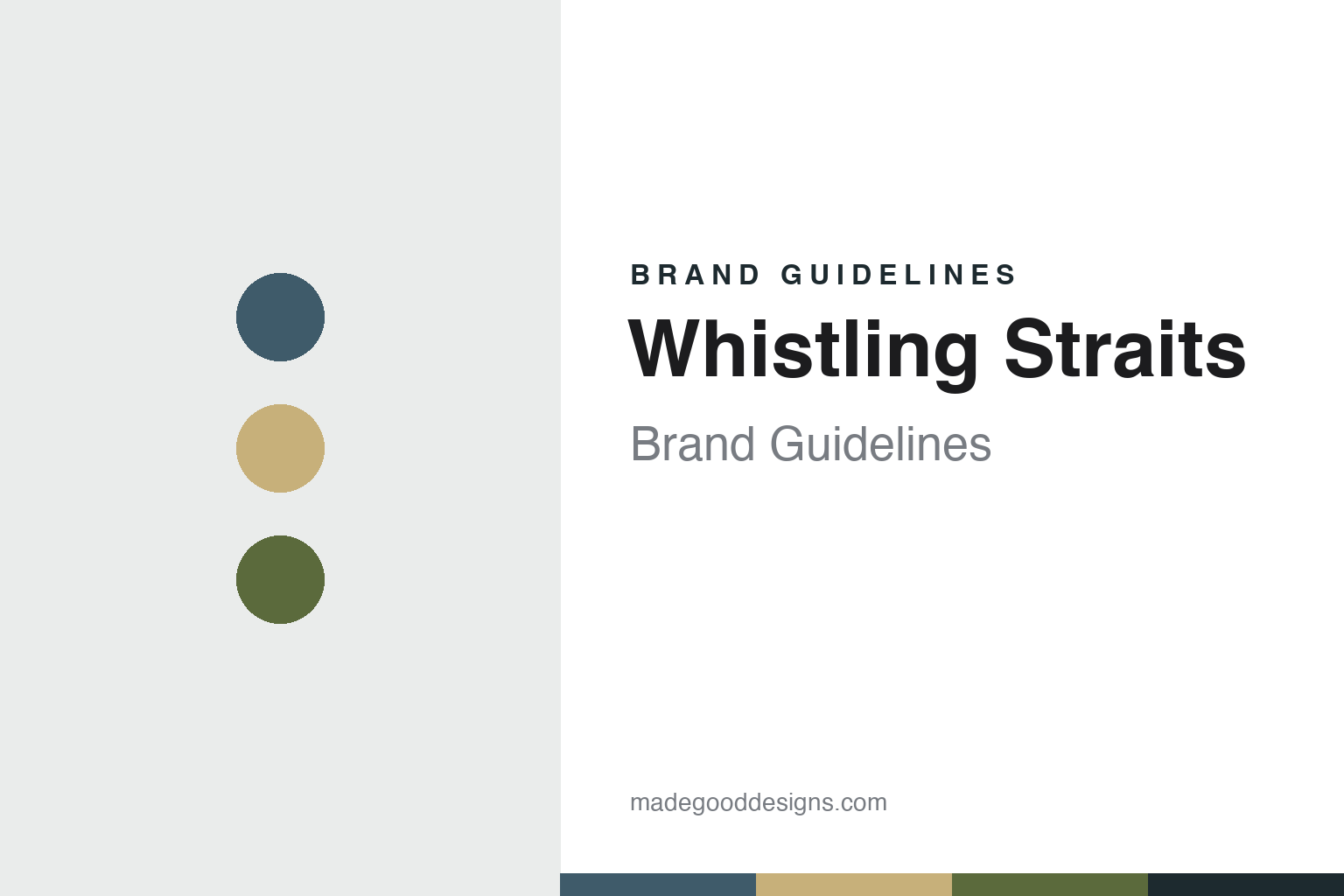
Two constants: a lake slate, fescue tan and dune green palette and a manor serif register. Abstract homage — not a Whistling Straits product or mark; no logo, flag or scorecard is reproduced.
From lakeshore to links
A lakefront site and an Irish idea.
Whistling Straits is a golf complex on the Lake Michigan shore at Haven, in the Town of Mosel north of Sheboygan, Wisconsin. English Wikipedia describes it as one of two 36-hole venues of the golf resort owned and operated by the Kohler Company, the plumbing-products maker based in the village of Kohler; the other is Blackwolf Run. Wikipedia names The American Club, Kohler’s hotel, as the operator. The complex has two courses: the Straits Course, which opened in 1998, and the Irish Course, which Wikipedia says opened in 2000.
The land had several earlier uses. The Irish Times reported in August 2004 that the site was leased in 1949 to the federal government as Camp Haven for about ten years. It was later bought by the Wisconsin Electric Power Company, which looked at it as a possible site for a nuclear power station that was never built; Golf.com wrote in 2021 that the land had also served as a makeshift dump. In 1995, The Irish Times reported, Kohler Co. completed an agreement with the power company for about 560 acres of lakefront, undertaking to work with government agencies on cleaning up the site and restoring the shoreline and its natural landscape.
Kohler’s chief executive, Herbert Kohler, hired Pete Dye as architect, and Wikipedia credits the courses to Pete and Alice Dye. According to The Irish Times, Kohler asked for something in the spirit of Royal Portrush and Ballybunion, Irish links he had played on golfing holidays, and Dye recalled being told to make it “as close to that as you can.” The paper said the flat site was reshaped with about 170,000 dump-truck loads of quarried sand, and Golf.com put construction at more than four years.
Colour
Sheep, stone and an Irish flag.
The Straits Course runs along about two miles of Lake Michigan shoreline, with eight holes beside the water, according to Wikipedia, which also lists three stone bridges and elevation changes of around 80 feet. The resort describes it as “panoramic links carved along two miles of rugged Lake Michigan coastline” and as a walking-only course. The Irish Times noted in 2004 that golfers there walked with caddies, some of them brought over from Ireland, along narrow foot trails between greens and tees, with no cart paths. Sand is part of the look: Golf.com reported in 2021 that course officials could put the number of bunkers only at “over 1,000.”
The Irish Course is described by Wikipedia as an inland grass-and-dune layout. The resort says it criss-crosses Seven Mile Creek and skirts the coastal dunes, mixing links and target golf.
Much of the identity sits off the fairways. A flock of Scottish Blackface sheep grazes the property in season; The Irish Times reported that Kohler had imported several dozen, and the resort still calls them its resident sheep. The same report said an Irish flag flew beside the US flag outside the clubhouse all year. It described the clubhouse, then six years old, as built to resemble an Irish manor house of the 1800s, with its whitewashed stones laid rough side out for a more natural look and locker-room drains copied from 19th-century Irish ones. The resort now describes its restaurant overlooking the 18th hole as a rustic farmhouse serving American food “with an Irish flair.”
Hole names carry the same tone onto the scorecard. Wikipedia’s hole-by-hole table, drawn from the PGA of America and the resort, lists Straits holes such as Outward Bound, Shipwreck and Cliff Hanger, and, at the 18th, Dyeabolical, a play on the architect’s name. Irish Course holes include Shepherd’s Post, Sandbanks and Deep Dye.
Typography
Links, courses and resorts.
Golf links, courses and resorts present themselves through place before anything else. A venue’s name is usually its town, its bay or its estate, and its crest, flag or wordmark tends to borrow from the land around it: a bridge, a tree, a stretch of coast, a stone building. In June 2025, for example, St Andrews Links introduced a separate icon for each of its courses, drawn from local history, while keeping its older Links Crest as the corporate mark of the trust that runs them, Golf Business News reported.
The identity then travels across a set of familiar objects. Scorecards and yardage books carry the course name and its hole-by-hole layout; tee markers, direction signs and pin flags repeat the mark out on the ground; and clubhouse shops put it on polo shirts, caps, headcovers and towels. Clubhouses and hotels give a venue its architecture, and the names of the course architects, as the venues and their histories credit them, often become part of the story a resort tells about each course.
Ownership shapes how these places speak. Some links are public land run by a trust or a council committee; others belong to a resort company, a family business or a larger group with hotels elsewhere. Several have changed hands more than once, and a few run courses under lease rather than outright ownership. This guide describes each owner plainly, by its business role and the dates its sources give.
History pages and championship lists are a large part of how these venues publish themselves: the year a course opened, the architects who shaped or revised it, and the championships it has hosted, given as dated facts. This guide follows that record. It does not rank courses, compare them, or quote green fees, room rates or membership prices, and the colours shown with each guide are an unofficial interpretation rather than a venue’s own palette.
Aa
A manor serif for an Irish-style clubhouse on Lake Michigan. (Specimen set in Libre Caslon Text, a serif STAND-IN; NOT the Whistling Straits logo.)
Whistling Straits
Majors, a Ryder Cup and a Kohler name.
Whistling Straits has hosted the PGA Championship three times, in 2004, 2010 and 2015, the U.S. Senior Open in 2007, and the Ryder Cup in September 2021, according to Wikipedia and the resort. Vijay Singh won the 2004 PGA Championship after a three-hole playoff, the resort says, and Jason Day won in 2015; the 2021 Ryder Cup was won by the United States team. Golf.com noted in September 2021 that it was the course’s debut as a Ryder Cup venue. The resort’s page now presents Whistling Straits as “home of four majors and the 43rd Ryder Cup.”
Ownership has stayed with Kohler. The Irish Times traced the company in 2004 to John Michael Kohler, an Austrian immigrant who bought a small foundry in Sheboygan in the second half of the 19th century, made cast-iron ploughs and other farm implements, and moved into baths and toilets. The paper also noted that Kohler’s design centre stands in the grounds of the resort.
The golf and hotel business now trades as Kohler, Wisconsin, at kohlerwisconsin.com, whose pages carry a 2026 copyright line for Kohler Co.; English Wikipedia calls the resort Destination Kohler, and the older destinationkohler.com address redirects to the new site. Its golf menu lists Whistling Straits alongside Blackwolf Run, Purebred Farm and the Kohler Golf Academy, and the Straits complex has its own golf shop and restaurant.
For a design guide, Whistling Straits shows how an American lakeshore course borrows the language of Irish links — sheep, whitewashed stone and punning hole names — under a corporate owner. Compare Kohler, the company that owns it, and TPC Sawgrass, another course credited to Pete Dye. For this guide we use a lake slate, a fescue tan and a dune green with a serif, an unofficial interpretation; no product or logo is reproduced.
Explore & save
Keep Whistling Straits’s identity on hand — save it to a board in the Made Good inspiration library.
Whistling Straits identity set
Pin the Whistling Straits lake slate, fescue tan and dune green palette and the manor serif register to your own board.
Source & notes
Frequently Asked Questions
What font can I use to match the Whistling Straits look?
This guide describes Whistling Straits’ type as “A manor serif for an Irish-style clubhouse on Lake Michigan”. Its type specimen is set in Libre Caslon Text from Google Fonts as a stand-in; Libre Caslon Text is not Whistling Straits’ own lettering.
What colours are in the Whistling Straits palette?
This guide’s Whistling Straits palette is Lake slate #3F5B6A, Fescue tan #C7B07A, Dune green #5B6A3C, Whitewash #F1EEE5 and Clubhouse ink #1D2A2F. The tones are the guide’s own unofficial interpretation, not official Whistling Straits hex codes.
When did Whistling Straits open?
Whistling Straits opened in 1998 (Straits), 2000 (Irish), in Haven, Wisconsin.
Who owns Whistling Straits?
Whistling Straits is owned by Kohler Co. This guide dates Whistling Straits to 1998 (Straits), 2000 (Irish), in Haven, Wisconsin.