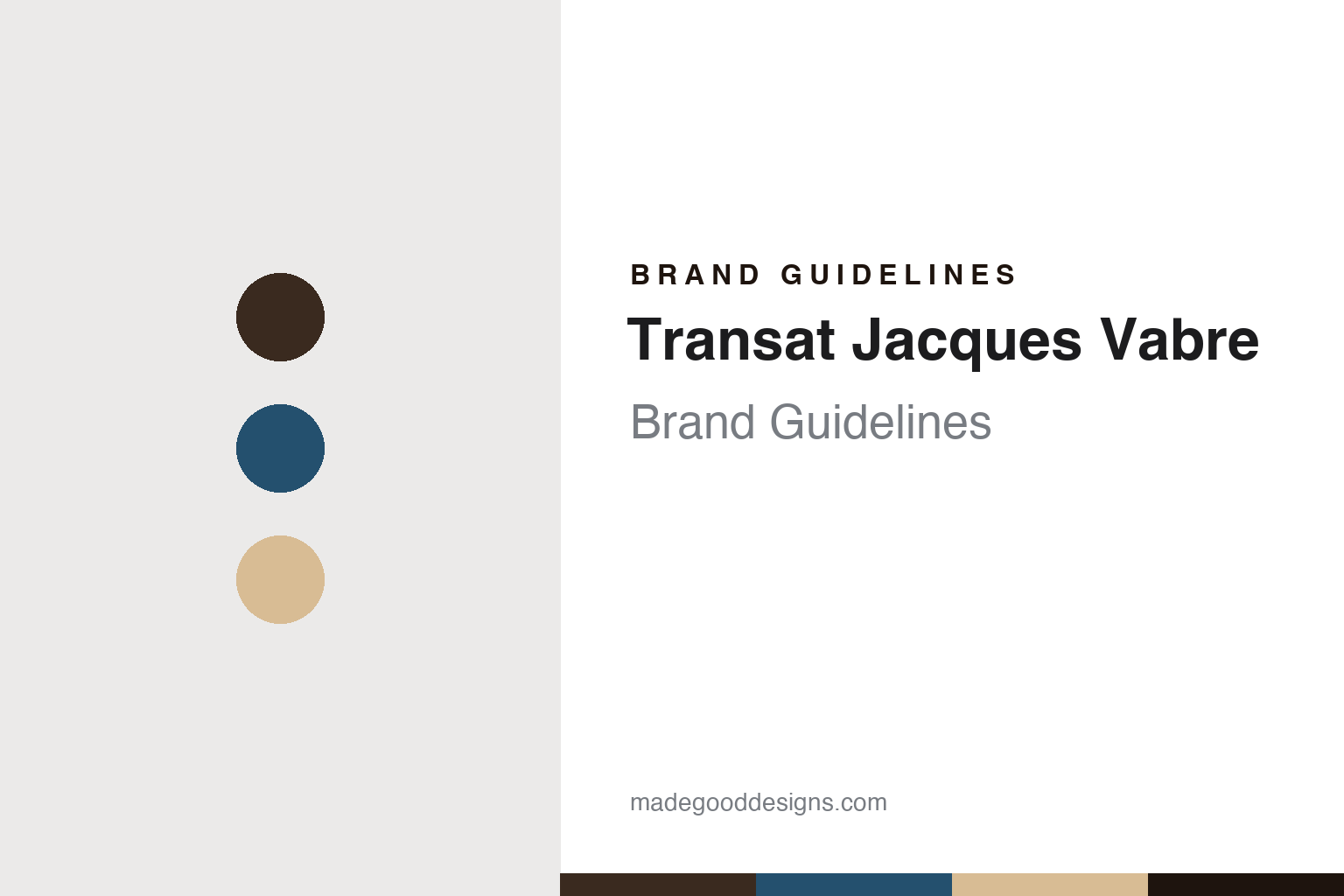
Transat Jacques Vabre Brand Guidelines
The Le Havre coffee-route race sailed by crews of two.
Aa
Two constants: an espresso, Atlantic blue and crema palette and a condensed sans register. Abstract homage — not a Transat Jacques Vabre or Transat Café L’Or mark; no logo, poster or boat livery is reproduced.
The Route du Café
A Le Havre start and a coffee partner since 1993.
The race now called the Transat Café L’Or began in 1993 as the Route du Café, a transatlantic race from Le Havre to Cartagena, in Colombia, run with the financial partnership of the coffee brand Jacques Vabre. French Wikipedia credits the idea to Xavier Dequest, and places the race after an earlier double-handed transatlantic race held with other sponsors in 1979, 1983 and 1989. Thirteen boats started the 1993 edition, which was sailed single-handed; from the second edition, in 1995, the race has been sailed by crews of two.
The race has kept its start and changed its finish. French Wikipedia lists Cartagena as the finish from 1993 to 1999, Salvador de Bahia in Brazil from 2001 to 2007, Puerto Limón in Costa Rica in 2009 and 2011, and Itajaí in Brazil in 2013 and 2015. Salvador returned for 2017 and 2019, a choice French Wikipedia says the sponsor made as a nod to the history of coffee in French–Brazilian sea trade. In 2021, for the fifteenth edition, the race was named the Transat Jacques Vabre Normandie Le Havre and finished for the first time in Martinique, in the bay of Fort-de-France; the 2023 and 2025 editions finished there too.
English Wikipedia describes the course as following the historic coffee-trading route between France and Brazil, in the wake of the clippers that once carried coffee to Le Havre. The race is held every other year, in odd years, and the start has stayed in Le Havre throughout its history.
Colour
Four classes, four courses, two sailors per boat.
The Transat is a multi-class race. Depending on the year, French Wikipedia says, it has been open to 60-foot IMOCA monohulls, 50-foot monohulls and the Class40, and to multihulls in the Multi50, ORMA 60, MOD70 and Ultim classes. The ORMA 60 multihulls raced in it for the last time in 2007, and the 50-foot monohull class gave way to the Class40. In 2019 the largest multihulls, the Ultims, did not take part; French Wikipedia says the organisers could not find room for them in the start and finish ports, and a separate double-handed race for the class, the Brest Atlantiques, started on 2 November that year. The Ultims returned in 2021.
Since then the organisers have set a different course for each class so that the fleets arrive close together in Martinique. The 2025 edition, the seventeenth, started from Le Havre on 26 October 2025 with 74 boats — 4 Ultim, 10 Ocean Fifty, 18 IMOCA and 42 Class40 — French Wikipedia says. The Ocean Fifty fleet started a day ahead of the others, and the organisers say the Class40 sailed their race in two stages, with a stop in A Coruña, in Spain. The 2023 edition, which marked the race’s thirtieth anniversary, gathered 95 boats, AFP reported in December 2024.
French Wikipedia counts five wins for Franck Cammas, three in the 60-foot multihull class and two in Ultim; the most recent, in 2025, came with Tom Laperche aboard the Ultim SVR-Lazartigue, according to the organisers’ results.
The race is run in an unusual way for an event of its size. Speaking to Sailorz, the English-language site of the French sailing publication Tip & Shaft, in December 2024, race co-director Gildas Gautier said the event has been governed by an association since 2010. The race website names the Association Transat Café L’Or as its owner. It lists the city of Le Havre and Café L’Or as founding partners, and says the Région Normandie has supported the race since 2017 and became an organising member in 2019, alongside the JDE group and the city. BRED Banque Populaire was the main partner of the 2025 edition, the site says.
Typography
Design and documentation.
Offshore races and regattas are run by organisers rather than manufacturers, so their identities live on posters, start lines, race villages, maps and broadcasts more than on products. Some organisers are clubs, some are private companies and some are semi-public bodies tied to a host town or region. A design guide for any of them starts with a plain question: who runs the event, and who owns the name.
Race names carry a lot of history. Many events have changed their names as title sponsors came and went, and an organiser’s pages on history and past editions usually list each edition under the name it raced under at the time. A wordmark often has to sit beside a sponsor’s name, a host town and a year, and partner logos are usually set in tiers below it, from title partner down to official suppliers.
Boat classes shape the look as well. Sources name classes such as IMOCA, Class40, the Mini 6.50 and the F50 one-design catamaran, and each event sets out which classes it admits. Sails, hulls and wings carry team names and partner marks, and course maps and tracking graphics let viewers follow a long race day by day.
The rest of the identity sits on land: the race village where boats are moored before the start, the signage on pontoons, the official merchandise and the trophy, which some organisers unveil publicly. The guides in this group describe what their sources show about those elements, name organisers, clubs and companies plainly, and treat editions and dates as the main facts.
Aa
A condensed sans for start-line graphics and race maps. (Specimen set in Barlow Condensed, a sans STAND-IN; NOT the Transat Jacques Vabre or Transat Café L’Or logo.)
Transat Café L’Or
A new name, announced in December 2024.
After three decades the coffee name changed. On 5 December 2024 the organisers announced in Le Havre that the race would become the Transat Café L’Or, AFP reported through Outremers360; the full title is TRANSAT CAFÉ L’OR Le Havre Normandie. Jacques Vabre and L’Or both belong to the coffee group JDE Peet’s, and Vincent Prolongeau, president of JDE France, told the press conference that the change confirmed the group’s commitment to the race and that nothing else would change. Gautier told Sailorz that the request came from JDE Peet’s France after the prize-giving for the 2023 edition, in January 2024, that agencies helped the organisers find the name, and that a new name “necessarily goes hand in hand with a new visual identity.” He added that the race had first been known as the Route du Café, and that it took time for the public to start calling it the Transat Jacques Vabre.
The first start under the new name was given on 26 October 2025. The old web address now forwards to the new site, and the organisers still call the race “la Route du café,” describing it with a simple formula: a coffee destination, two sailors per boat, four classes, four courses and four winning duos. Before each start a race village opens on the Le Havre quays — in 2025 from 17 October, the site says.
For a design guide, the Transat Jacques Vabre shows how a race can keep its course, its port and its nickname while the sponsor’s brand on the title changes. Compare Route du Rhum, another transatlantic race that starts from a French port, and the Vendée Globe, another French offshore race. For this guide we use espresso, Atlantic blue and crema with a condensed sans, an unofficial interpretation; no product or logo is reproduced.
Explore & save
Keep Transat Jacques Vabre’s identity on hand — save it to a board in the Made Good inspiration library.
Transat Jacques Vabre identity set
Pin the espresso, Atlantic blue and crema palette and the condensed sans register to your own board.
Source & notes
Frequently Asked Questions
What font can I use to match the Transat Jacques Vabre look?
This guide describes Transat Jacques Vabre’s type as “A condensed sans for start-line graphics and race maps”. Its type specimen is set in Barlow Condensed from Google Fonts as a stand-in; Barlow Condensed is not Transat Jacques Vabre’s own lettering.
What colours are in the Transat Jacques Vabre palette?
This guide’s Transat Jacques Vabre palette is Espresso #3A2A1F, Roast #1E140E, Atlantic blue #24506E, Crema #D8BC94 and Quay paper #F5F1EA. The tones are the guide’s own unofficial interpretation, not official Transat Jacques Vabre hex codes.