Casson Mann Brand Guidelines
The London studio that built its name on the V&A’s British Galleries.
Aa
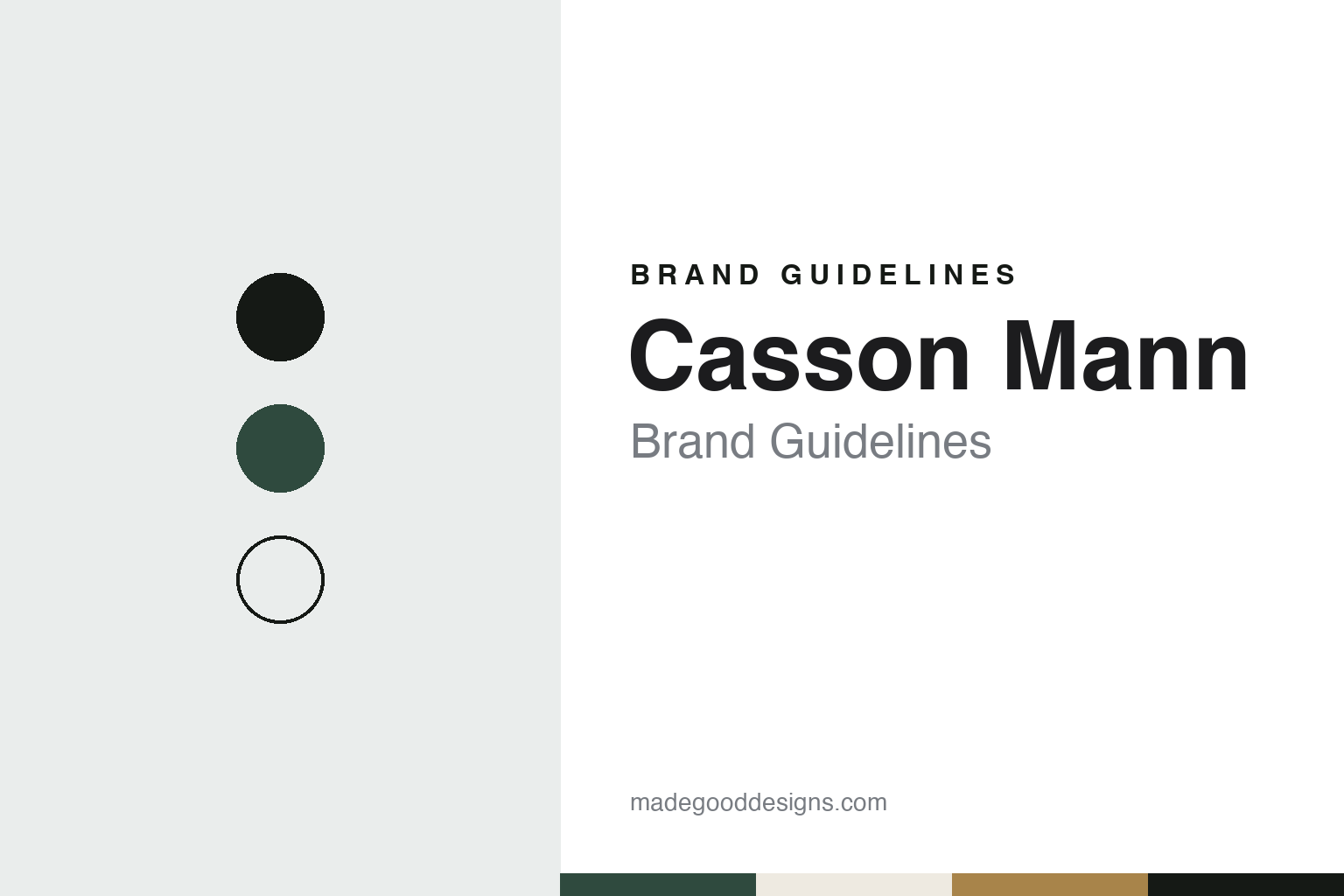
Two constants: a green, linen and brass palette and a bookish serif register. Abstract homage — not a Casson Mann asset; no project, logo or wordmark is reproduced.
Casson Mann
Two designers, one practice, four decades.
Casson Mann describes itself as a studio of “museum, exhibition and interior designers.” Its own history page says it was founded in 1984 by the designers Dinah Casson and Roger Mann. English Wikipedia’s article on Dinah Casson gives the same year and adds that she had set up her own design practice in 1970, after graduating from Ravensbourne College of Art and Design in 1968. She later wrote Closed on Mondays: Behind the Scenes at the Museum, published by Lund Humphries in 2020. The studio’s site says she retired from Casson Mann in 2017.
Today the practice is led by Roger Mann, whom its team page names as founder and creative director and says is involved creatively in all projects. Three directors lead the project teams, among them Gary Shelley. In November 2026 the team page described Casson Mann as a group of 34 people, with skills it lists as running from model-making to script-writing, and named roles such as designer, project designer, content developer, interpretation assistant and office administrator. Its contact page gives two offices, in London and Paris, and the website is published in English, French and German.
The studio’s list of services is broad. It names museum, exhibition, installation and interior design; interpretative strategies; visioning; masterplanning; and concepts and art direction for multimedia. It says it works with architects and creatives from other fields and takes on projects at every stage from concept to completion. Those are the company’s own words. Its about page adds that it starts each project by listening to the client’s ideas, and that it helps clients find a narrative for their collections.
Colour
Four projects with dates.
The project that the studio itself puts first in its history is the British Galleries at the Victoria and Albert Museum in London, completed in 2001. English Wikipedia’s article on the museum says the rebuilding covered fifteen galleries, replaced displays installed in 1947–52 and 1964–66, and, by taking in adjacent storerooms and offices, increased the display space by a quarter so that about 3,000 objects could be shown, with study rooms, interactive spaces and five complete period rooms. The National Lottery Heritage Fund, which funded the scheme, describes the galleries as arranged in three periods: Tudor and Stuart, Hanoverian and Victorian. Casson Mann marked the galleries’ twenty-fifth year in a news post in October 2026.
At Jodrell Bank in Cheshire, the First Light Pavilion opened on 4 June 2022, according to Casson Mann, which says it designed the permanent exhibition around a circular array of panels taken from the dish of the Lovell Telescope, and that the building was designed around that array. Archive film, sound and interactives tell the story of the scientists who worked there.
In Paris, the studio says its scenography for the Musée national de la Marine at the Palais de Chaillot opened in November 2023, with large sculptural “landmarks” such as a ship’s hull, a suspended shipping container and a wave animated by projections, and a ship-model gallery with views all round the models. The studio says the scheme combines the collection’s marine art with tactile models and digital interactives. Museums Journal, in February 2026, named the Paris museum and Showtown as recent Casson Mann work.
Showtown, Blackpool’s museum of entertainment, opened on 15 March 2024. The BBC reported in January 2020 that it would be organised in six themes: seaside, magic, shows, circus, illuminations and dance. The Guardian, on 12 March 2024, described a highly interactive museum mixing artefacts with games, and quoted Gary Shelley, “the museum’s designer, from Casson Mann,” calling it “a museum for people who don’t go to museums.” The newspaper listed exhibits including the Blackpool police cell from which Harry Houdini escaped in 1905, and said 27 items had been lent by the V&A in London; the BBC had put the planned display at about 800 objects.
Typography
How exhibition studios present themselves.
Exhibition, museum and experience-design studios rarely sell a product with their name on it. What they publish instead is a body of work: galleries, visitor centres, pavilions and installations, each credited to the studio by the museum, the client or the trade press. A guide to their identity therefore starts with how they present that work, and with the names and wordmarks on their own websites.
Several of these practices are named after their founders or partners, and some shorten a longer name to initials: Ralph Appelbaum Associates calls itself RAA on its own site. Their websites show a wordmark, a project list and a few pages on the practice. Founders and partners appear in a professional role, as creative directors or principals, and team pages can list designers, content developers and model-makers alongside them, as Casson Mann’s does.
The project case study is the core format. A typical page names the client and the opening date, then shows the gallery graphics, wayfinding, display furniture, projections and interactive installations that make up the scheme; Casson Mann’s pages call this mix its scenography. Independent coverage, in titles such as Museums Journal, Blooloop and national newspapers, is the surest way to date and credit a project, because a single building can involve more than one design firm: English Wikipedia credits the conversion of the IKEA Museum in Älmhult to both WilkinsonEyre and Ralph Appelbaum Associates.
Corporate pages fill in the rest: office locations, practice history, renamings and, where it has happened, a change of ownership. This guide sets out what dated sources say about each studio, keeps company statements attributed, and leaves out awards and any claims about what an exhibition does for its visitors.
Aa
A bookish serif for a studio that writes as much as it builds. (Specimen set in Newsreader, a serif STAND-IN; NOT the Casson Mann logo.)
casson mann
Two surnames, set quietly.
The studio presents itself with restraint. Its website is built around four plain headings, projects, about, team and news, set in lower case, and the footer gives the name the same way, as “casson mann.” The home page opens with a short line, “we are museum, exhibition and interior designers,” followed by a rotating set of recent projects. The name has stayed the two founders’ surnames since 1984, including after Dinah Casson’s retirement in 2017.
Each project page follows a consistent pattern: the name of the gallery or museum, its location and opening date, then a paragraph on the design idea and a set of photographs. The pages describe the stories behind collections and the way a scheme is paced. On the British Galleries, it says it varied “the pace, texture, acoustics, density, colour and interactivity” of the rooms, with 3,000 objects spread over about 3,000 square metres.
The work also shows how material choices are described in public. Museums Journal reported in February 2026 that, for a gallery project at the Royal Observatory Greenwich, the studio’s designers had opted for exhibition furniture that is mechanically fixed rather than glued, with the joints between parts left visible to give a “constructed” look. In the same article Izzie Cullen, a content developer at Casson Mann, described comparing alternative materials for each proposed finish.
For a design guide, Casson Mann shows how a two-name studio can keep a quiet, lower-case identity while its projects carry the names of the museums. Compare Event Communications, another London museum-design studio, and Ralph Appelbaum Associates, whose London studio works in the same field. For this guide we use a gallery green, linen and brass with a serif, an unofficial interpretation; no product or logo is reproduced.
Explore & save
Keep Casson Mann’s identity on hand — save it to a board in the Made Good inspiration library.
Casson Mann identity set
Pin the green, linen and brass palette and the bookish serif register to your own board.
Source & notes
Frequently Asked Questions
What font can I use to match the Casson Mann look?
This guide describes Casson Mann’s type as “A bookish serif for a studio that writes as much as it builds”. Its type specimen is set in Newsreader from Google Fonts as a stand-in; Newsreader is not Casson Mann’s own lettering.
What colours are in the Casson Mann palette?
This guide’s Casson Mann palette is Gallery green #2F4A3E, Ink #151915, Linen #EEEAE1, Brass #A8844A and Paper #F9F8F3. The tones are the guide’s own unofficial interpretation, not official Casson Mann hex codes.
When was Casson Mann founded?
Casson Mann was founded in 1984, in London, United Kingdom.
Who founded Casson Mann?
Casson Mann was founded by Dinah Casson and Roger Mann in 1984.