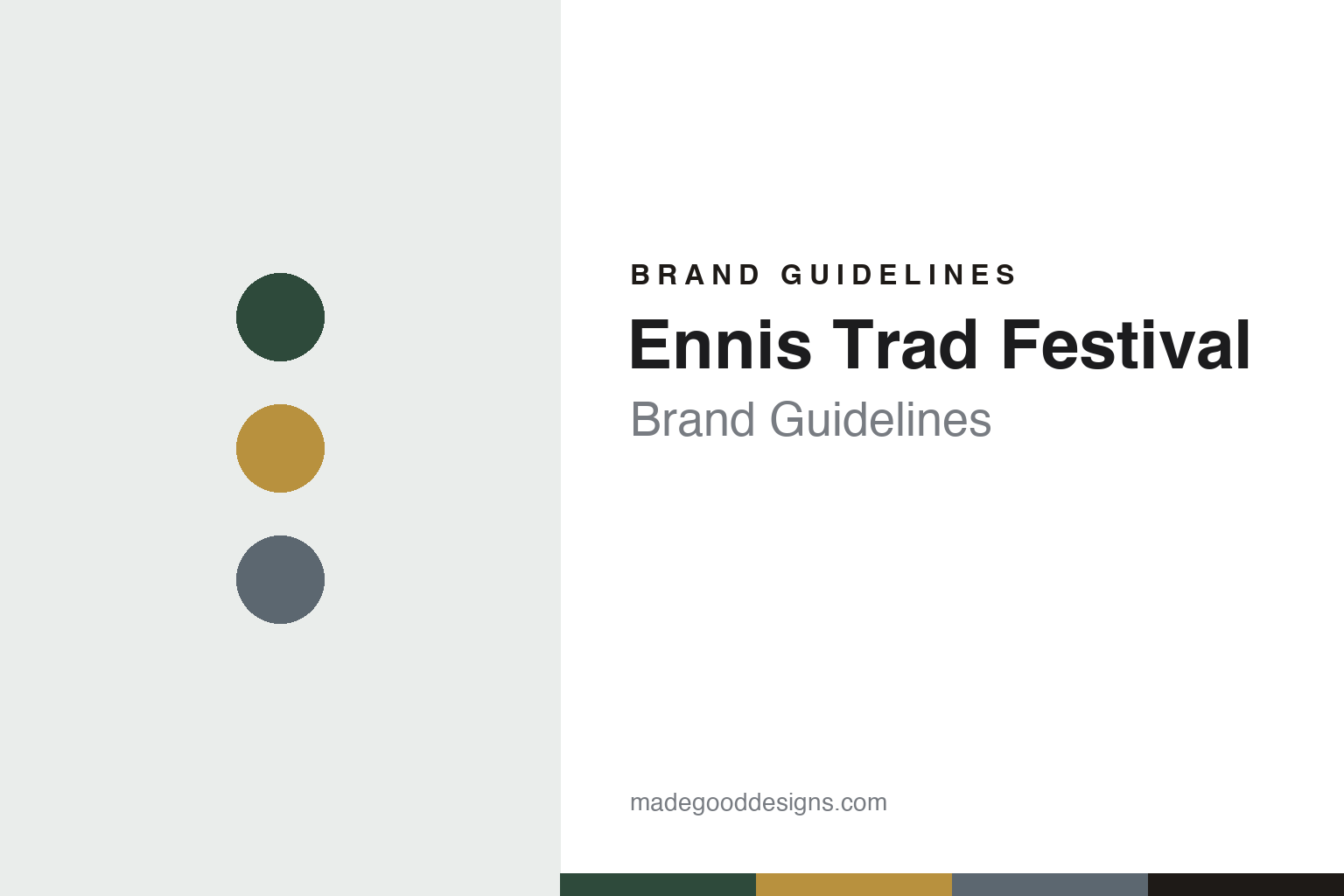
Ennis Trad Festival Brand Guidelines
A session trail, a concert every night and a long weekend of Irish music each November in Ennis.
Aa
Two constants: a Clare green, brass gold and slate palette and a narrow sans register. Abstract homage — not an Ennis Trad Festival poster or mark; no logo, artwork or programme is reproduced.
A musicians’ festival
A long weekend in November in the County Clare town.
The Ennis Trad Festival, which calls itself Ennis Trad Fest on its website and keeps the longer name in the titles of its concerts, takes place each November in Ennis, County Clare, in the west of Ireland. The festival describes its home as “the medieval town of Ennis.” According to The Clare Echo, which previewed the 2024 programme in November that year, the festival dates from its inception in 1994; the 2024 edition, held from 7 to 11 November, was its thirtieth year.
Its timing gives it a distinct place in the town’s year. Reporting on the Fleadh Nua, the separate spring festival that Comhaltas Ceoltóirí Éireann holds in Ennis, The Irish Times quoted the owner of a traditional music shop in the town in May 2000, who contrasted the two events: “In November, there is the Ennis Traditional Festival which is more of a musicians’ festival.” The same idea still runs through the way the festival is described. At the launch of the 2024 edition the Cathaoirleach, or chair, of Clare County Council said the festival prided itself on being the “Musician’s Festival,” run by musicians, for musicians, and thanked its organising committee, The Clare Echo reported; the council supports the event.
A festival listing published by the folk magazine The Living Tradition describes more than 20 venues hosting selected traditional musicians, spotlight concerts every night from Thursday to Monday, CD launches, recitals, instrument and singing masterclasses and céilís, all over a “(very) long weekend in November.” The festival counted its 2026 edition, held from 5 to 9 November, as its 32nd.
Colour
Sessions, concerts and a trad disco.
The core of the festival is its session trail. The festival says the trail runs every day of the festival, is free, and takes in more than 100 sessions in venues across the town, with musicians from Ireland and abroad. Each year it publishes the trail twice over, once by date and once by venue, listing every session with its time and the names of the musicians playing, and it keeps those lists online back to 2014. Tourism Ireland, the island’s tourism marketing body, added in October 2024 that there are also open sessions to which amateur and professional musicians can bring their instruments and play together.
Around the trail sit the ticketed events. For 2024, The Clare Echo named the Michael McGoldrick Big Band, Sharon Shannon and her band, the Five Counties Céilí Band and the Clare Youth Trad Orchestra among the performers, and said the big concerts on the Friday and Saturday nights would be followed by the festival’s trad disco, running into the small hours. The paper also listed album launches around the town and a free Saturday-morning session at 11am, the Festival Fry Session. Tourism Ireland counted more than 100 sessions and concerts that year, with album and book launches, céilís, workshops and the trad disco in more than 20 venues.
Teaching is part of the programme too. The festival runs a morning of masterclasses on the Saturday, which The Clare Echo listed for 2024 in accordion, banjo, concertina, fiddle, flute and uilleann pipes; the festival says they are open to all ages but meant for musicians at intermediate level, and held them in 2024 and 2025 at the Gaelscoil Mhíchíl Cíosóg school. Trad 4 Teens, an annual session for teenagers led by well-known musicians, has its own place on the bill; in 2025 it ran on the Friday and Saturday at the glór arts centre.
Typography
Folk festivals and their settings.
A folk festival rarely has a single building to stand for it. Its identity is carried instead by a place and a date: a seaside town that turns its gardens and promenade into stages for a week, an island whose villages and halls share the programme, a showground or estate field where marquees go up for a long weekend, a cultural village set in a rainforest, or a run of community halls in the cold months. The setting gives the festival its name, and the calendar fixes it in the memory, whether that is the week that takes in the first Monday in August or a bank holiday weekend at the end of summer.
The programme is the second layer. Concert marquees, standing big tops, dance houses, storytelling tents and children’s areas are usually given names of their own, and those names recur in programmes, on site maps and on stage boards year after year. Dance displays and processions take the festival out into the streets, so that teams of morris, sword, rapper or clog dancers become part of the look of the event as much as any printed material.
Print and lettering then travel from one edition to the next. A festival may commission a new poster each year while keeping the same wordmark, or keep a house style while changing its artwork; edition numbers, founding years and the name of the host town often sit beside the title on programmes, wristbands and listings. When a festival changes its name, moves to a new site or passes to a new organiser, these repeated elements are what carry its identity across the change.
The guides in this group look at folk festivals through those elements: where they are held, when they fall in the year, how their sites and stages are named, and how their names and printed matter have been handled over time. The colours and typefaces shown are our own interpretation, not official assets.
Aa
A narrow sans — a festival that prints its sessions by date and by venue. (Specimen set in Archivo Narrow, a sans STAND-IN; NOT the Ennis Trad Festival logo.)
Ennis Trad Festival
Hotels, an arts centre and a programme in two orders.
The festival’s own event listings show how the weekend moves through the town. In 2025 the official launch, on Thursday 6 November, took place at The Sanctuary, followed there by album launches; the Friday and Saturday concerts were at The Queens Hotel, each followed by the trad disco, the Sunday night concert at The Old Ground Hotel and the Monday night concert back at The Queens Hotel. In 2026 the launch moved to The Temple Gate Hotel, which also hosted a run of album launches over the weekend, while the glór arts centre presented two concerts under the banner “glór presents @ Ennis Trad Fest,” one of them with the Clare Youth Trad Orchestra, and the Clare Arts Office presented a free afternoon event there. An afternoon céilí with a céilí band filled the Sunday at Cois na hAbhna.
Concerts in hotels and the arts centre, launches and the session trail through venues across the town make up the weekend. The festival’s categories on its website follow the same lines, with separate headings for concerts, launches, free events, special events, the trad disco and Trad 4 Teens.
Its visual identity is carried mostly by those listings and by the annual brochure. The festival’s website, credited to the designer Aoife Kelly, puts the edition’s dates at the top of its home page, offers a downloadable programme brochure, and keeps galleries, masterclass pages and session trails for past years, so that the record of each November stays in public view. The shortened name, Ennis Trad Fest, is the one used across the site and in its headings.
For a design guide, the Ennis Trad Festival shows how a festival’s identity can rest on a dated, published list of sessions as much as on a logo, with a whole town’s rooms carrying the programme for five days. Compare Celtic Connections, a winter festival of traditional and roots music in Glasgow, and Førde Festival, another festival that spreads across the venues of one small town. For this guide we use a Clare green, a brass gold and a slate with a sans, an unofficial interpretation; no product or logo is reproduced.
Explore & save
Keep Ennis Trad Festival’s identity on hand — save it to a board in the Made Good inspiration library.
Ennis Trad Festival identity set
Pin the Ennis Trad Festival Clare green, brass gold and slate palette and the narrow sans register to your own board.
Source & notes
Frequently Asked Questions
What font can I use to match the Ennis Trad Festival look?
This guide describes Ennis Trad Festival’s type as “A narrow sans — a festival that prints its sessions by date and by venue”. Its type specimen is set in Archivo Narrow from Google Fonts as a stand-in; Archivo Narrow is not Ennis Trad Festival’s own lettering.
What colours are in the Ennis Trad Festival palette?
This guide’s Ennis Trad Festival palette is Clare green #2E4A3B, Peat brown #1E1A17, Brass gold #B8913E, Slate #5C6770 and Paper #F6F2EA. The tones are the guide’s own unofficial interpretation, not official Ennis Trad Festival hex codes.
When was Ennis Trad Festival founded?
Ennis Trad Festival was founded in 1994, in Ennis, County Clare, Ireland.