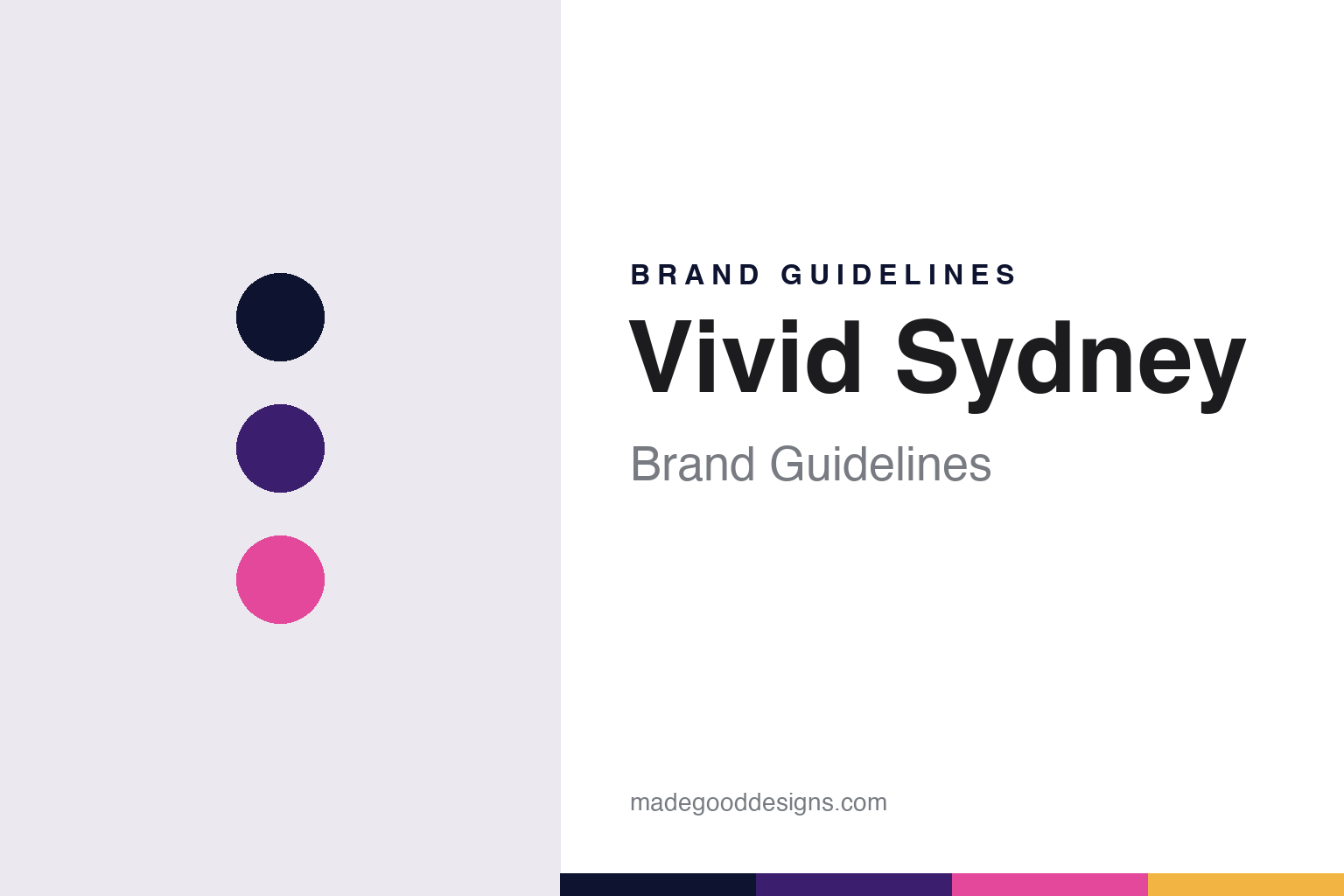
Vivid Sydney Brand Guidelines
Sydney’s winter festival of light, music, minds and food.
Aa
Two constants: a harbour-night palette with violet, pink and amber and a projection sans register. Abstract homage — not a Vivid Sydney asset; no logo, artwork or projection is reproduced.
Smart Light Sydney
A light walk, a lit Opera House and an idea about low-energy light.
Vivid Sydney began in 2009 as a new early-winter festival of “music, light and ideas” spread over three weeks, the arts magazine RealTime reported in its April–May 2009 issue. That first edition ran from 26 May to 14 June 2009 and was produced by Events Sydney. Its light strand had a name of its own, the Smart Light Sydney festival, directed by the lighting designer Mary-Anne Kyriakou, who then led the architectural lighting division of the consultancy Meinhardt in Sydney. She described it to RealTime as “a low energy light festival” and traced the idea back to a light festival she visited after a lighting trade fair in Germany in 2006.
The 2009 programme had two large parts, RealTime reported. One was the Smart Light Festival, with installations at the University of Technology Sydney and a Light Walk that took visitors, map in hand, from Observatory Hill through The Rocks and Circular Quay to the Sydney Opera House. The other was Luminous, a music and light programme curated for the Opera House by the musician and artist Brian Eno. English Wikipedia says the original name, Smart Light Sydney, was replaced by Vivid Sydney to cover the three streams of Light, Music and Ideas.
Eno’s contribution to the light strand was a work for the building itself. The design magazine Indesign reported on 28 May 2009 that projectors set up around the harbour cast an evolving, abstract light work, adapted from his earlier piece 77 Million Paintings, onto the curves of the Opera House sails, lighting them from both sides. The same report said Smart Light Sydney set out to show what low-energy lighting could do, through displays and symposiums.
The installations previewed by RealTime give a sense of that first route. They included a pixel façade of a giant human face hanging above a laneway in The Rocks, built from 191 light spheres by researchers at UTS, and a plan by the Portuguese multimedia studio Ocubo to cover a building façade in The Rocks with virtual tiles that passers-by could “paint” with the colours of their clothes and their movements. RealTime illustrated that plan with a photograph of Ocubo’s work at GLOW in Eindhoven in 2008.
Colour
Light, Music, Minds and Food.
From one light walk, the festival has grown into several strands. English Wikipedia dates the talks programme, Vivid Ideas, to 2012; in May 2015 The Guardian called it “the talks and workshops component of the city’s annual light show,” and noted that Vivid’s opening day that year fell in the same week as TEDxSydney and the Sydney Writers’ Festival. Vivid Food was added in 2023, English Wikipedia says. In November 2026 the festival’s website describes 23 nights of programming across four strands, Light, Music, Minds and Food: the ideas strand now carries the name Vivid Minds.
The light strand is still built around a walk. The website describes the Vivid Light Walk as a free trail of light projections and installations across the harbour foreshore. English Wikipedia places the route through The Rocks, Circular Quay and the Royal Botanic Garden, with large projections on buildings such as the Museum of Contemporary Art Australia, Customs House and Cadmans Cottage, and the Sydney Harbour Bridge lit as well. For 2014 it lists Walsh Bay, North Sydney and Darling Harbour among the areas involved, with Harbour Lights, the illumination of boats on the harbour, joining that year.
The recurring headline is the Lighting of the Sails of the Sydney Opera House, a new commission each year. English Wikipedia credits the 2014 work to the London studio 59 Productions. In June 2022 the ABC reported that Yarrkalpa – Hunting Ground, a painting made in 2013 by Martumili artists from the East Pilbara in Western Australia, had been animated across the sails. The painting depicts the country around Parnngurr, on the edge of the Great Sandy Desert, and shows the seasons, burning practices, cycles of regrowth, hunting and land management; the creative technologists Curiious handled the animation, and the electronic duo Electric Fields wrote the soundtrack, the ABC said.
For 2026 the festival’s website lists Opera Mundi by the French multimedia artist Yann Nguema, produced by his animation studio Anima Lux, which the site says was founded in La Rochelle in 2018. The site presents the work as a study of changes in land, sea and sky, the landscape that inspired the building’s architect, and says it was built from generative design, algorithms and data.
Not every year has gone ahead. English Wikipedia, citing the ABC and News.com.au, says the 2020 and 2021 editions did not take place; the website counted 16 editions by 2026.
Typography
How light festivals present themselves.
Light festivals usually name themselves in one of two ways. Some join a city’s name to a word for light, as Lyon’s Fête des Lumières and the Festival of Lights in Berlin do; others use a coined word, as Vivid Sydney and GLOW Eindhoven do, with the city added alongside. Most are held on autumn or winter evenings, when it is dark early: Lyon’s festival runs over four evenings around 8 December, while Sydney’s takes place in May and June, the start of the southern winter.
The organisers are mostly public bodies. The Fête des Lumières is organised by the City of Lyon, and Vivid Sydney is owned, managed and produced by Destination NSW, the New South Wales Government’s tourism and major events agency. Other festivals are run by foundations, non-profit organisations or production companies working with their city.
The format is broadly shared. Visitors follow a route of installations through a city centre, usually on foot, and the largest works are projections on landmark buildings: a cathedral, a town hall, an opera house. The works come from invited artists, lighting designers and studios, and many festivals name each work and its makers in a printed or online programme and on a map of the route.
Each edition brings new works and, often, a new theme, poster or campaign image, so a festival’s look can change completely from year to year while its name, its route and its main buildings stay the same. This guide sets out what can be checked about each festival: who started it and when, who organises it now, where it takes place and how its works and imagery are described in dated sources.
Aa
A bold grotesque for night-time signage and programme pages. (Specimen set in Archivo, a sans STAND-IN; NOT the Vivid Sydney logo.)
Vivid Sydney
A festival run by the state’s events agency.
Vivid Sydney is run by a state agency. Its website says it is owned, managed and produced by Destination NSW, the New South Wales Government’s tourism and major events agency, and the site’s copyright line names Destination NSW. In 2009 the producer named by RealTime was Events Sydney. The festival is named on its own pages as “Vivid Sydney,” often shortened to “Vivid” in programme titles such as Vivid Light, Vivid Music, Vivid Minds and Vivid Food, and its page title in November 2026 read “Light, Music, Minds & Food.”
The programme is organised around named works and named places. The website’s 2026 highlights opened with Lighting of the Sails: Opera Mundi and also listed a work called Laser Lightfall and another called Molecule of Light, alongside music and talks. In 2009 RealTime described a Light Walk map available online; today the website describes the trail as a free walk along the harbour foreshore, while the music, talks and food events take place in venues across the city.
The festival’s visual story has always begun with the Opera House. In 2009 Indesign described Eno’s work on the sails as “a continually changing, morphing series of abstract images” that would light the building for the duration of the festival; in 2022 the ABC described a painting by Martumili artists moving across the same sails; and in 2026 the website described a generative work by a French studio. Each was a single commission, made for one building.
For a design guide, Vivid Sydney shows how a city festival can be built on one recurring canvas and a walk around the water that changes every year. Compare the Sydney Opera House, the building at the centre of the light walk, and GLOW Eindhoven, the Dutch light festival pictured in RealTime’s 2009 preview. For this guide we use a harbour-night navy, a violet, a projection pink and a warm amber with a sans, an unofficial interpretation; no product or logo is reproduced.
Explore & save
Keep Vivid Sydney’s identity on hand — save it to a board in the Made Good inspiration library.
Vivid Sydney identity set
Pin the harbour-night, violet, pink and amber palette and the projection sans register to your own board.
Source & notes
Frequently Asked Questions
What font can I use to match the Vivid Sydney look?
This guide describes Vivid Sydney’s type as “A bold grotesque for night-time signage and programme pages”. Its type specimen is set in Archivo from Google Fonts as a stand-in; Archivo is not Vivid Sydney’s own lettering.
What colours are in the Vivid Sydney palette?
This guide’s Vivid Sydney palette is Harbour night #0E1430, Sail violet #3B1E6E, Projection pink #E4489A, Foreshore amber #F2B544 and Sandstone #F6F1E8. The tones are the guide’s own unofficial interpretation, not official Vivid Sydney hex codes.
When was Vivid Sydney founded?
Vivid Sydney was founded in 2009, in Sydney, Australia. This guide lists Destination NSW as its owner.
Who owns Vivid Sydney?
Vivid Sydney is owned by Destination NSW. This guide dates Vivid Sydney to 2009, in Sydney, Australia.