Fête des Lumières Brand Guidelines
Lyon’s 8 December candles and projections.
Aa
Two constants: a winter-night, glass-red and candle-amber palette and a lumignon serif register. Abstract homage — not a Fête des Lumières asset; no logo, artwork or projection is reproduced.
8 December 1852
Candles in the windows, and a date that moved twice.
The Fête des Lumières grew out of a Lyon custom that dates to 8 December 1852. The City of Lyon’s festival website and French Wikipedia tell the story in the same order. That year a statue of the Virgin Mary was to be placed on Fourvière hill, on the bell tower of the old chapel there, and its inauguration was set for 8 September, the date of the city’s traditional aldermen’s procession. Flooding of the Saône delayed the statue, so the ceremony was moved to 8 December, the Feast of the Immaculate Conception. On the day, bad weather led the organisers to call off the evening’s official events. When the sky cleared at nightfall, residents placed lit candles on their window sills and balconies, and whole districts were lit up.
French Wikipedia says the statue was the work of the sculptor Joseph-Hugues Fabisch, whose design won a competition launched in 1850. It adds that the evening has been repeated every year since 1852.
The object at the centre of the custom is the lumignon: a short, fluted candle set in a thick glass, sometimes coloured, and placed on the window sill on the evening of 8 December. French Wikipedia says families keep their set of glasses with their Christmas decorations, and that bags of the candles appear in Lyon’s shops from November. The city’s website describes the same scene in its own words: candles in coloured glasses on the window sills, in memory of the 1852 evening.
The city links the festival to a longer history of lighting in Lyon. Its website says shop-window illumination competitions, especially among food shops, carried the tradition on in the 1960s, and that in 1989 Lyon adopted its first Plan Lumière, a lighting plan for its heritage sites; the city says that first plan brought permanent lighting to more than 250 sites, and a second plan followed in 2004. French Wikipedia records a first municipal artistic event the same year, 1989: Traboules Blues, organised by the town hall of the 1st arrondissement, with jazz musicians and blue projectors on the slopes of the Croix-Rousse.
Colour
From a city festival in 1999 to four evenings of projections.
The modern festival was launched by the City of Lyon in 1999, French Wikipedia says. That year the event ran for five days under the name “Festival Lyon Lumières,” with light installations spread across the city and projections on the façades of monuments. In 2000 it was shortened to four days, and in 2001 it took the name “Lyon 8 Décembre – Fête des Lumières,” the second half of which became the everyday name. From 2005, French Wikipedia says, the festival grew in the size and number of its projects.
It now runs over four evenings around 8 December. English Wikipedia names two long-standing focal points: the Basilica of Notre-Dame de Fourvière, lit in changing colours, and the Place des Terreaux, which hosts a different light show each year. French Wikipedia’s list of the festival’s main sites includes the Place Bellecour, the Fourvière hill, the cathédrale Saint-Jean and the Parc de la Tête-d’Or. In 2023 the festival added works visible by day, including one inside the Théâtre des Célestins, and in 2024, for the 25th anniversary of the first edition, it showed six “retrospective” works on major sites, French Wikipedia says. The 2020 edition did not take place.
The 2025 edition ran from 5 to 8 December 2025. Light ZOOM Lumière, a French lighting-trade site, reported in November 2025 that the programme had 23 works, against 32 the year before, and that 13 of them were by artists from Lyon and its surrounding area. Among them were L’Éveil des Lumières, a show of 500 drones flown over the lake of the Parc de la Tête d’Or for eight minutes each evening, and Les Malles Persanes by Thierry Pierras, set along the quais de Saône. The city’s 2025 programme also listed Lumina at Saint-Jean Cathedral, Row in the foyer of the Opéra de Lyon and a work called Le lundi c’est raviolis ! on the Place des Terreaux.
For 2026 the city announced in November a programme of 27 installations by artists of 14 nationalities, including 10 teams based in Lyon, and said video mapping remains one of the festival’s defining features, alongside light sculptures, laser displays, sound pieces and interactive works.
Typography
How light festivals present themselves.
Light festivals usually name themselves in one of two ways. Some join a city’s name to a word for light, as Lyon’s Fête des Lumières and the Festival of Lights in Berlin do; others use a coined word, as Vivid Sydney and GLOW Eindhoven do, with the city added alongside. Most are held on autumn or winter evenings, when it is dark early: Lyon’s festival runs over four evenings around 8 December, while Sydney’s takes place in May and June, the start of the southern winter.
The organisers are mostly public bodies. The Fête des Lumières is organised by the City of Lyon, and Vivid Sydney is owned, managed and produced by Destination NSW, the New South Wales Government’s tourism and major events agency. Other festivals are run by foundations, non-profit organisations or production companies working with their city.
The format is broadly shared. Visitors follow a route of installations through a city centre, usually on foot, and the largest works are projections on landmark buildings: a cathedral, a town hall, an opera house. The works come from invited artists, lighting designers and studios, and many festivals name each work and its makers in a printed or online programme and on a map of the route.
Each edition brings new works and, often, a new theme, poster or campaign image, so a festival’s look can change completely from year to year while its name, its route and its main buildings stay the same. This guide sets out what can be checked about each festival: who started it and when, who organises it now, where it takes place and how its works and imagery are described in dated sources.
Aa
A high-contrast Garamond-style serif for a festival rooted in 1852. (Specimen set in Cormorant Garamond, a serif STAND-IN; NOT the Fête des Lumières logo.)
Fête des Lumières
A city’s festival, and a city’s lighting network.
The festival is organised by the City of Lyon, and its website, fetedeslumieres.lyon.fr, is run by the city in French and English. The English pages call it the “Festival of Lights,” while the French pages use Fête des Lumières; French Wikipedia also records the older names for the evening itself, such as the “fête du 8 décembre” and the “illuminations.” In November 2026 the website’s home page carried the line “We’ll light your way!”
Lyon also hosts a professional side to the event. The city says it set up LUCI (Lighting Urban Community International) in 2002, a network of cities that use urban lighting, which the city says brings together 70 municipalities on six continents. Light ZOOM Lumière reported that LUCI organised its annual Lyon Creative Lighting Forum with the City of Lyon on 4 and 5 December 2025, during the festival, for city delegations, lighting professionals, light artists, designers and festival organisers.
The festival’s imagery draws on two layers. One is the lumignon: French Wikipedia notes that the illuminated inscription beside the Fourvière basilica gained a drawing of the fluted candle in 2020. The other is the projection on stone, which the city describes as turning the Renaissance façades of the Presqu’île and Vieux-Lyon into backdrops for large son et lumière works. A third, lighter motif recurs too: French Wikipedia records the work I Love Lyon on the equestrian statue in the Place Bellecour in 2006, 2007 and 2024.
For a design guide, the Fête des Lumières shows how a modern festival can grow from a household custom: a small glass and a candle, repeated in thousands of windows, set beside projections on the façades of its old centre. Compare the Opéra de Lyon, whose foyer held a work in 2025, and Amsterdam Light Festival, another winter light festival. For this guide we use a winter-night blue, a glass red, a candle amber and a pale stone with a serif, an unofficial interpretation; no product or logo is reproduced.
Explore & save
Keep Fête des Lumières’s identity on hand — save it to a board in the Made Good inspiration library.
Fête des Lumières identity set
Pin the winter-night, glass-red and candle-amber palette and the lumignon serif register to your own board.
Source & notes
Frequently Asked Questions
What font can I use to match the Fête des Lumières look?
This guide describes Fête des Lumières’ type as “A high-contrast Garamond-style serif for a festival rooted in 1852”. Its type specimen is set in Cormorant Garamond from Google Fonts as a stand-in; Cormorant Garamond is not Fête des Lumières’ own lettering.
What colours are in the Fête des Lumières palette?
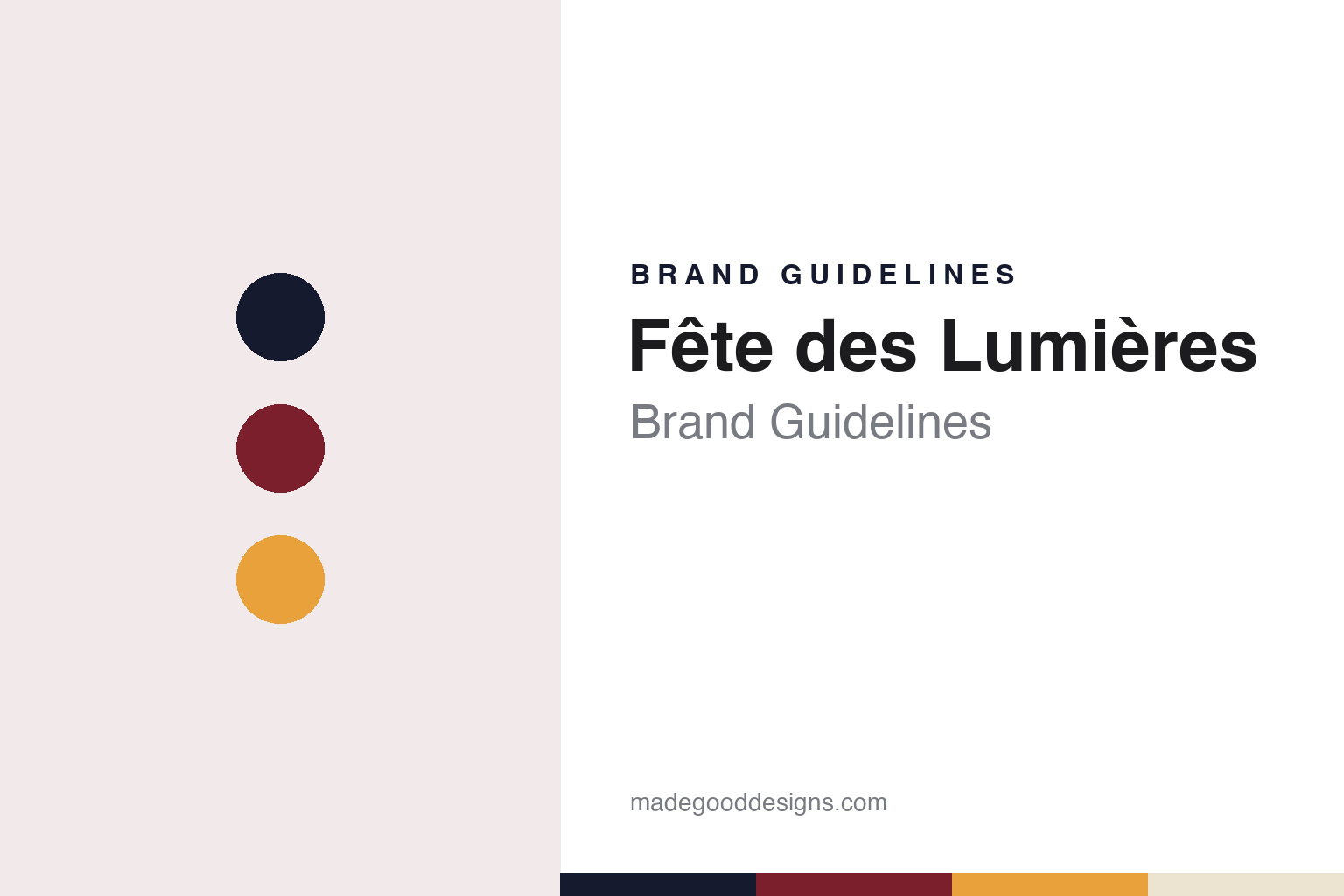
This guide’s Fête des Lumières palette is Winter night #151A2E, Glass red #7A1F2B, Candle amber #E9A23B, Presqu’île stone #EDE3D1 and Paper #FAF7F1. The tones are the guide’s own unofficial interpretation, not official Fête des Lumières hex codes.