Spielwarenmesse Brand Guidelines
The Nuremberg toy trade fair, held each winter since 1950.
Aa
Two constants: a red, ochre and sandstone palette and a rounded grotesque register. Abstract homage — not a Spielwarenmesse asset; no logo, emblem or product is reproduced.
A fair for a toy town
From church halls and tents to a purpose-built exhibition centre.
The Spielwarenmesse is the annual toy trade fair of Nuremberg, in Bavaria. Its own history, as summarised by German Wikipedia from the organiser’s 1998 anniversary book, begins in 1949, when four figures from the toy industry and the toy retail trade, among them Carl Ehmann of the model-railway maker Märklin, agreed to set up a German trade fair for toys. Nuremberg was chosen because of its long tradition as a toy-making city.
The first fair, then called the Deutsche Spielwarenfachmesse, ran from 12 to 18 March 1950. According to German Wikipedia, 351 exhibitors and 4,321 trade buyers took part, on about 3,000 square metres spread across the Wieseler Haus, a parish hall, the trade museum, a Red Cross building and two tent halls in the Maxfeld district. An article published by the venue company NürnbergMesse in January 2026 gives the same picture: 351 companies “in and around the Wieseler Haus” and about 4,300 buyers.
On 11 July 1950, 46 toy manufacturers founded a registered cooperative to run the fair, German Wikipedia says. It was first called Deutsche Spielwaren-Fachmesse eGmbH, became Spielwarenmesse eGmbH in 1958 and has been Spielwarenmesse eG since 1973. The cooperative is governed by a board, a supervisory board and a general assembly, and in the 2026 NürnbergMesse article Christian Ulrich is named as spokesman of its board. The fair has been held every year since 1950, except that the on-site fair did not take place in 2021 and 2022; the organiser offered an online format, Spielwarenmesse Digital, in its place.
The name has changed with the fair’s reach. International exhibitors were admitted from 1958, when it became the Internationale Spielwarenmesse Nürnberg. In 1997 it was renamed Spielwarenmesse International Toy Fair Nürnberg, and since 2013 it has used the single word Spielwarenmesse, which German Wikipedia says became a registered trade mark in Germany that year.
Colour
Six days of halls, in late January or early February.
In 1973 the fair moved into the newly built exhibition centre in the Langwasser district, today the Messezentrum Nürnberg. The NürnbergMesse article of January 2026 says the toy fair was the first event held there and the driving force behind building it; the venue company itself was formally founded in 1974. With 52,000 square metres available, goods could be arranged by product group for the first time. The organiser now gives the gross exhibition space as 175,000 square metres.
The fair is trade only. Its website says tickets can be bought only by trade professionals, and that visitors under 16 are not admitted, apart from babies up to six months old accompanying an approved participant. German Wikipedia describes the audience as trade visitors, press and invited guests. German Wikipedia describes a fair of about six days opening in early February; the 2026 edition was held in late January.
The halls are arranged by product group. The organiser lists thirteen, among them dolls and soft toys; model construction and model railways; games, books, learning and experimenting; and festive articles, carnival and fireworks, with separate groups for baby and infant articles and for sports, leisure and outdoor goods. Around them run a conference and talks programme, a trend presentation and an inventors’ convention for game designers.
Figures are the organiser’s own. For the 2026 edition, the 75th fair, Spielwarenmesse eG reports 2,313 exhibitors from 68 countries, 488 of them new, and 58,941 trade visitors from 123 countries, about two-thirds of them from abroad; the US Commercial Service repeats the exhibitor and visitor totals on its Germany trade-events page. Earlier figures follow the same pattern: German Wikipedia, citing Nordbayern in February 2014, gives about 76,000 trade visitors that year, 56 per cent of them from abroad, and records that at the 60th fair in 2009, 44 exhibitors were taking part for the sixtieth time. The NürnbergMesse article notes that fifteen exhibitors at the 2026 fair had been there since the first edition, and that Ravensburger and Märklin opened their archives for the anniversary.
The cooperative also works abroad. German Wikipedia records a Shanghai subsidiary founded in 2010, reported by ToyNews at the time, an Istanbul subsidiary founded in 2013 to run the Kids Turkey fair, and an Indian subsidiary from 2016 that organises Kids India in Mumbai, held since 2012.
Typography
How toy, music and sporting-goods fairs present themselves.
Trade fairs for toys, musical instruments and sporting goods tend to name themselves plainly. Most pair the product field with a city or with a single word such as fair, show or expo, so that the name alone tells a buyer what is on offer and where to go. Some keep a word in the language of their home city even when most visitors come from abroad; others have shortened longer official titles to the form people already used.
Many of these events are built for the trade rather than the public. Trade days are usually reserved for retailers, buyers, distributors, manufacturers and press, and some fairs check credentials or set a minimum age at the door. Others are open to the public, either throughout or on particular days, and present themselves more like festivals for players, musicians or riders.
Behind the fairs stand different kinds of organiser: trade associations representing an industry, cooperatives owned by the exhibitors themselves, and exhibition companies that run the halls and sell the space. Dates matter as much as names. A fair tied to the buying calendar may move between seasons when the industry’s order cycle changes, and the month becomes part of how the event is known.
Inside, the halls are usually arranged by product group, so that a visitor can walk from one category to the next. Demonstration areas, play areas, sound booths and test tracks let products be tried rather than only seen. The visual identity often follows a simple pattern: a wordmark or emblem kept from year to year, set beside a key visual, edition number and dates that change with each edition. This guide describes those identities from dated sources and uses colours and type of our own choosing.
Aa
A rounded grotesque for a fair with a tower-and-horse emblem. (Specimen set in Bricolage Grotesque, a sans STAND-IN; NOT the Spielwarenmesse logo.)
Tower and rocking horse
An emblem drawn from the city wall.
The fair’s emblem comes from its city. German Wikipedia, citing the organiser’s history pages, says the 1950 fair used a single tower modelled on the towers of the Nuremberg city wall. In 1951 the mark changed to a tower standing on a rocking horse, and variations of that sign are still in use. A version of the logo used until 2013 is kept on Wikimedia Commons, and after the 2013 renaming the fair has presented the one word Spielwarenmesse as its name in both German and English.
Outside Germany the fair was long called the Nuremberg International Toy Fair, and English Wikipedia still files it under that title; the organiser’s own English pages now simply say Spielwarenmesse, with the city, the dates and the year beside it.
For a design guide, Spielwarenmesse shows how a trade fair can keep one civic emblem for more than seventy years while its name moves from German to international and back to a single German word. Compare Toy Fair New York, the American trade show for the same industry, and London Toy Fair. For this guide we use a tower red, an ochre and a sandstone with a rounded sans, an unofficial interpretation; no product or logo is reproduced.
Explore & save
Keep Spielwarenmesse’s identity on hand — save it to a board in the Made Good inspiration library.
Spielwarenmesse identity set
Pin the Spielwarenmesse red, ochre and sandstone palette and the rounded grotesque register to your own board.
Source & notes
Frequently Asked Questions
What font can I use to match the Spielwarenmesse look?
This guide describes Spielwarenmesse’s type as “A rounded grotesque for a fair with a tower-and-horse emblem”. Its type specimen is set in Bricolage Grotesque from Google Fonts as a stand-in; Bricolage Grotesque is not Spielwarenmesse’s own lettering.
What colours are in the Spielwarenmesse palette?
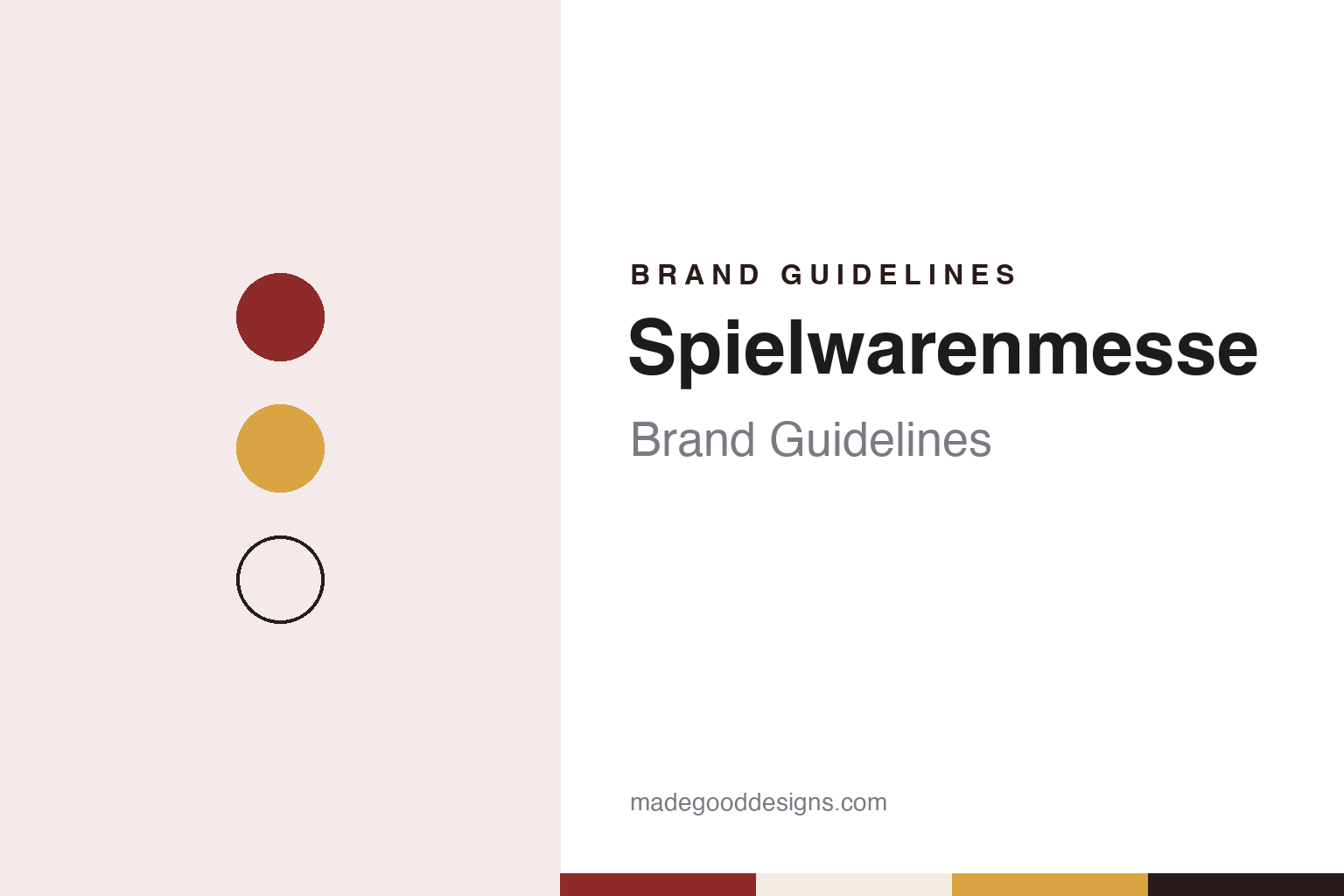
This guide’s Spielwarenmesse palette is Tower red #8E2A2A, Dark timber #2B1A1A, Rocking-horse ochre #D9A441, Sandstone #F3ECE2 and Paper #FAF7F2. The tones are the guide’s own unofficial interpretation, not official Spielwarenmesse hex codes.
When was Spielwarenmesse founded?
Spielwarenmesse was founded in March 1950, in Nuremberg, Germany.