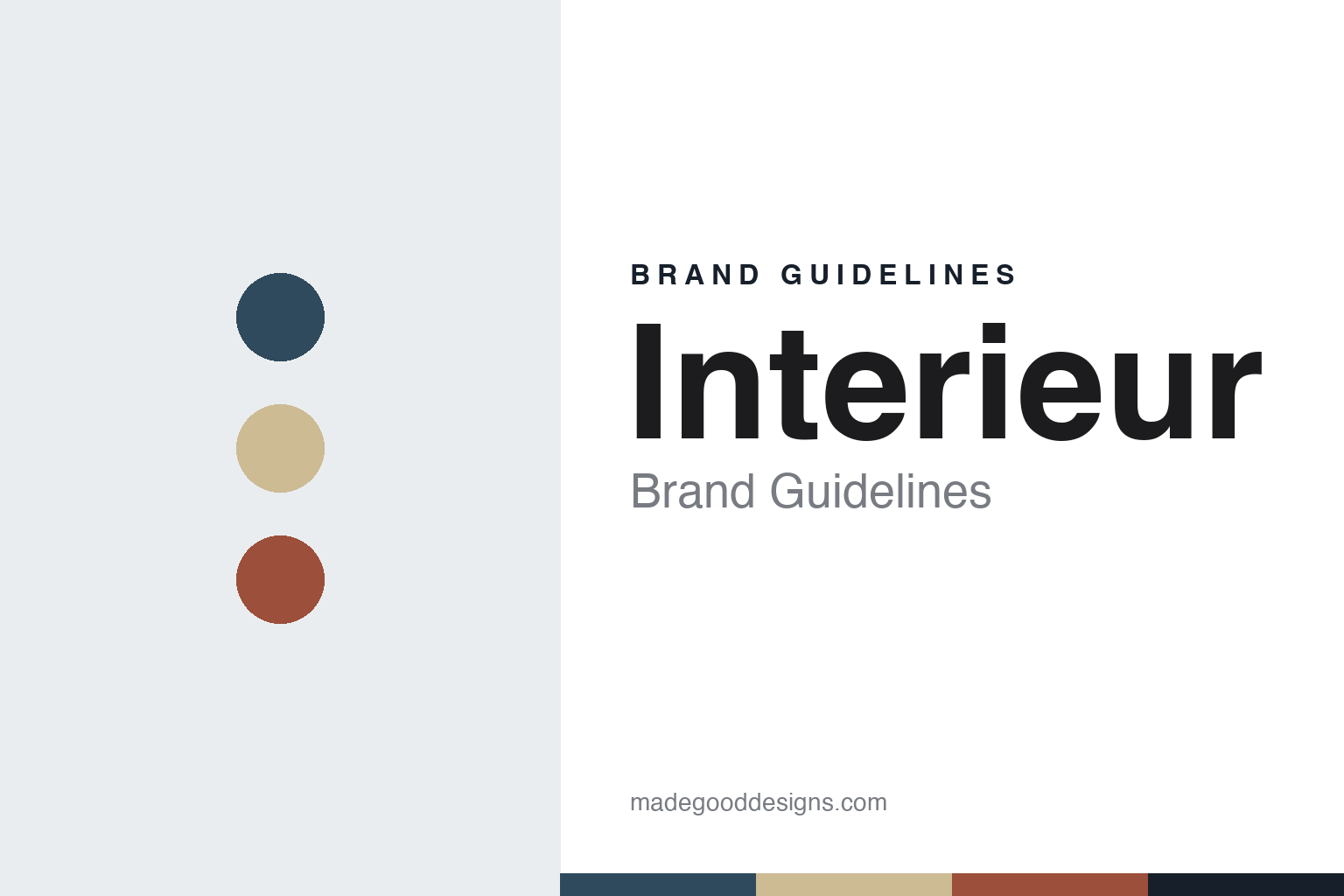
Interieur Brand Guidelines
The Kortrijk design biennale, 1968 to 2018.
Aa
Two constants: a river blue, flax and brick palette and a Plain grotesque register. Abstract homage — not an Interieur product or mark; no logo, key visual or stand is reproduced.
A biennale in the halls
Kortrijk, 1968.
Interieur was a design fair held every two years in Kortrijk, in West Flanders, Belgium. Known in full as the Biennale Interieur, and often as Interieur Kortrijk or, in English, the Courtray Design Biennale, it took place in October of even years, Dutch Wikipedia says. It was organised by a non-profit association, the Biennale Interieur vzw, also referred to as Stichting Interieur, and manufacturers used it to show new interior products to trade visitors and to the general public alike.
The first edition was held in 1968, in what were then called the Hallen van Kortrijk, the halls of Kortrijk. Dutch Wikipedia says the City of Kortrijk began building the complex in 1966 beside the exit of a planned motorway, today the A14/E17, and opened it in April 1967 as “De Hallen”. It started with 6,000 square metres of exhibition space and was later enlarged several times. On 2 December 1999 it was renamed Kortrijk Xpo, and a large expansion in 2009 was carried out with big international fairs such as Interieur in mind, the same article says.
From the start the biennale added programmes around the fair itself. Each edition invited a guest of honour from the design world, and over the decades the event grew to include debates and lectures, a YoungDesignersFair for new designers, and side events named Design at Work and Exterieur, according to English and Dutch Wikipedia. English Wikipedia says the fair became steadily more international in the decades after 1968.
In its later years the fair moved into the town. In 2012, for the first time, the biennale used the city centre as well as the halls: the new arts centre in the Buda factory, on the Buda island, was added, with a shuttle linking it to Kortrijk Xpo. In 2014 the route went further into the centre, with locations including the Buda tower, the Broelmuseum and the Broel towers. In 2016 it centred on Kortrijk Xpo and the site of the national flax museum, the Vlasmuseum, in the middle of town, the Wikipedia articles say.
Colour
Shorter, postponed, called off.
The format began to change after 2016. The 25th biennale, in October 2016, lasted ten days. In October 2017 Interieurjournaal, a Dutch-language interiors news site, reported that Stichting Interieur had decided to cut the next edition to five days, sharper and aimed more at a professional audience, and to combine it with a festival in the city that ran for longer. The organisation gave a fast-changing market and a new economic reality as its reasons.
The 26th biennale ran from 18 to 22 October 2018. Stichting Interieur counted 51,000 visitors, Interieurjournaal reported on 23 October 2018, and the accompanying Interieur City Festival continued over two more weekends, until 4 November. Dutch Wikipedia calls it the last edition of the biennale.
The 27th edition did not follow on schedule. In May 2020 the organisers moved it by a year, to 21–25 October 2021, Interieurjournaal reported. Jo Libeer, then the director, said the extra year gave room to work on a stronger biennale, and the report linked the move to the new model the organisation had begun a few years earlier, in which Interieur was to grow into a city festival with a more professional programme. In the end, 2021 brought an altered format rather than a full biennale: an exhibition called Please, Have a Seat, held on the Van Marcke site in Kortrijk as part of the Wonder city festival. Interieurjournaal described it in February 2022 as a curated, interactive exhibition exploring the story of the seat, combined with a gallery of chairs.
In February 2022 Caroline Fiers, who had led Please, Have a Seat as commercial director and had been part of the Interieur team since 2019, succeeded Jo Libeer as director, the same title reported. A renewed 27th Biennale Interieur had been announced for 20 to 24 October 2022 at Kortrijk Xpo under the title “The Digital Era”. On 1 July 2022 Interieurjournaal reported that this edition had been called off: according to the organisation, shifts in the calendar of interior and design fairs made it too great a challenge to guarantee a successful edition of the quality it wanted. Dutch Wikipedia says the fair was then taken off the agenda.
Typography
How the trade fairs present themselves.
Home, interiors and building trade fairs tend to go by short names. Some are a single word, some an acronym or a coined compound, and many are written entirely in lower case or entirely in capitals; a city name is often added, sometimes in its English form, sometimes in the local one. Behind each name stands an organiser: an exhibition company owned by a city or a region, a trade association that sponsors the event, or, in the case of some American furniture markets, a market authority.
Most of these fairs are held for the trade. Their visitors are retailers and buyers, architects, interior designers, installers, contract and hospitality buyers, and the purchasing groups that supply large chains. A few keep public days at the end of the run or are built for the public from the start, with show homes and room sets for people planning their own homes. Many follow a fixed calendar, annual or every two years, tied to the ordering seasons of their trade.
Inside the halls, the fairs are arranged by product group. One may cover tableware, kitchenware, gifts and home accessories; another furniture and lighting; others floor coverings, ceramic tiles, kitchens, bathrooms or heating and building systems. Most add trend areas, special shows and talk programmes, and several now group suppliers from abroad into sourcing sections or country pavilions.
The identity of such a fair usually rests on a wordmark that is kept from edition to edition, while a key visual, colour or theme changes each year. The guides in this collection describe those names, organisers, dates and formats as dated sources give them, and treat the colours and type shown here as our own interpretation rather than any fair’s official material.
Aa
A plain grotesque — one word that reads in two languages. (Specimen set in Archivo, a sans STAND-IN; NOT the Interieur logo.)
Interieur
One word, two languages.
The name was a single word that reads in both of Belgium’s main languages: interieur in Dutch and, with an accent, intérieur in French both mean interior. It appeared on its own, with “Biennale” in front, or with the city name after it, and trade coverage used all three forms. The fair’s organiser, Stichting Interieur, carried the same word.
The venue went on hosting design events under a new name. In February 2023 Kortrijk Xpo announced Design Nation, a trade-only, invitation-only event for design professionals and buyers in the contract and project market, which Interieurjournaal said would fill the gap left when the biennale did not take place in 2022; there had been no design event at Kortrijk Xpo since 2018, the site noted. The first Design Nation was held on 19 and 20 October 2023 with 2,652 visitors, according to Kortrijk Xpo, and its organisers presented it as the successor to the Biennale Interieur, now aimed at professionals rather than end users. Its third edition in Kortrijk took place on 15 and 16 October 2026, Design Nation says. In November 2026 the old interieur.be address redirected to the Design Nation website.
For designers, Interieur is a record of a fair identity tied to a place: a plain word, a fixed two-year rhythm, halls at the edge of town and, in its later years, a route through the town centre. Its history also shows how that identity was stretched as the format changed, from a ten-day biennale open to the public to a five-day professional event, then to a single exhibition, and finally to a successor under another name.
For a design guide, Interieur shows how a design fair can be remembered by one plain word after its last edition. Compare Maison&Objet, the Paris design and decoration fair, and 3daysofdesign, the Copenhagen design festival. For this guide we use a river blue, a flax and a brick with a sans, an unofficial interpretation; no product or logo is reproduced.
Explore & save
Keep Interieur’s identity on hand — save it to a board in the Made Good inspiration library.
Interieur identity set
Pin the river blue, flax and brick palette and the Plain grotesque register to your own board.
Source & notes
Frequently Asked Questions
What font can I use to match the Interieur look?
This guide describes Interieur’s type as “A plain grotesque — one word that reads in two languages”. Its type specimen is set in Archivo from Google Fonts as a stand-in; Archivo is not Interieur’s own lettering.
What colours are in the Interieur palette?
This guide’s Interieur palette is Leie blue #2F4A5C, Ink #17202A, Flax #CDBB94, Brick #9C4F3A and Paper #F7F4EE. The tones are the guide’s own unofficial interpretation, not official Interieur hex codes.
When was Interieur founded?
Interieur was founded in 1968, in Kortrijk, Belgium.