Ultra Music Festival Brand Guidelines
Miami’s March electronic festival, from a Miami Beach park to Bayfront Park and editions abroad.
Aa
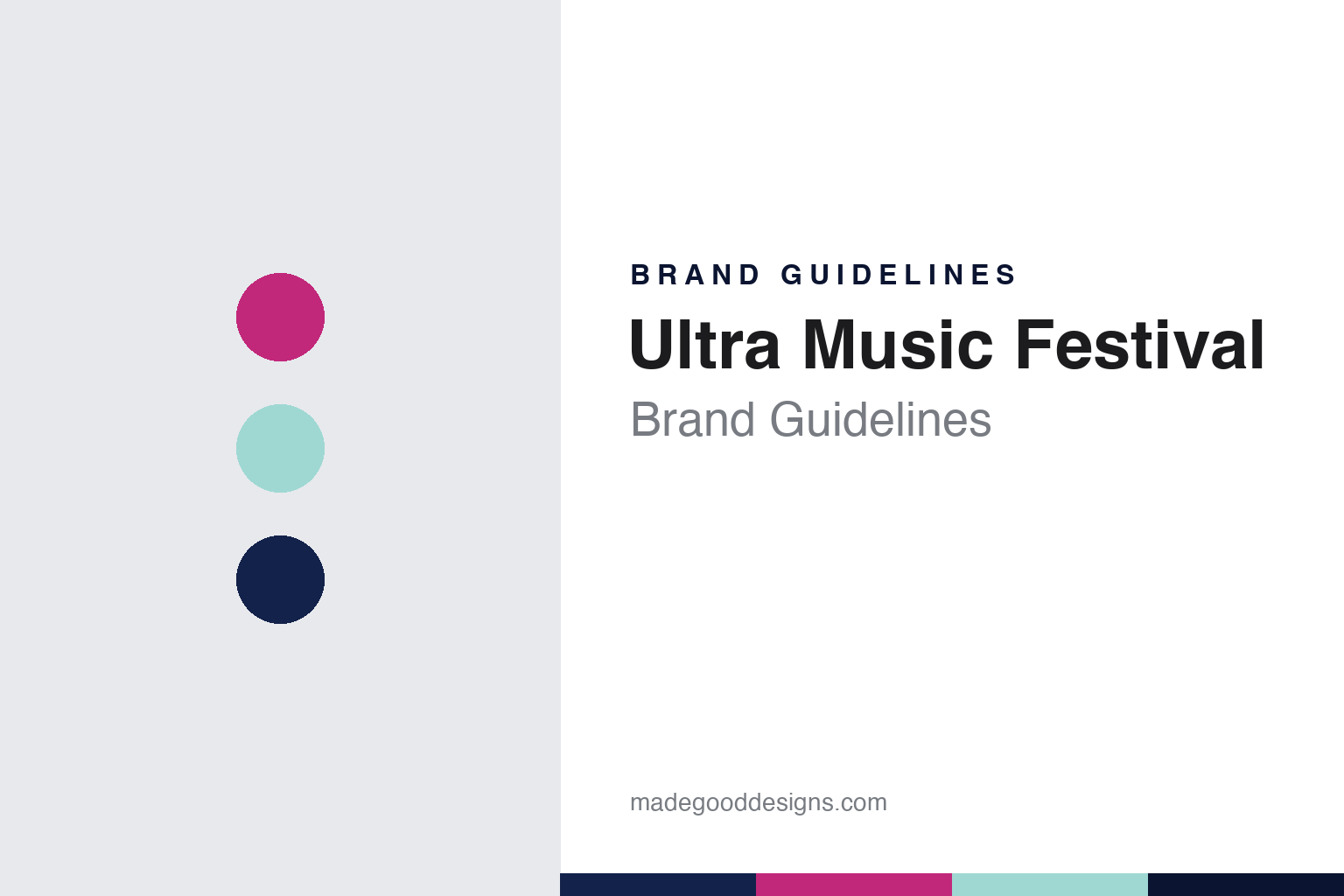
Two constants: an Ultra night blue, magenta and pale aqua palette and a Geometric sans register. Abstract homage — not an Ultra Music Festival asset or mark; no logo, stage or artwork is reproduced.
A beach party in March
Two Miami promoters and a conference week.
Ultra Music Festival is an outdoor electronic music festival held each March in Miami. It was founded by the promoters Russell Faibisch and Alex Omes, and its first edition took place on March 13, 1999, at Collins Park on Miami Beach, Miami New Times reported in a March 2013 history of the festival. About 10,000 fans attended that day, the paper wrote, with the Tampa-based electronic act Rabbit in the Moon as the headliner after nightfall.
The name came from music. Faibisch named the festival after Ultra, the 1997 studio album by Depeche Mode, Miami New Times reported, and told the paper that seeing the band in Miami in 1993 had made him want to work in music. Omes, who had published a dance-music magazine called D’VOX, brought industry contacts to the venture, while Faibisch handled the business side, according to the same article. English Wikipedia gives the company’s formal name as Ultra Enterprises, Inc., and records the festival’s shorthand as UMF.
From the start the festival was tied to a week of industry events. The Winter Music Conference, launched in 1985, brought DJs, producers and promoters to Miami every March for panels and club nights, and Ultra was conceived as a beachside party during that week, Miami New Times reported; the two coordinated their dates, and conference badge holders were allowed into Ultra. Wikipedia says Ultra acquired the Winter Music Conference outright in 2018, and that the festival is now held alongside it and Miami Music Week, a wider programme of concerts and parties across the region that usually leads into the festival weekend.
Colour
Collins Park, Bayfront Park and the world.
The festival soon moved to the mainland. After a second edition at Collins Park in 2000, it moved in 2001 to Bayfront Park in downtown Miami at the city’s insistence, Miami New Times reported, and attendance grew from 10,000 to 23,000. It stayed at Bayfront until 2005, when the park’s trust urged a move to the larger Bicentennial Park, the paper wrote. Wikipedia records that the festival was held at Bicentennial Park from 2006 and returned to Bayfront Park in 2012, when construction of the Miami Art Museum took over the Bicentennial site.
Its length grew with it. Wikipedia records a two-day format from 2007 and three days, Friday to Sunday, from 2011. For its 15th anniversary in 2013 the festival was held over two consecutive weekends, as Miami New Times reported that March, before returning to a single weekend in 2014. In 2019 it was held for one year on Virginia Key, at Historic Virginia Key Beach Park and the Miami Marine Stadium. The 2020 and 2021 editions did not take place, and the festival returned to Bayfront Park in March 2022, Wikipedia says. Miami New Times described the edition of March 27–29, 2026, at Bayfront Park, as the 26th.
Ultra also exports its name. Under the umbrella Ultra Worldwide, Wikipedia says, the company began with Ultra Brasil in São Paulo in 2008 and went on to stage festivals in cities including Buenos Aires, Seoul, Tokyo and Singapore. Ultra Europe, a week of events at different venues across Croatia, started in July 2013, and single-day, single-stage events under the title “Road to Ultra” began in 2012. By March 2013, Miami New Times already listed satellite Ultra festivals in Brazil, Ibiza, South Korea, Croatia, Argentina and Chile.
Typography
Festivals and their faces.
Music festivals in the United States usually take their names from somewhere or something particular: a city, a park, an island, a television programme, an idea or a short coined word. Austin City Limits Music Festival borrowed the name of a public-television concert series; Governors Ball kept the name of the island where it began even after it moved. Long names are soon cut down to initials or nicknames — ACL Fest, Gov Ball — and posters, wristbands and websites often pair that short form with a year.
Behind the names stand different kinds of organiser. Some festivals are run by promoters and festival companies, a number of which sit inside larger live-entertainment groups; others are run by non-profit foundations or produced in partnership with park foundations and city departments, which grant the use of public land each year. The organiser is rarely the face of the festival, but its name appears in the small print and in the trade press.
The setting is part of the identity. A festival may fill a city park, a polo ground, a motor speedway, a waterfront or a fairground for one weekend or several, laid out with a number of stages, food areas drawn from local restaurants, art installations and markets, and often a children’s area. When a festival changes venue, the new place name usually joins the dates in the line that sits beside the festival name.
Each year brings a new lineup poster, with headliners set in large type above rows of smaller names, and an edition key visual that changes from year to year. Around these, a steady wordmark, the place and the dates hold the identity together. This guide looks at how each festival handles that balance, using only what dated sources and the festivals’ own pages show.
Aa
A geometric sans — one short word on every edition. (Specimen set in Montserrat, a sans STAND-IN; NOT the Ultra Music Festival logo.)
Ultra Music Festival
One short word, many editions.
Ultra’s look is set by its stages as much as by its name. Wikipedia describes a stage dedicated to a trance radio show, introduced in 2011 and held on the third day each year, and a stage area called Resistance, introduced in 2015 for lesser-known “underground” electronic music such as deep house and techno. Resistance was built around installations by the British collective Arcadia Spectacular: a 360-degree stage called “Afterburner” in 2015 and the “Spider” in 2016, Wikipedia says. From 2017 the Resistance name also became an event series of its own, with an international tour and a weekly residency in Ibiza. The festival began producing an official live-stream broadcast in 2012.
The name does much of the work. “Ultra” is a single short word that sits easily in front of a country or a city — Ultra Europe, Ultra Brasil, Ultra Japan — or after a phrase, as in Road to Ultra, so that each edition abroad reads as part of one family. The Miami flagship has kept the same month since 1999, tied to the conference week it grew up beside, and has spent most of its history in Bayfront Park, in the middle of downtown Miami, rather than on a remote site. Even its one year away, on Virginia Key in 2019, kept the festival in Miami, at a beach park and the Miami Marine Stadium on the island.
That gives designers a clear set of constants: a fixed month, a downtown park, a one-word name and a stage list that changes each year around them.
For a design guide, Ultra Music Festival shows how one short word, tied to one month and one city park, can be stretched into a family of editions abroad. Compare Electric Daisy Carnival, the Las Vegas dance-music festival run by Insomniac, and Tomorrowland, the Belgian electronic music festival. For this guide we use a night blue, a magenta and a pale aqua with a geometric sans, an unofficial interpretation; no product or logo is reproduced.
Explore & save
Keep Ultra Music Festival’s identity on hand — save it to a board in the Made Good inspiration library.
Ultra Music Festival identity set
Pin the Ultra night blue, magenta and pale aqua palette and the Geometric sans register to your own board.
Source & notes
Frequently Asked Questions
What font can I use to match the Ultra Music Festival look?
This guide describes Ultra Music Festival’s type as “A geometric sans — one short word on every edition”. Its type specimen is set in Montserrat from Google Fonts as a stand-in; Montserrat is not Ultra Music Festival’s own lettering.
What colours are in the Ultra Music Festival palette?
This guide’s Ultra Music Festival palette is Night blue #13224A, Magenta #C2287A, Pale aqua #9FD8D3, Ink #0B1430 and Paper #F5F7FA. The tones are the guide’s own unofficial interpretation, not official Ultra Music Festival hex codes.
When was Ultra Music Festival founded?
Ultra Music Festival was founded in 1999, in Collins Park, Miami Beach.
Who founded Ultra Music Festival?
Ultra Music Festival was founded by Russell Faibisch and Alex Omes in 1999.