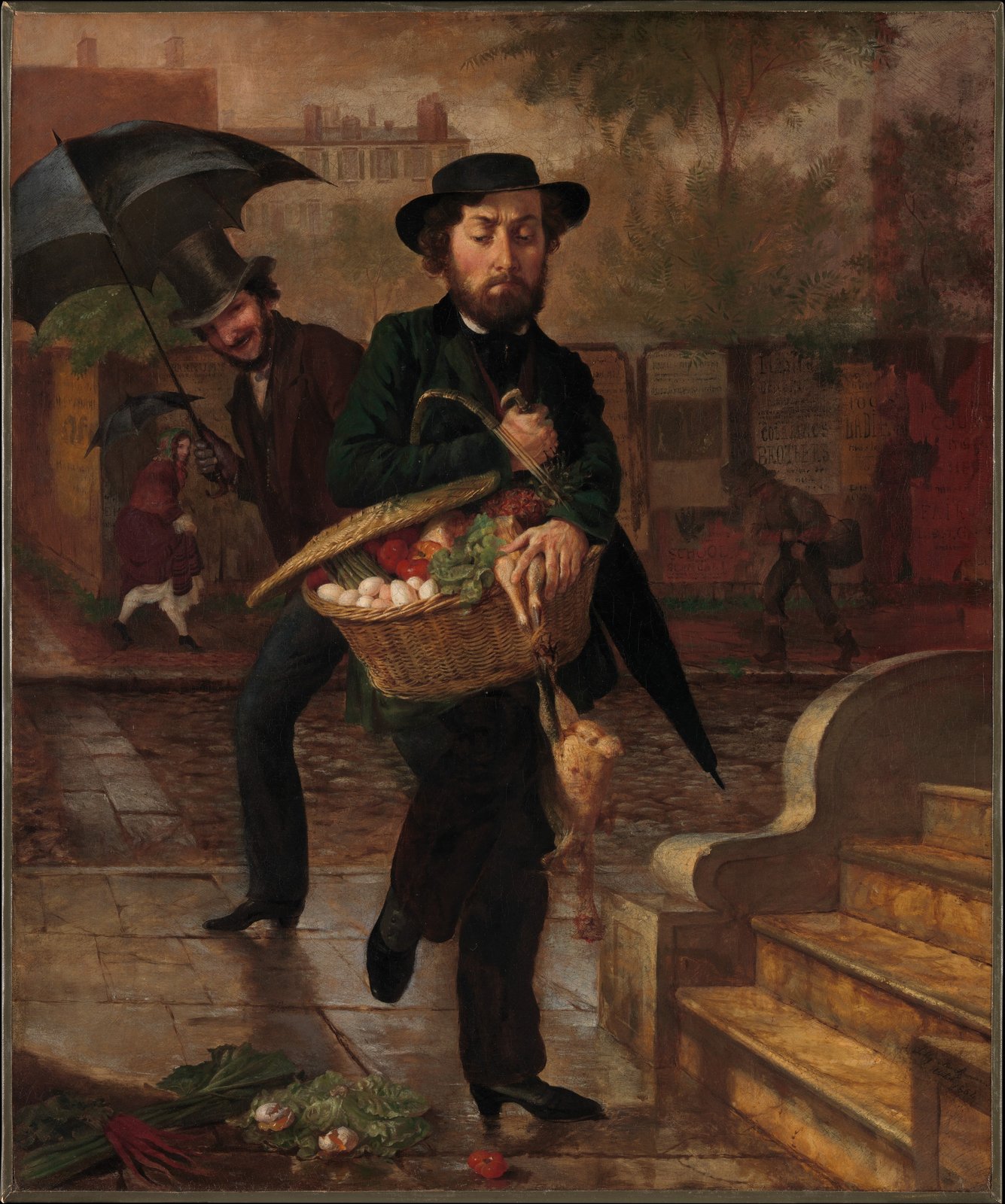
Lilly Martin Spencer painted the comedy of ordinary home life: a husband struggling home in the rain with the groceries, a cook threatening a suitor with a spoon of molasses, a baby giggling during a counting game. Her pictures were made to be read quickly and reproduced widely, which makes them useful for illustrators and anyone telling a story in a single frame. Lilly Martin Spencer built those stories from objects, gestures and a clear, polished finish.
Three of her paintings are public domain in the Met’s and the Art Institute of Chicago’s collections and appear below. You can find more public-domain works to download and study in the MGD museum inspiration collection.
Who was Lilly Martin Spencer?
She was born Angélique Marie Martin in Exeter, England, in 1822, and known as Lilly, according to the National Museum of Women in the Arts (NMWA) in Washington; the Smithsonian American Art Museum (SAAM) also gives Exeter and 1822. NMWA describes her parents as politically progressive and of French descent. NMWA and the biographical encyclopedia Women in World History date the family’s arrival in the United States to 1830, while SAAM says she was brought to Ohio in 1833. She grew up in Marietta, Ohio, as NMWA, SAAM and the historian Wendy Katz all record.
In 1841 she went to Cincinnati, as Katz and Women in World History both report; SAAM calls the city a bustling cultural centre of the time. SAAM says she had little formal training; NMWA and Women in World History name the portrait painter John Insco Williams as a teacher there. Katz and Women in World History both mention the support of the Cincinnati patron Nicholas Longworth.
She married Benjamin Rush Spencer, in 1844 according to Women in World History (NMWA says at 22), and in 1848 the couple moved to New York, as SAAM, Katz and Women in World History agree. SAAM and NMWA both describe her as the family’s main earner, with her husband looking after the household and their large family. NMWA records later homes in Newark, New Jersey (from 1858, according to Women in World History), and Highland, New York, across the Hudson from Poughkeepsie. She died in New York City in 1902, according to SAAM and NMWA; Women in World History gives the date as 22 May.
Paintings made for prints
Spencer’s career ran through the art unions and print publishers of the mid-century. Katz’s 2001 article in American Studies records that she exhibited with the Western Art Union and the American Art Union and showed at the National Academy of Design, and Women in World History also notes the Western Art-Union and the Academy. NMWA says much of her fame came from inexpensive engraved copies of her paintings, and Katz writes that she supplied a steady stream of lithographs, mainly to the publisher Goupil and mostly of children.
That market shaped the look of the work. Katz describes one Spencer lithograph as having clear outlines, discrete areas of colour and a smooth surface, with shapes rhymed across the composition and shadows kept transparent so that no line is lost. SAAM describes her style in similar terms, with hard outlines, bold colours and closely rendered textures. Those qualities help an image survive being copied, shrunk or printed cheaply. For more on the printing process behind such reproductions, see our guide to lithography.
Key works by Lilly Martin Spencer
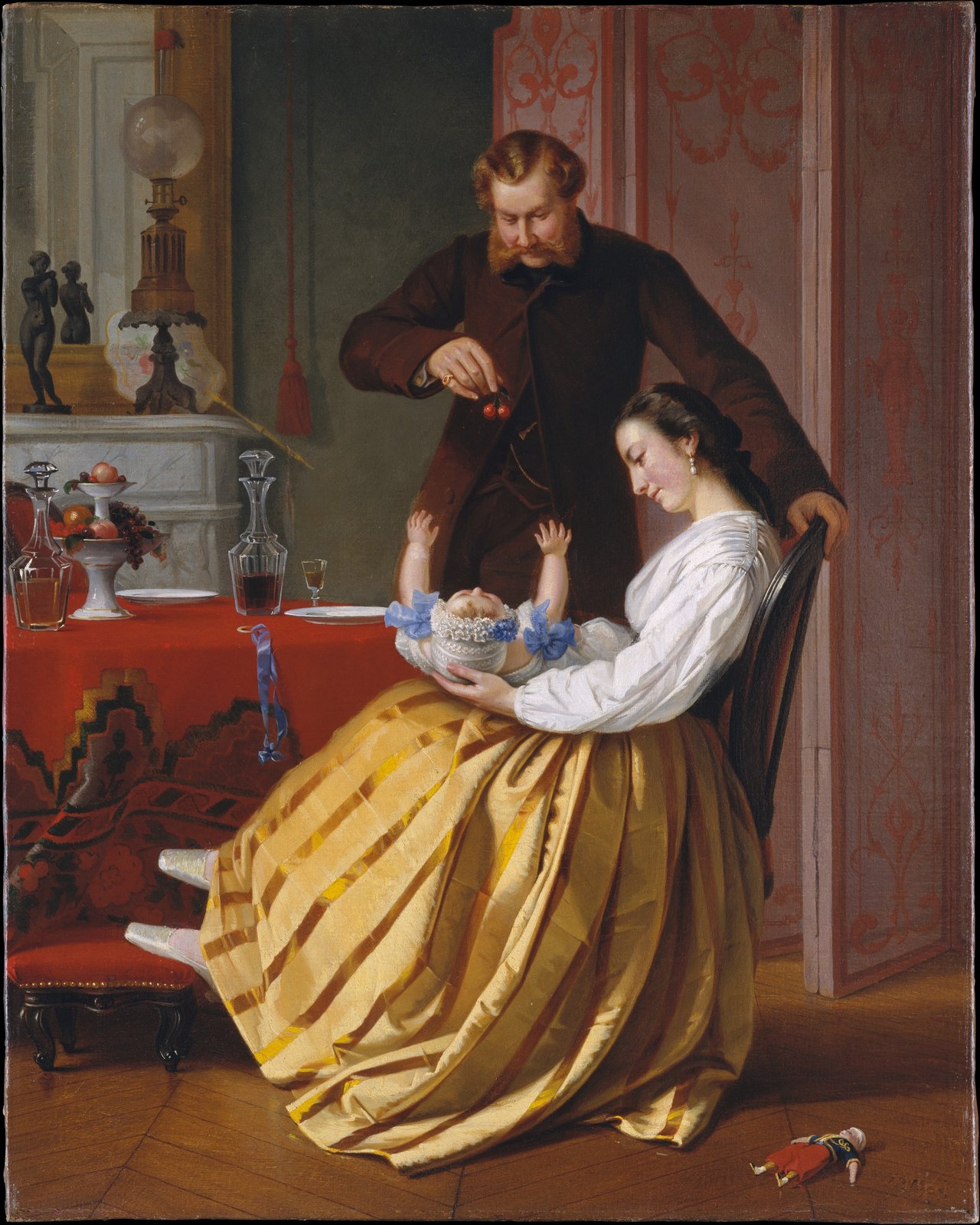
Conversation Piece, ca. 1851–52
The Met records this oil on canvas, 71.9 by 57.5 centimetres, as dated about 1851–52. A young couple play with their baby: the father leans in to dangle cherries, the mother tips back in her chair, and a tiny doll lies abandoned on the floor. The striped silk skirt fills almost a third of the canvas and acts as the picture’s anchor, while the red tablecloth carries the eye to the left.
Young Husband: First Marketing, 1854
The Met’s record gives this oil on canvas as 74.9 by 62.9 centimetres, a gift of 2015. The young husband has been sent out for the shopping and is losing the battle: rain, an overloaded basket, a dangling chicken and vegetables dropping on the pavement, while a man under an umbrella grins behind him. The Met also owns Young Wife: First Stew (1854), acquired in 2017, which it lists as an oil on canvas by Spencer; that companion picture is not marked public domain and is described here in text only.
Kiss Me and You’ll Kiss the ’Lasses, 1856
Katz’s article dates this painting to 1856 and credits it to the Brooklyn Museum, whose collection record gives the same date. Katz describes a woman alone in her kitchen putting up fruit, surrounded by tin tubs, glass pitchers and painted jars, with a glimpse of a parlour behind; the title is her answer to a suitor, warning him off with a spoon of molasses. The picture looks straight at the viewer, which is what makes the joke work.
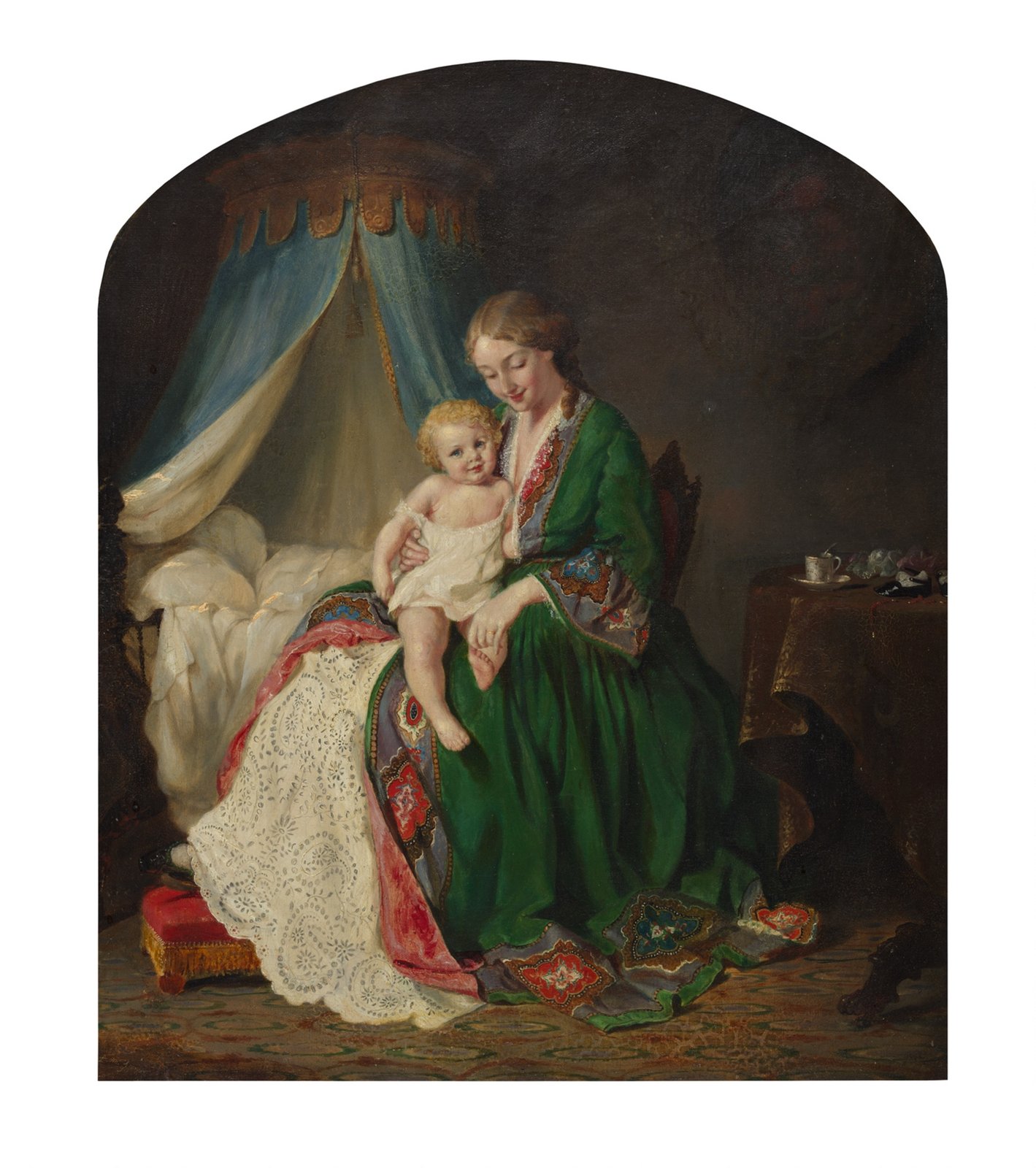
This Little Pig Went to Market, c. 1857
The Art Institute of Chicago dates its version to about 1857 and records it as oil on canvas. Katz reproduces a version with an arched top, painted on composition board, at the Ohio Historical Society, and dates it to 1857, as does Women in World History. Katz notes that the canopied bed forms a pyramidal composition and that the laughing child looks out at the viewer, drawing us into a private moment.
Later works
SAAM owns We Both Must Fade (Mrs. Fithian) (1869), a commissioned portrait of a woman in an ornate parlour holding a rose as its petals fall. NMWA owns The Artist and Her Family at a Fourth of July Picnic (about 1864), with her husband stretched out on a swing at the centre.
Technique, light and palette
Spencer painted in oil and filled her canvases with detail, as SAAM notes, from silk and lace to glass, tin and fruit. Katz quotes the writer Elizabeth Ellet, a patron, saying that Spencer “uses the highly-finished German style”, a reference to the Düsseldorf school of genre painting, whose New York gallery she exhibited at. Light usually falls from one side across a darker background, so the figures and the key props sit forward like actors on a stage.
Colours measured from the museums’ scans of these paintings (not original pigments) show how much of each picture is warm shadow. Conversation Piece gives a silk gold of about #c3a77c, a tablecloth red of about #763221 and a near-black of about #241d1d. Young Husband: First Marketing runs from #14110f through #7b5a3d to a lighter brown of #936f4c. In the Chicago This Little Pig Went to Market, the green robe’s shadow measures about #202c1c against linen of about #dfd6c4 and a red-brown of #5a301f. You can sample your own values with the image colour picker and build schemes in the colour palette generator.
How designers can borrow from Lilly Martin Spencer
- Let props tell the story. A spilled basket, a dangling chicken, a doll on the floor: each object advances the plot. In an illustration or a product shot, choose two or three props that explain the moment without a caption.
- Design for reproduction. Clear outlines, separated colour areas and transparent shadows let her images survive as prints. The same logic applies to icons, thumbnails and screen-printed packaging.
- Look at the viewer. Several of her figures meet our eyes and share the joke. A direct gaze in an advertisement or cover pulls the audience into the scene.
- Use one big fabric shape. The silk skirt in Conversation Piece is a single large area of pattern that holds the composition together; a strong block of colour or texture can do the same on a poster.
For an American contemporary who also painted everyday comedy, see our guide to William Sidney Mount, and for the broader movement toward ordinary subjects, our guide to realism in art.
Where to see her work
Works discussed here are held by the Metropolitan Museum of Art in New York, the Art Institute of Chicago, the Brooklyn Museum, the Smithsonian American Art Museum and NMWA in Washington. NMWA notes that she exhibited at the Women’s Pavilion of the 1876 Philadelphia Centennial Exhibition.
Frequently asked questions
What is Lilly Martin Spencer known for?
She is known for humorous and affectionate scenes of American domestic life from the 1850s and 1860s, such as Young Husband: First Marketing and Kiss Me and You’ll Kiss the ’Lasses, many of which circulated as prints.
Where was Lilly Martin Spencer born?
She was born in Exeter, England, in 1822, and grew up in Marietta, Ohio, before working in Cincinnati, New York and Newark.
Why were her paintings made into prints?
Art unions and publishers such as Goupil reproduced popular paintings for a wide audience, and Katz notes that Spencer supplied a steady number of lithographs, mainly to Goupil and mostly of children.
Are Lilly Martin Spencer’s paintings public domain?
The three paintings shown here are flagged public domain by the Met and the Art Institute of Chicago. Other works, including the Met’s Young Wife: First Stew, are not marked public domain by their museums and are described in text only.