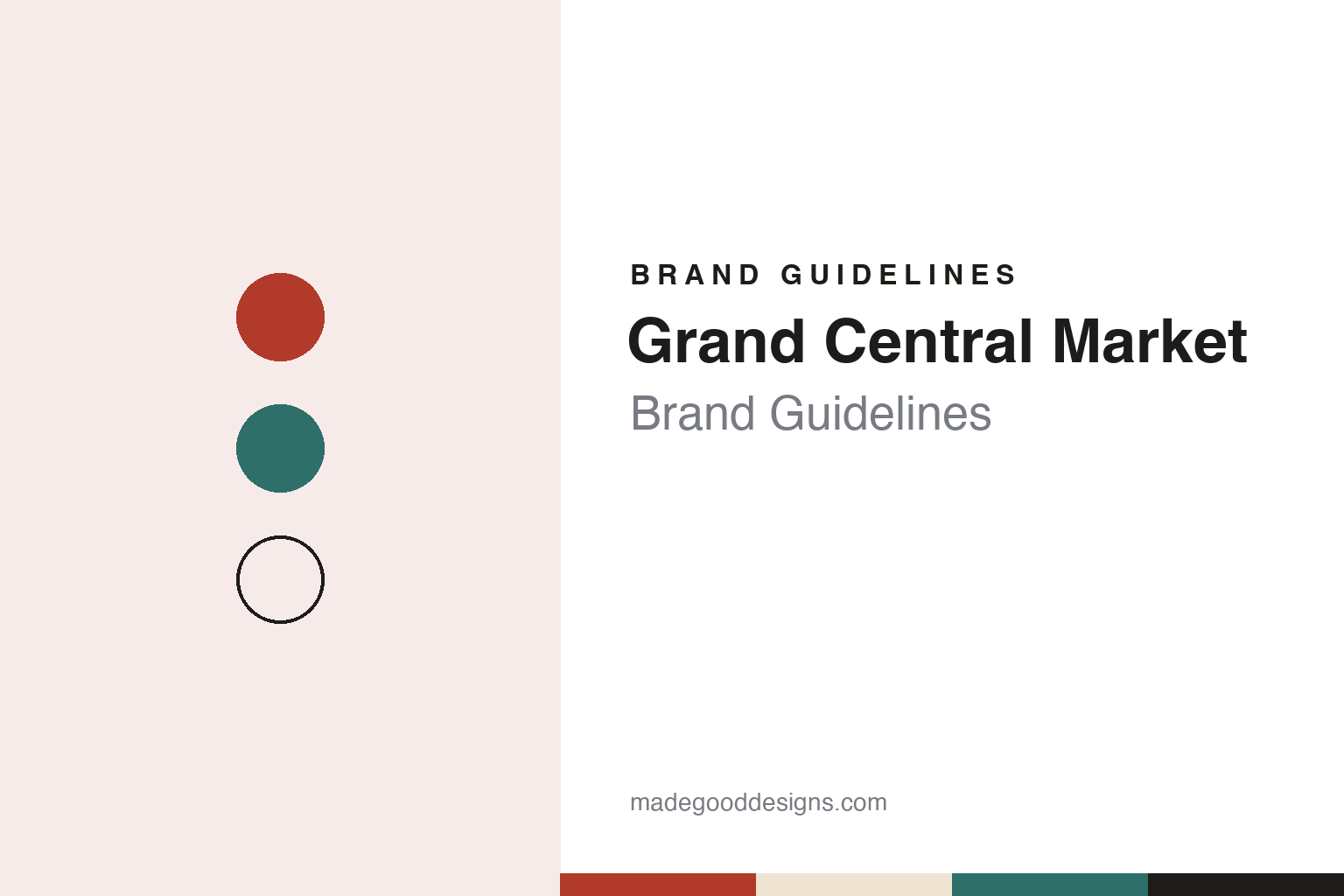
Grand Central Market Brand Guidelines
Downtown Los Angeles’s market hall since 1917.
Aa
Two constants: a neon red, plaster cream and teal palette and a condensed neon-sign sans register. Abstract homage — not a Grand Central Market asset; no sign, logo or photograph is reproduced.
The Wonder Market
A market hall in two joined Beaux Arts buildings.
Grand Central Market is a public market on Broadway in Downtown Los Angeles that has traded on the same site since 1917. Sources differ on the month: the market’s own history page and English Wikipedia give October 1917, while the Los Angeles Conservancy gives September 1917. In its early years it was called the “Wonder Market,” and it filled the whole ground floor of the Homer Laughlin Building, taking the place of the Ville de Paris department store, which moved to Seventh Street that year, according to the Conservancy.
The market occupies the ground floor and basement of two joined buildings rather than one, the Los Angeles Conservancy says. The Broadway building went up in 1897; the Conservancy calls it one of downtown’s oldest commercial structures in continuous use and the city’s earliest steel-reinforced building. In 1905 a second structure, known as the Laughlin Annex or Lyon Building, extended it through the block to Hill Street; the Conservancy describes that annex as the earliest reinforced-concrete building in Southern California. It credits the buildings to the architects John Parkinson and Harrison Albright, naming Albright as the architect of the 1905 extension, and gives their style as Beaux Arts.
English Wikipedia describes the early market as a hall of fish, oyster, meat and produce stalls alongside eggs and butter, bakeries, delicatessens, florists and lunch counters, and puts the number of stalls at 120 by 1926. Many of its customers then came down from Bunker Hill on the Angels Flight railway, the same article says. As downtown changed after the Second World War and new supermarkets and farmers’ markets opened across the city, the market turned towards low-cost groceries and shrank to 52 stalls by 1968, according to English Wikipedia, which cites a 1978 Los Angeles Times estimate that about half of its weekly shoppers were of Latino descent.
Colour
The Yellin years and a sale in 2017.
The market has changed hands only a few times. In 1985 it was bought by the Beverly Hills attorney and developer Ira Yellin, English Wikipedia says; Time Out Los Angeles reported in November 2017 that the Yellin family had owned it since the 1980s. Under the Yellin Company it was renovated in the 1990s as part of a wider project called Grand Central Square, according to the Los Angeles Conservancy. By 2017 that name covered the market together with the neighbouring Million Dollar Theater, about 120 apartments, office space and a parking structure, Time Out reported.
The renovation dealt as much with the building’s face as with its stalls. The Los Angeles Conservancy says a tile façade added in the 1960s was removed to reveal the second-storey windows, many of the original Beaux Arts details were restored, and the neon signs that mark each stall were either restored, where they were vintage, or newly made. English Wikipedia describes the same work as removing mid-century additions and installing vintage and new neon.
From around 2012, English Wikipedia says, the Yellin Company renewed its investment and began pairing long-standing vendors with newer food counters. Time Out counted 39 vendors in November 2017, including a general store in the basement, and noted stalls dating from the 1950s and 1960s trading beside businesses only months old. At the end of October 2017 the sale of Grand Central Square, including the market, to Langdon Street Capital, a Beverly Hills real-estate firm, closed for an undisclosed amount, Time Out reported, citing the Los Angeles Times. Commercial Observer reported the same month that the seller was the Yellin Company and that the deal also took in the twelve-storey Million Dollar Theatre tower, the Grand Central Square apartments and the parking structure.
Today the market’s website lists about 40 stalls and states that the market is owned and operated by GCS Equity LLC. It describes a mix of long-running vendors and newer food businesses, open every day of the week, and presents the stalls as a picture of the immigrant communities that shaped Los Angeles. The Los Angeles Conservancy notes that each stall is privately owned and operated, and lists the market as lying within a national historic district. The hall has also appeared on screen, in films including Midnight Run (1988) and City of Angels (1998), English Wikipedia says.
Typography
Markets in train sheds, ferry terminals and factories.
Public markets and food halls in North America and Australia usually introduce themselves through who stands behind the name and when the market began. Some are run by a city council or a public development authority set up by a city charter, some by a non-profit corporation and some by a private property company. A founding date tends to sit close to the name, and a market’s documented origins and its present building often carry different dates.
The buildings do much of the work of an identity. Several markets occupy structures built for something else: space under a former railway train shed, a ferry terminal on a waterfront, or the brick and timber blocks of a former biscuit factory. Others grew as rows of covered arcades and open-sided sheds added stall by stall over decades, with halls for meat and fish and long tables for farmers who rent space by the day.
Lettering is often attached to the architecture rather than drawn for a page. A rooftop sign, a clock above an entrance, painted lettering on a wall or old company monograms set into an entryway can become the image that a market protects as a trademark, and in a historic district a commission may need to approve any change to that signage.
Inside, most of these markets describe their mix in general terms: fresh produce, fish, butchers, bakers and delis alongside food counters with seating, craft stalls and shops. Some are not buildings at all but weekly open-air markets that set up in a park or on a waterfront lot. Each guide in this series describes one market from dated sources and pairs it with a palette and typeface of our own.
Aa
A condensed sans in the spirit of the hall’s neon stall signs. (Specimen set in Oswald, a sans STAND-IN; NOT the Grand Central Market logo.)
Grand Central Market
A building and its stall signs.
For a designer, the market’s identity sits in three layers that the sources describe. One is the building: a Beaux Arts commercial block of 1897 and 1905, with its upper windows reopened in the 1990s after a later tile front was taken off. Another is the plan: a ground-floor hall that runs right through the block, with one entrance on Broadway and another on Hill Street. The last is the signage: the neon signs over the stalls, some vintage and some made new during the restoration, according to the Los Angeles Conservancy, so that each counter carries its own lettering under one roof.
The market’s own website tells its story largely through archive photographs — the Homer Laughlin Building in 1898, Hill Street in 1910, shoppers inside the hall and a parade outside in the 1940s — and through the name it carried in 1917, the “Wonder Market.” The name it uses today is plain and descriptive: a market, on a downtown site it has occupied for more than a century, with the date 1917 attached to it in its own copy.
That leaves a designer with a clear, documented brief: the warm tones of a Beaux Arts façade, the glow of neon against a dark interior, and the variety of a hall where many independent counters each have their own sign.
For a design guide, Grand Central Market shows how a market can let its building and its stall signs do much of the work of a logo. Compare Walt Disney Concert Hall, another downtown Los Angeles building, and LACMA, the Los Angeles County Museum of Art, as well as St. Lawrence Market in Toronto, another market housed in a remodelled older building. For this guide we use a warm neon red, plaster cream, a dusty teal and a dark ink with a condensed sans, an unofficial interpretation; no product or logo is reproduced.
Explore & save
Keep Grand Central Market’s identity on hand — save it to a board in the Made Good inspiration library.
Grand Central Market identity set
Pin the Grand Central Market neon red, plaster cream and teal palette and the condensed neon-sign sans register to your own board.
Source & notes
Frequently Asked Questions
What font can I use to match the Grand Central Market look?
This guide describes Grand Central Market’s type as “A condensed sans in the spirit of the hall’s neon stall signs”. Its type specimen is set in Oswald from Google Fonts as a stand-in; Oswald is not Grand Central Market’s own lettering.
What colours are in the Grand Central Market palette?
This guide’s Grand Central Market palette is Neon red #B23A2A, Night ink #1E1B18, Plaster cream #EFE4D2, Dusty teal #2F6F6A and Paper #F8F5EF. The tones are the guide’s own unofficial interpretation, not official Grand Central Market hex codes.
When did Grand Central Market open?
Grand Central Market opened in 1917, in Broadway, Downtown Los Angeles.